


It’s official – this year’s Prime Day will be taking place over 11th-12th July, so now is the time for advertisers to check in with clients about their prime day ads and advertising strategy.
Last years Prime Day was the biggest to date, with over 300 million items being purchased online, and this year, there’s more pointing towards another huge day for online retail as Google reports a clear ‘shift in consumer behaviours and expectations’ and potential customers that are ‘exploring and evaluating options more than ever before.’ (Google Marketing Live, 2023)
For advertisers and brands alike, Prime Day is ‘prime time’ for online retail as shopper intent heightens and an average 30% (2022) of global consumers plan to shop on this day specifically.
Top Tips For Your Prime Day Ads
There’s certainly no one-size-fits-all strategy when it comes to planning for Prime Day, but there are certainly some actions that all advertisers should be taking to ensure that their clients are ready for whatever the big day brings!
Look into historical data:
What has Prime Day looked like for your clients in the past? When working out a Prime Day strategy with your clients, historical data is a huge asset, and can highlight what has and hasn’t worked in the past to drive a successful strategy going forward. In addition to looking at your client’s historical data, the seasonal trends and industry data available from previous years can help you to benchmark your clients performance against industry standards.
Check out the competition:
Are Amazon, or any other competitors, stocking the same product lines as any of your clients? Are they currently undercutting your client on price? During the recent Google Marketing Live event, we discovered that the buyer journey has become more complex than ever before, with over 50% of consumers using five or more online sources before making a final purchase decision. However, impulse shopping has also grown YOY, so visibility and making sure your ads display the right message to the right people at the right time, is just as important as competitiveness when it comes to standing out to potential customers.
Do your research:
Are there any internal or external factors that could influence and affect your client’s performance? Last year, there were a number of external issues that affected peak seasonal periods, such as postal service strikes, the ongoing Russo-Ukrainian war, and an ever increasing cost-of-living. Whilst it’s important to be aware of these issues, it’s also important to communicate with your clients to understand if there are any internal issues that could affect their Prime Day strategy.
Does your client have enough resource to keep up with potential demand? Are there any current stock issues? Understanding and preparing for potential issues in advance could help both you and your clients to mitigate risk and ensure that their Prime Day ads are designed with these factors in mind.
Case Study: Prime Day 2022
Our client, a health and beauty brand, saw incredible increases in sales, revenue and ROI during July 2022 – when Prime Day took place.
In anticipation of the event, our client wanted to launch a ‘buy one get one free’ sale to take advantage of the higher shopper intent during this period, as well as effectively competing with retailers that also stocked their products.
In order to best optimise the account to perform effectively during the sale, a number of actions were taken such as performance data analysis and reviewing shopping feed improvements and changes.
These actions – along with consistent monitoring of performance – helped increase ad visibility over Prime Day, and we saw a sudden then gradual increase in ROI which peaked during the Prime Day period. MOM increases displayed an ROI increase to over 10X, as well as growth of over 200%; a total revenue increase of 103%; and more than doubling the amount of sales, despite a reduction of over 30% in spend.
So remember, Prime Day isn’t just for Amazon, and it’s a great way for you and your clients to make the most of an increasingly popular time period for retailers all around the world.
Want to know more about how PPC can help you to drive success during Prime Day? Contact us!
UA to GA4: Why And How To Make The Switch
PPC advertisers currently using Universal Analytics (UA) will be aware of the upcoming deadline of July 1st to migrate over to Google Analytics 4 (GA4) and ensure that tracking is enabled when UA stops measuring at the end of the month.
So, what are the benefits of moving from UA to GA4, and how can you make sure you do it right?
The Benefits of Migrating From UA to GA4
The transition from UA to GA4 represents a significant shift in how data is collected, organized, and analyzed. Here are some key changes that will occur with the introduction of GA4:
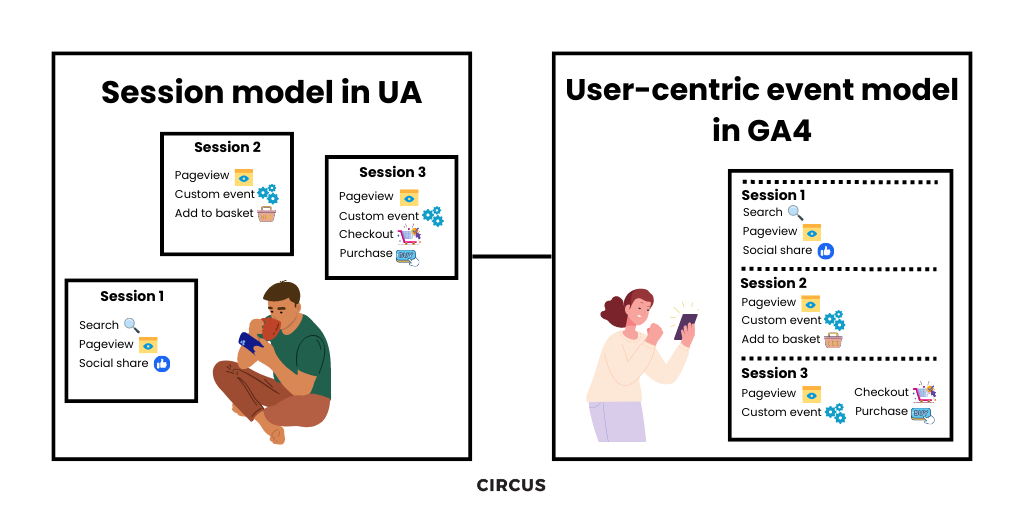
- Events instead of sessions: GA4 focuses on tracking specific actions or events users take on a website or app, like clicking a button or watching a video. This provides more flexibility in understanding user interactions.
- Tracking across different platforms: GA4 now allows businesses to track user behaviour across websites, mobile apps, and other devices. This helps understand how users engage with the business across different platforms.
- Smarter insights with machine learning: GA4 uses advanced technology to automatically identify important trends and anomalies in the data. It helps businesses understand key insights without having to manually analyse the data.
- Understanding users, not just sessions: Instead of looking at individual sessions, GA4 focuses on tracking users and their interactions across multiple visits. This gives a more complete picture of how users engage with a business over time.
- Privacy and consent management: GA4 has features that respect user privacy and comply with privacy regulations. It provides options for users to control their data and consent to its collection.
- Easier setup: GA4 simplifies the initial setup process, so businesses can start tracking basic data without complex configurations. It’s designed to get you up and running quickly.
- BigQuery integration: GA4 integrates with Google BigQuery, a powerful data analysis tool. This integration allows businesses to export their data to BigQuery for more in-depth analysis and advanced data processing.
These changes in GA4 make it a more comprehensive, privacy-conscious, and flexible analytics solution that helps businesses understand user behaviour and make informed decisions.
Google recently highlighted some of their newest products and updates at the Google Marketing Live event, which you can read more about in our blog post here.
How To Migrate From UA to GA4
“Migrating to GA4 before 1st July is a must for all brands and advertisers. UA properties will stop collecting data on this date, so if your GA4 solution isn’t in place, you will have a data blackout until it is. In addition, some marketeers are importing goals from UA for use with smart bidding in Google Ads. If these goals aren’t replicated once UA is discontinued, there could be huge ramifications for campaign performance, as there will no longer be a flow of conversion data running through the account.”
Meg Wilson-Taylor, Operations Manager
For more on how you can start the process of migrating to GA4, you can find all of the information you need here on the Google Analytics Help Centre.
Countdown to GA4Google Marketing Live Recap: What’s New For 2023?
Read on for our Google Marketing Live recap following the 2023 event held across 24th and 25th May 2023.
It’s not a huge surprise that there was one topic in particular that dominated this year’s Google Marketing Live event. And that is: AI. Recently, AI has become much more prevalent, and now, is something we can leverage to change the way we work.
Google Marketing Live: The Main Points
Conversational Updates & AI For Search Queries
Google announced the release of a new user-friendly, conversational interface to assist advertisers with the creation of new campaigns.
Driven by AI, the ‘assistant’ will generate relevant assets such as headlines, descriptions, images, keywords and more – all following an analysis of existing landing pages and ads.
One important – and comforting – thing to remember is that these suggestions can all be altered before launching, meaning advertisers are still in control of what their ads look like.
Automatically created assets will also embrace the power of generative AI to enhance ad relevancy in a similar way, and as a result, modify Search ads to better reflect the context of individual search queries and user intent.
What did our experts say?
“The conversational AI features that will be coming to the ad creation interface look super exciting. As marketeers we know our customers best, but leveraging AI to create initial ad copy, that can then be tweaked via our inputs, could create something really special. Sometimes you know your ad needs to be more ‘fun’ or more ‘formal’ but it can take a while to land on the right messaging. This new conversational interface will hopefully help us reach that place faster.”
Meg Wilson-Taylor, Operations Manager
Generative AI & Simplified Performance Max
Performance Max may not have been around for long, but it has certainly demonstrated the ways in which AI-powered campaigns can help drive growth and improve account performance.
In response to the success of PMax, Google will introduce generative AI into the campaign type, simplifying how custom assets are created and improved upon.
By providing Google with your website URL, your brand will be explored using AI, and campaigns will be populated with assets that accurately reflect the findings. Google also spoke about how the AI will make image suggestions made specifically for you and your brand.
Google Product Studio & AI Images
Google announced the upcoming launch of Product Studio, a tool that will allow merchants to seamlessly create AI-generated product images. Product Studio will be available in Merchant Centre Next (see more below).
Some of the capabilities of the new tool include image generation and enhancement through text descriptors, removing the need for merchants to manually create content and instead, focus on reusing and repurposing product images within a variety of different campaigns.
What did our experts say?
“The image AI will be very useful when it comes to being able to create images for image extensions, and will help us to increase CTR and create engaging headlines.”
Lauren Morton, PPC Executive
Merchant Centre Next
The new and improved Merchant Centre – Merchant Centre Next – has been simplified to remove complications and provide an improved user experience. Some of the updated features include automatic updates to the product feed from information detected on your website, and access to insights report in the Merchant Centre Performance tab.
Merchants and advertisers can expect to see Merchant Centre Next fully rolled out in 2024, with new users already granted access.
What did our experts say?
“The evolving structure of Google campaigns are going to bring a lot of excitement to the industry.
Having worked closely with my clients to implement a tiered profit-based approach to the PMax system, seeing the wheel reinvented slightly will change way our setups have worked. Creating a Merchant Centre with ROAS targets that reflect the profitability of the products in individual tiers has enabled us better control over our PMax campaigns.
These new tools will allow advertisers to focus on creating the best retail experience for our clients needs. Being able to drive more profitable and ROAS-led sales, whilst utilising AI to create on-brand messaging and ad copy for products, will help us to deliver on client expectations and help drive business growth.”
Ru Watt, PPC Executive
New Google Ads Features & Campaign Types
In addition to the countless ways that Google are harnessing the power of AI, they also announced some new Google Ads features and campaigns types. Said features include brand restrictions in broad match to help to ‘leverage broad match with the brand traffic specified by the advertiser,’ and the implementation of AI into Smart Bidding to help LLMs to cleverly optimise for search queries that it might not have previously encountered.
The new campaigns that are going to become available in Google Ads are ‘video views’ and ‘demand generation’ – both video-first campaigns and the former of which does what it says on the tin, maximises views, with the latter using AI to engage users and drive them to take specific actions.
Stay tuned for more on these specific features and campaign types as we explore what they could mean for advertisers in future blogs.
What It Means For Marketeers
So, we hear you asking, what does all of this mean for marketeers?
This year, with it being the 10th anniversary of the Google Marketing Live event, we expected some big updates and news, and that’s exactly what we got. The focus on AI, whilst unsurprising due to its ever-growing popularity and relevance, is something that we’re extremely excited to see play out, and we’re looking forward to providing continuous updates on how new tools, products, and ways of working will allow us to drive desired growth for our clients.
Ask The Experts: ChatGPT & PPC
The word on the tip of everyone’s tongue at the moment is ‘ChatGPT,’ and there’s no surprise as to why.
Since it was launched by Open AI on November 30th 2022, it has been dubbed the ‘best AI chatbot ever released’ by the New York Times, become the fastest growing app in the world by accruing 100m users in just 2 months of launch, and even inspired Google into releasing it’s own chatbot, Bard AI.
But just how reliable and capable can ChatGPT and other advancing AI be when it comes to PPC? We spoke to some of our PPC experts on how they think AI will impact PPC management as advancements continue, and people become more intrigued by the possibilities that AI possesses.
‘AI is the car, we are the drivers.’
“If automated tools like ChatGPT and AI are the car, then we as marketeers need to focus on laying the road, filling the car with petrol, and smoothing over potholes in order to allow automation to drive efficiently and in the direction we want it to go.
Just like a Tesla, it might be able to drive itself, but it doesn’t mean that it’ll do everything right each time without human intervention. PPC management from actual humans will still be needed to inspire overarching strategy.“
Meg Wilson-Taylor, Operations Manager
‘Use AI to assist, not to take over.’
“As the saying goes, there are two sides to every story. One the one side, ChatGPT and other AI tools will absolutely become beneficial when it comes to monotonous, time-consuming tasks. On the other hand, access to, and total reliance on, these tools, will highlight ‘lazy PPC’ through usually avoidable and clumsy mistakes.
Either way, advancements in AI should be something that PPC experts look to enhance their work – not completely take over.“
Ahmed Chopdat, Commercial Director
‘AI isn’t quite ready to rule the world.’
“ChatGPT and other similar tools can be used in everyday life, but they have flawed limitations including information accuracy and algorithmic bias, which signals that further improvements are needed. Currently, these limitations feel quite significant, but equally, these tools represent a huge step forward in development.
It’s doubtful that ChatGPT and AI in general will ever reach a state of ‘perfection,’ but I’d like to believe that future developments will help find solutions to the existing limitations, making these tools even more beneficial to those who use them.“
Inny Vaiciute, PPC Executive
In addition to the benefits that ChatGPT possesses, there are also a number of disadvantages that come with the program, such as being unable to access the internet, relying on training data that is cutoff at 2021, and threats to cybersecurity and higher education due to it’s ability to create both convincing phishing messages and research papers. (Source: TechCrunch)
Similarly to the threats that ‘deep fake’ videos posed, which saw existing images and videos replaced with other people’s likeness, ChatGPT has been reported to be able to ‘imitate’ the writing style of famous personalities, posing the danger of both identity fraud and misleading the general public, which if left unsupervised, could lead to some catastrophic consequences.
Across both the PPC industry and other marketing industries, ChatGPT and AI should be used to improve the way we work, and even as a supplement for spending long periods of time on more mundane, long-drawn-out tasks. However, reports so far tell us that it’s not quite ready to be taking over anytime soon.
Read more about why AI doesn’t stand a chance against humans when it comes to ad copy here.
Circus PPC Wins ‘PPC Agency of the Year’
We are proud and excited to announce that we’ve been named 2023’s ‘PPC Agency of the Year’ at the recent UK Digital Excellence Awards.
The award ceremony took place on Thursday 19th January in London, and looked to reward the agencies and campaigns in the digital industry that stood out during the past year.
The expert judging panel decided to award Circus with the accolade, saying:
“The agency drove amazing results for their customers. It was great to see ambitious goals and impressive results for a small team. We especially loved the focus on value for clients when given extra budget. They are clearly an agency doing all the right things!”
Read more about the work done to optimise extra budget provided by the client here.
Following our win, we look forward to exercising our title as ‘PPC Agency of the Year’ to continue delivering outstanding PPC services to ambitious clients, and consistently improving our agency to make it the best place to work.
2023 PPC Predictions: What Do The Experts Think?
2023 is just around the corner, which means that we’re already thinking about the updates and changes that we might encounter across the PPC landscape next year. We spoke to the experts about their PPC predictions for the next 12 months.
Updated Performance Max Visibility
“Performance Max is still a relatively new Google Ads product, so we’re currently working with less visibility than we had before in terms of the platforms that ads are serving on, the role they play in overall sales, and the performance of individual assets.
I think (and hope) that we’re going to start seeing more interface features on both GA4 and Google Ads that allow more clarity on how Performance Max campaigns are affecting our client accounts – ranging from the performance of descriptions and headlines to the overall sales and ‘the bigger picture.'”
Chloe Tetmajeris, PPC Analyst
Reduced Twitter Advertising Budgets
“With all of the current issues on Twitter, a lot of companies and individuals have started to distance themselves from the platform. Advertising on Twitter at the moment feels like you are essentially lining the pockets of someone who is slowly destroying the platform, which is why I would expect many to move away from not only advertising on Twitter, but away from the platform as a whole in 2023.”
Ahmed Chopdat, Commercial Director
Focus On Traffic Quality Over Volume
“I think we’re going to see a shift in focus from visibility to traffic quality across much smaller target audiences because of tightened privacy laws and the use of cookies. For lead generation accounts, this could mean reducing ads visibility for audiences that are bringing lower quality leads, and for eCommerce clients, eliminating poor performing audiences as much as possible.
Along with this, I think we’ll see a willingness from advertisers to become more aggressive across said audiences, directing as much budget as possible towards PPC ads that are targeting the correct audience for good quality leads and sales.”
Inny Vaiciute, PPC Executive
The End Of Phrase Match
“Phrase Match is already doing the same as Broad Match in a lot of situations, and when it comes to the likes of Shopping and Performance Max, there seems to be a much more streamlined approach. There’s a chance that this could lead to Phrase Match being scrapped completely, or this option being considered at least.”
Abbie Hampson, PPC Manager
More From Microsoft Advertising
“Microsoft Advertising have a few things that are unique to them and don’t exist in Google Ads – such as Action Extensions and Filter Link Extensions. I predict that they will continue to release ad extensions that we don’t have on Google Ads, as a point of differentiation.”
Meg Wilson-Taylor, Operations Manager
What are your PPC predictions for 2023?
How Should Businesses Approach Spending During The Market Crash?
The current cost-of-living crisis has been difficult for both businesses and consumers to navigate, and following recent reports of the UK inflation rate rising to over 10%, many are anticipating that the country is soon to fall into a recession following a market crash.
During tough financial times, marketing is often one of the first costs to be reduced – especially when it comes to PPC, which can be an expensive, but extremely effective, type of marketing.
Understandably, those responsible for business expenditure will be worried and careful when it comes to deciding how to move forward with spending and how it might affect business performance. Despite these worries, it’s important for businesses to remain level-headed, and think carefully before making changes to their paid marketing strategies.
Rick Tobin, Founder and Managing Director at Circus PPC Agency, spoke about how businesses should approach the uncertainty they might be feeling as a result of news around the economy and the anticipated market crash:
“It’s understandable that businesses might be worried about the future when it comes to the expected recession, which might lead to big and uncomfortable decisions around where to put money in order to keep the business afloat. However, it’s important that these decisions are carefully considered in order to set up the business for the best results possible.
Even if there are some worries or apprehensions surrounding the future of your business as a result of the upcoming recession, making a slap-dash decision around your marketing spend could do more harm than good, and damage your account performance in the long term. The best thing to do is to consult an industry specialist, or if you’re already working with an agency, contact them to make sure you’re on the same page, and for any reassurances you need prior to making any important decisions.”
Luckily for you, we’ve consulted some of the top specialists in the industry to find out what exactly businesses should be doing to maintain or even drive performance during a potentially challenging period. We’ll give you a hint… it doesn’t include reducing spend!
Is there anything that businesses should be particularly worried about in anticipation of the market crash?
Paul Fernandez, The Growth Guys: There are a few things that can typically become a concern for businesses during a market crash. Firstly, cash reserves can be something that keeps a business owner up at night. Cash flow is the lifeblood of a business and this can become threatened when an upheaval in the market is on the horizon. Secondly, future sales are at risk. In a crash, consumers make conscious decisions about their spending depending on their immediate needs. Finally, the last thing is employee retention. During a time of financial uncertainty, a business’s staff will be experiencing uncertainty too, and the subject of salaries can be a difficult conversation. Business owners will be worried about how to keep hold of talent to help ride out the storm.
John Cave, Shoptimised: During any downturn, we’ll hear a lot of ‘we’re all in the same boat.’ However, that isn’t remotely true. All businesses are different and therefore face different challenges during periods like this. We might all be in the same storm, but everybody’s boat is different. Personally, I wouldn’t mind borrowing Amazon’s boat for the next 12 months. Worry is inevitable, but all we can do is focus on what we can control during these periods. Naturally, some businesses will choose to cut costs which may or may not include reducing the advertising budgets.
Amar Chana, Lunio: A tougher economic climate, such as a market crash, means it’s even more important to have a firm grasp of your numbers, especially in relation to your ad spend. Just because your campaigns are currently profitable doesn’t mean they’ll remain so indefinitely, so now’s the time to be proactive. What is your breakeven ROAS? What is your breakeven cost to acquire a new customer? Is your first sale more valuable because you can upsell more on the backend? Or is your first sale typically less valuable than the ones that follow? How much money are you losing each month to fake clicks and other invalid activity? These are the kinds of questions you need answers to. If you know your numbers inside out, you can translate them into concrete goals within the ad platforms you’re using, and your can course-correct quickly if your performance begins to dip.
Michelle Cartwright, Salesfire: Any major economic crisis is a cause for concern. There are many unknowns to prepare for in a turbulent market. Inflation, interest rates, strikes, and supply chain shortages are all under scrutiny and projected to be worse than the financial crisis of 2008. Right now is a key time to be showcasing your value as a business by nurturing your existing customer base with value driven content. Learning about your consumers’ buyer behaviour can give you key insights into how you can delight your customers throughout their purchasing journey. Through tough times, you need to be willing to engage your customers and compete against the rest of the market as consumers begin to prioritise their outgoings and are spending more on essential areas like gas, electricity and fuel.
John: The immediate focus needs to be put into reducing wasted advertising budgets. By this, I don’t mean stopping your top funnel marketing because the ROAS is lower. The impact of that action may lead to a reduction in the bottom of your funnel. Any approach to reducing waste needs to consider the entire funnel within your analysis. Cutting spend on products within Google Shopping can be achieved using performance rules within Shoptimised. This doesn’t mean the spend will be stopped, reduced, or, saved. Instead, you’re just cutting or restricting the products that costing too much money and not converting. This means your budget can be better utilised within converting products which improves performance.
We discussed the effect of the market crash and how it has led to increased CPCs in a recent blog. Read more here.
What approach to spending would you advise businesses take in preparation for the market crash?
Amar: The goals should be achieving more conversions with the same ad spend. One straightforward way to do this is by eliminating all fake clicks and invalid traffic from your campaigns on search and social. The money saved can then be reinvested to reach more customers with genuine conversion potential. It’s worth keeping in mind that savings are typically highest during peak sales season, when CPC shoots up dramatically for the majority of retailers. If you’re paying upwards of $5-10 per click, you’re at risk of losing a significant amount of budget to click fraud. At Lunio, we’ve helped clients boost their conversion rates by up to 120% by automatically blocking fake traffic from all acquisition channels hitting their site.
Paul: When it comes to spending, businesses, understandably, need to be frugal – but only in the necessary places. Spend money in the places that make you money. Spend money on the people within the organisation that make things possible. When it comes to marketing spend specifically, analysing your most successful marketing channels is a must. Look at the places where they are winning the most and double down. Focusing a large proportion of spend on customer retention during a crash is an approach that every business should be taking as this is likely the most profitable route.
What are the benefits of continuing to spend during this period?
John: If you can continue to spend and your advertising efforts are successful, you will come out of this period a stronger and bigger business. Again, this is easier said than done and does require capital which is not always a resource every business can rely on. Therefore, in addition to capital you also require smart, strategic planning. Remain in control of everything that you can and put your focus there. You can’t control the storm, just your boat.
Michelle: When looking at the clothing industry specifically in the first half of 2022, fewer visitors and fewer orders were registered compared to the same period in 2021. This indicates that less impulse purchases were made. However, in the same industry, TrendDesk recorded an increase of 1.29% in revenue and 3.9% increase in conversion rates, which points towards more intentional purchases being completed. These percentages show that continuing to spend on your acquisition marketing could be beneficial for your eCommerce business as although a potential recession is looming, people are being more savvy with their purchases. Informed purchase decisions are changing the shopping journey and overall buyer behaviour. Consumers are researching before shopping, and this is prime placement for you to push your brand.
Paul: Quite simply, businesses who are spending during this period will be doing something that most other business aren’t. It’s an opportunity to play the field and win when other teams aren’t even on the pitch!
Amar: According to the recent ROI Genome Intelligence Report by marketing intelligence provider Analytic Partners, more than half (60%) of businesses that increased media investment during the last recession saw ROI improvements. Conversely, brands that cut spending risked losing 15% of business to competitors that boosted their spending. This report undermines the logic of the typical knee-jerk reaction of cutting ad spend and marketing headcount at the first sign of a recession. In the long run, it undermines margins and efficiency. When competitors are panicking and dropping PPC budgets, it creates an opportunity to increase your own market share.
Why should businesses stay away from reducing spend despite the potential market crash?
Amar: Slashing ad spend may deliver a short-term benefit when it comes to your Q4 financial report. But doing so is short-sighted. You’ll inevitably pay the price later down the line when the reduced visibility and ad impression share catches up with you. That said, most businesses aren’t in a position to significantly increase their ad spend overnight, and it’s wise to remain cautious. We’d (Lunio) recommend keeping your budget the same or increasing it incrementally over weeks and months while doing everything you can to squeeze additional value out of it.
John: The maths is pretty simple. If you spend less on advertising, you will generate less in revenue. Having less revenue during more challenging times leads to even more challenging times. But, and this is a pretty big old but… you can only spend what you can afford! Don’t try to push yourself beyond your own comfort zone, it’s not the time to gamble and go all in on the first hand. However, it is a time to be sensible, plan, be calm, and stay in the game.
Paul: Reducing spend isn’t necessarily the best strategy as there could be opportunities to make larger gains. The gains will be reduced if the spend is reduced also. Instead, explore potential new avenues or channels, focusing on the areas that have proven successful in the past, or create a strategy where you can look at both.
John Cave, Co-Founder & Director of Shoptimised, discussed the areas that businesses should consider focusing on as we approach the market crash, and a likely difficult financial period for many companies:
Conversion Rate Optimisation
Increasing your conversion rate from 1.6% to 1.8%, or your average order value from £58 to £64, can have a huge impact and is often overlooked whilst hoping for a silver bullet from your marketing teams. There are always multiple areas of your website that you can improve which ultimately improve the performance of your marketing channels as a result.
Improved Reporting & Analytics
You’ll need to understand the top and bottom line of your performance and be able to ask some searching questions. Your reporting and analysis is going to improve your insight immensely. Not only should your reporting improve, but the frequency of your reporting should improve. The faster you know, the smarter you will be.
Make sure your reporting is not just a Hollywood blockbuster with a happy ending. It’s just as important to know what isn’t working as it is to know what is working. Some elements of your marketing will not work! They aren’t working now, and they won’t work then. Knowing what these are is the only way to improve those areas.
Strategic Discounting & Bundle Offers
Consumers love a good bargain, and you will be tempted to give into this to improve your cashflow. At some point, everyone is going to consider this, but consider your product performance first. Don’t blanket discount to include top seller or strong performing products and ranges. Only add discounts to stock that has sat on your shelves for too long or is going out of season.
You should also consider creating product bundles that collectively offer a discount. This helps to improve your Average Order Value whilst selling through more product.
Google CSS
If you’re still buying your Shopping traffic directly from Google, you’re losing 20% of your bid immediately. That 20% is going straight into Google’s bank account. Working with a CSS Partner ensures that 100% of your bid is used in the auction which initially helps to improve your position and CTR, which in the long term, lowers your CPC.
You might be thinking, ‘well of course a PPC agency will advise us to continue spending during a market crash.’
And yes, we’d be lying if we said that clients continuing to spend doesn’t benefit us – it’s what keeps us going as a business.
However, we’ve seen incredible growth across client accounts during economic periods of difficulty and assumed danger for many of our clients. Take the pandemic, for example. Something that, unfortunately for many businesses, lead to difficult decisions around the future of the company and in many cases, whether the business would continue to exist following the pandemic.
For advertisers working with limited budget, check out our guide to succeeding with PPC on a budget.
Despite the trials and tribulations faced by a lot of businesses, we saw many of our clients thrive during this period, and reach milestones within their accounts – like UK Rads, our client who saw a revenue increase of over 1,500% between March 2020 and March 2022. Read more about their success here.
Taking all of these factors into account, our core advice would be to spend time figuring out what would work best for you as a business, stay away from making any rash decisions, and talk to the experts.
Agency PPC VS In-House PPC: Tackling The Current Climate
As we approach what is set to be a difficult financial period for both businesses and individuals, what’s best for your business? Agency PPC, or In-House PPC?
There’s been a huge number of worrying reports and forecasts when it comes the state of the UK both societally and economically. The continuously rising cost of living, expected recession looming, and consumer spending reducing as a result, has led to many businesses reconsidering where they are spending, and figuring out where their money could be best allocated.
Smaller businesses in particularly are having to look closely at the way they are spending to remain profitable in line with these rising costs. For some, this might look like reducing overhead prices by encouraging or implementing remote work, prioritising certain workplace benefits, or even looking at how outsourcing some work might work out better for the business.
We looked at the benefits of agency PPC compared to hiring someone to do the job in-house, and how this could be a financially sound idea to help businesses to better prepare themselves for the upcoming economical changes in the UK.
Specified Expertise
Would you service your own car? Comparing in-house and agency PPC is difficult, due to the fact that they are so different and could both be successful in different scenarios.
However, specialist agencies are built of a team of professionals that are focused on a specific area of expertise, and are aware of how to best approach different businesses, in different industries, and with different account needs, due to the extensive training and experience they’ve received during their career and through working amongst fellow experts.
It’s important to understand that PPC is a constant, and isn’t something that can be looked at on a part-time basis, so having focused experts taking care of your account on a daily basis is most likely to be much more effective than a single in-house team member who may not have the expertise to confidently drive goals alongside their other responsibilities.
Better Resources
PPC requires a full time focus, and in turn, team members that are experienced across a range of industries, and that have the capacity to keep up with changes and trends across the PPC landscape to best drive performance.
Often, smaller businesses and start-ups can focus on a culture of ‘everyone chipping in where needed’ due to limited resources, which might create a culture of comradery, but can also stretch team members thinly, and stop them from being able to fully focus on their day-to-day role.
By outsourcing to an agency, you can ensure that your PPC is carefully taken care of by industry experts, whilst also ensuring that your in-house team members are able to concentrate fully on their own roles.
Unlike in-house marketing teams, agencies often have an entire team of experts who are experienced in delivering outstanding PPC results, and therefore are able to share insights, findings and updates with one another, and if a client’s account manager isn’t available, can help out where needed.
“Agencies have a huge advantage on in-house teams when it comes to visibility across relevant markets, as well as technologies and product updates, and being an authoritative voice in the industry. Unlike in-house teams, agencies also have the opportunity to work more closely with partner businesses such as Google, who run a Premier Partner programme for agencies that provides a number of benefits including access to BETAs, direct training, and events.”
Rick Tobin, Managing Director & Founder of Circus PPC Agency
Less Commitment
The relationship between a client and an agency is completely different than the relationship between an employer and an employee.
Recruitment is no easy feat, and one of the reasons it can be difficult is due to the level of commitment from the both the business and individual in question. Commitment comes not only in the form of salary, but also pension contributions, training, appraisals, company events and expenses.
Unlike the financial commitment that comes with taking on a member of staff, agencies often come with initial contracts, whether that’s 3, 6, or 12 months, before moving onto a rolling contract that can be as little as 1 month at a time when the business-agency relationship has been developed.
Ultimately, the seemingly high costs of working with an agency are often much more financially attainable, and more likely to pay off (literally), in the long run.
So, you’ve decided to work with an agency – what now? Here’s what you should be looking for before taking the plunge:
- Google might be the biggest platform, but its certainly not the only platform. Make sure your chosen agency have a breadth of knowledge across various relevant platforms, including holding a Bing Accreditation.
- Check out client feedback on the agency’s website, or ask for case studies and contact details of previous clients. Treat choosing an agency as you would hiring a new member of staff – make sure their up to the job!
- Look into the agency’s qualifications – the very best agencies will be committed to keeping up with accreditations and qualifications, as well as being registered as Google Partners, or better yet, being qualified Google Premier Partners.
For more on what it means to be a Google Premier Partner, read more here.
- Prioritise regular account optimisation – your chosen agency should be working to drive the maximum return-on-investment for your spend. Set goals with the agency and review them often.
- Access to insightful reporting is a must-have. Prior to any agreement, ask to see examples of the reporting an agency provides, and ensure it’s something that you can understand and interpret to measure against your business goals.
If there’s anything to take away from this, it’s to make sure that you don’t wait until it’s too late.
Look at business forecasting now, before the expected changes to the economy and consumer spending fully kick in – which could lead to even more difficult decisions if unprepared. Smaller agencies who have more important and essential decisions around potential outsourcing could be particularly vulnerable during this time, and having crisis management steps in place can help avoid shock or unexpected consequences of economical changes can help to better position the business for success during more testing financial periods.
In addition to this, when it comes to PPC, working with experts to begin strengthening your account and driving growth sooner rather than later could assist in better stabilising performance for when the market does crash.
What’s the deal with Prime Day 2?
There’s no denying that the cost of living crisis has many looking for ways to save money before the arrival of a highly anticipated recession in the UK, alongside rising energy bills and inflation at an all time high. However, did anyone expect Amazon to announce Prime Day 2, set to take on 11th and 12th October this year?
Is this an opportunity for retailers, or a little too close to Black Friday and Cyber Monday, which takes place at the end of November every year?
Read Circus’s ULTIMATE Guide to Black Friday here.
We spoke to Client Services Manager, Anna Wood, and PPC Executive, Inny Vaiciute, about what Prime Day 2 means for participating retailers, and how retailers who are unsure should approach it.
“Due to Prime Day 2 being a new thing, it’s not engrained into ‘retail culture’ like Black Friday is. It’s hard to tell how hard Amazon have been pushing a second Prime Day, but the majority of customers will be very much aware of Black Friday, and not necessarily aware of Prime Day 2. My advice to retailers thinking about whether to change strategy as they approach Prime Day 2 would be to sit tight and hold out until Black Friday.
For retailers that can afford to jump on the bandwagon, it may be good opportunity. However, given the current climate, it could prove difficult to run two big sales and maintain steady and satisfactory profit.”
Anna Wood, Client Services Manager
“I think the biggest benefit for retailers looking to participate in Prime Day 2 is that there might not be as much competition as there will be on Black Friday. However, due to how famous and widely anticipated Black Friday is, search volumes will be lower, which means sales will be lower. So, for retailers that have limited budget, but want high visibility and sales volume, Black Friday might be better suited as more people know about and expect it.”
Inny Vaiciute, PPC Executive
Essentially, the most important thing, like always, is to do what’s best for your business, which might prove harder to determine now that we’re facing a time of economic crisis and a reduction in consumer spending. Keep your eyes peeled for more as we approach Black Friday and Cyber Monday this year!
Performance Max: What We Know So Far
Those familiar with Google and Google Ads will also be familiar with the new-to-2022 campaign type from Google, Performance Max.
At the beginning of the year, Google announced its plans for all campaigns to eventually be upgraded to Performance Max, which in turn, drove many advertisers to beat them to it, upgrading their campaigns earlier on and finding out exactly what Performance Max is all about.
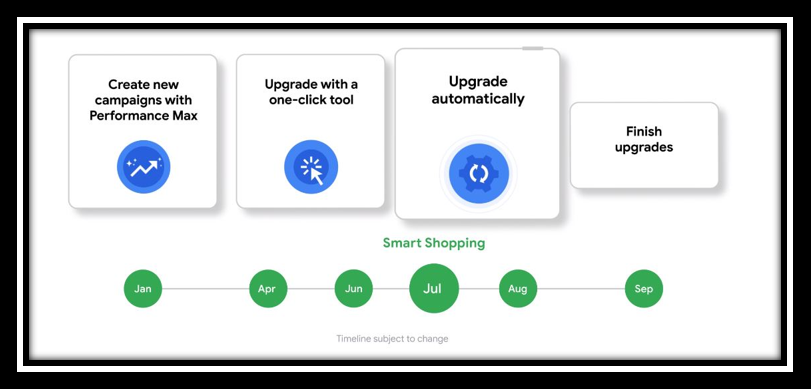
Now that we’ve reached the end of the timeline for upgrades to be completed – whether automatically or manually –, we’re taking a look at what we know so far when it comes to Performance Max.
Take Back Your Time
Advancements within Performance Max mean that automation is more prevalent, which takes away some of the ‘responsibility’ or day-to-day work that needs to be put into maintaining and optimising accounts. For many who are new automation, this might be a scary thought. However, it’s beneficial when it comes to providing advertisers with more time to focus on larger-scale strategy for accounts over simpler, yet time-consuming, tasks.
“Performance Max isn’t a lazy way of managing but gives you back more time so you can concentrate on more strategy to ensure you aren’t wasting your time on much simpler tasks.”
Ahmed Chopdat, Commercial Director, Circus PPC Agency
Never Stop Testing
Despite the advancements that Performance Max has offered to advertisers, it’s still important to test any new method of advertising to ensure that you’re aware of the effects it could have on both a short and long term basis when it comes to your client’s accounts.
“The idea of upgrading to Performance Max might be scary – like anything unknown. However, how can you possibly get an idea of the potential results without even giving it a try? The worst case scenario is that a test is unsuccessful, and a campaign is reverted back to Standard Shopping after a month or two.”
Inny Vaiciute, PPC Executive, Circus PPC Agency
But, what do I tell my clients if it does fail?
When it comes to testing, the bad news is that… well, it can work both ways. There’s no way of knowing if it’ll work or not without taking the plunge.
The good news, however, is that you are the expert, and hopefully, you’ve built enough trust with your clients to explain the testing process and how this might affect results.
Think about it like this: there’s not guarantee that anything will work, and you’ve given that a go before, so think of this as another test to
Recently, our client saw a 3-month revenue increase of 88% as a result of the implementation of Performance Max across some of their campaigns. Read more about it here.
Lean Into Automation
Data collection through automated practices is hugely beneficial to the management of clients accounts, and can help PPC experts to drive success where needed by touching upon relevant data points and using this information to inspire an increase in performance.
“Performance Max boasts Google’s most advanced machine learning to date. The amalgamation of campaign types coming together under one umbrella not only saves time, but allows us to follow users across different devices and platforms to make sure we’re at the forefront of their online experience.”
Chloe Tetmajeris, PPC Analyst, Circus PPC Agency
Mini Case Study: Performance Max
Our retail client has seen good performance over the past 30 days (06/08/22-05/09/22) from Performance Max, with 75% of sales attributed to Google campaigns coming from those upgraded to Performance Max. These campaigns also pose an average CVR of 6.9% – over double the clients’ industry average of 3.36%.
So far, we’ve noticed some positive results on account performance from using Performance Max, along other benefits including the ability to align and oversee the effects of multiple campaigns, and embracing automation to take back some of the time usually spent on minor account activity.
It’ll be a while before we’ll be able to provide a more in-depth analysis of our findings, and how Performance Max has changed accounts, but right now, we’re seeing some positive results from the campaigns so far.