


Prime Day 2024 is almost upon us, and for shoppers that can’t wait for Black Friday, Prime Day has become the summer equivalent of the colossal sales day that sees retailers slash their prices to drive sales in the run up to Christmas.
Whilst Prime Day is a great time for retailers to jump in and drive sales with extra investment in PPC, there are also risks involved such as heightened competition, that might hinder performance, rather than improve it.
Operations Manager, Meg, has rounded up some of the questions that advertisers and retailers should be asking themselves in the lead up to Prime Day in order to approach the day in a way that works for them.
Prime Day 2024 Success: What To Consider
Initially created by Amazon to offer Prime members access to limited time offers across a variety of brands, Prime Day has become a popular day for retailers to make the most of increased buying intent from their customers, with many temporarily slashing the prices of their products to drive sales.
However, Prime Day isn’t right for everyone, and we’ve put together some of the questions you should be asking yourself to work out whether it can work for you.
Are any of your products sold by other e-tailers?
One of the biggest challenges during sales periods is competition.
Retailers are all on the same page, hoping to drive sales and see an uplift in performance as shoppers make the most of discounted prices, which is why you need to be aware of potential competition (especially those selling the same products)!
Is Amazon one of these e-tailers?
Unsurprisingly, competing with Amazon on Prime Day is not for the faint-hearted. However, their Prime Day strategy famously offers exclusive, member-only discounts, which could risk a loss of sales from those that don’t have a prime membership, and are rather searching for accessible deals that don’t require a monthly membership fee.
Are you running promotions on your website?
If you aren’t planning on running promotions on your website and your product is available elsewhere, it might be worth pulling back on spend or aggression.
However, deciding to tap into shopper intent during this time with promotions and discounts will give you the best possible chance of driving sales, as this is a period that we know shoppers are aware of, and use to find deals that they might not usually see.
Are there any expected industry spikes and trends?
Depending on the industry you work in or with, spikes and trends before and during sales periods are to be expected.
Consumers are doing more research into products than ever, guaranteeing themselves the best possible value for money when it comes to committing to a purchase, so being aware of your competitors and what they’re offering is essential – especially if they sell the same product.
What market fluctuations has your industry seen during this period in the past?
Additionally, recognising the industry fluctuations taking place during busy sales periods such as Prime Day and Black Friday can help you to identify patterns in consumer behaviour and intent, as well as audience demographics, giving you the knowledge you need to create campaigns that reach the right people, in the right places, at the right time.
What was your previous Prime Day strategy?
If you’ve previously taken part in Prime Day, you’re likely sitting on a gold mine of data that can help you to decipher what worked, didn’t work, could work, and definitely won’t work when it comes to considering your Prime Day 2024 strategy.
Have you analysed previous performance and historical data?
Historical data and past performance during sales periods such as Prime Day or Black Friday can be a great indicator for future performance during the same periods. From demand and CTR, to conversions and ROI, there are a multitude of factors to consider and prioritise in order to understand what success looks like to you, and whether a previous strategy could work again.
Putting Prime Day 2024 Plans Into Action
Similarly to Black Friday, your strategy for Prime Day needs attention to best drive efficient and successful performance. Some of the ways you can help your strategy stand out include revealing promotions earlier and extending them later to best reach a wider audience, updating your campaigns and ad copy to reflect Prime Day intent, and reviewing your previous Prime Day strategy and results to assess what has worked for you in the past.
We’ve worked with clients on their Prime Day strategy to help them to best drive the results they want. To find out how we can help you with your strategy for Prime Day 2024, contact us here.
How Will Performance Max Affect Black Friday This Year?
Google’s Performance Max was officially rolled out to advertisers in November 2021, and as planned, has completely replaced all Smart Shopping campaigns (as of Q3 2022).
Now, as we come up to Black Friday, advertisers will be able to see how Performance Max campaigns might affect or change performance, compared to Smart Shopping, during the Black Friday period.
Check out Circus’ ULTIMATE Guide to Black Friday here.
We spoke to Operations Manager, Meg Wilson-Taylor, about how Black Friday might be affected by the introduction of Performance Max, and how advertisers can best utilise the new campaign type:
What’s changed since Performance Max (PMax) replaced Smart Shopping?
“We’re aware that customer purchase journeys typically take place over multiple touchpoints, and Performance Max allows us to access Google’s entire inventory (YouTube, Display, Search, Discover, Gmail, and Maps) through a single campaign type, so one campaign can reach the same customer in different locations.
Performance Max also has richer insights than Smart Shopping, which allows advertisers to:
- View week-on-week stats in one place and see changes in revenue, cost, ROAS, and conversions.
- View top search categories and top search terms within these, which might help you better understand what words your customers are using to find your ads. These insights can be used to edit your ad copy text or shopping feed to better match with your users.
- Access more information in the Auction Insights section. For example, you may discover that impression share has decreased for your competitors and in turn, been able to take advantage of this knowledge (as evidenced by an increase in revenue).
It’s still too early to tell how much will change as a result of the change, but so far, we’ve seen some great results.”
Read more about what we know about Performance Max so far.
How might PMax improve results on Black Friday?
“Advertisers who are using Performance Max campaigns see an average increase of 12% in conversion value (revenue) at the same or better return-on-ad-spend (ROAS), so it’s fair to expect to see improved results when comparing to last year, when Smart Shopping campaigns were in play.
Performance Max is a cross-network campaign, which means ads are eligible to serve across Google’s entire inventory (detailed above). With Performance Max, we can reach the right person, at the right time, in the right place, which over Black Friday should mean we can get in front our potential customers, wherever they are on the internet.”
How should advertisers be using PMax to best set accounts up for success on Black Friday?
“There are a number of actions that advertisers should consider when it comes to setting up their clients’ accounts for success, including:
- Leveraging first-party data for Performance Max campaigns. If consumers have been viewing a category page for a certain product but not yet converted, it’s worth trying to bring them back for Black Friday.
- Updating headline and description assets to better align with the Black Friday messaging you’re using on site – just remember to change them when Black Friday has passed!
- Making sure budget caps are high enough to allow ads to match with traffic across the day. If you’re too conservative, Google might not enter your ads in some of the relevant ad auctions earlier in the day, or your ads might stop showing in the evenings, which is when many people will be finished with work and ready to purchase.
- Checking over historical data, as conversion rates are likely to have improved over the Black Friday period in the past, so you may want to make target changes to capture more traffic than usual due to higher purchase intent.
- Ensuring that promotion extensions are added to your Performance Max campaign, not just your Search campaigns!
- Checking Final URL expansion, which by default is switched on, so could send traffic to pages on your website that aren’t geared towards driving conversions.
Taking the above actions into account can help you to improve results for clients and make the most of Performance Max campaigns.”
Meet The Team – Meg
Meg is a long-standing member of the Circus PPC Team, having worked here for almost 5 years, and in that time, going from PPC Trainee to super-skilled PPC expert working across multiple client accounts and training new starters to help them to develop their PPC expertise. Meg has also recently been nominated in the ‘Young Outstanding Contributor to the North’ category at the Prolific North Champions Awards!
Find out more about Meg here…

Name: Meg
Date Started at Circus: September 2017
What first made you want to work at Circus?
I was really looking for a career where I could be logical and creative, and PPC hits both those marks!
What’s your favourite thing about working at Circus?
The fact that I get to work on different things daily and the happy working environment I come into every day. Another one of my favourite things is working with and learning from the team. No one can know everything, so I feel very fortunate to be surrounded by a group of experts who I can lean on.
Who is your dream client?
I think working on the Moomin website would be really fun, I reckon looking at their little faces all day would be good for the soul.
If you could solve one PPC issue forever, what would it be?
It would be great if I could click my fingers and that would guarantee flawless tracking. Bad data leads to bad decisions, so I’d like to get rid of that risk.
What’s your dream holiday destination?
I’d love to go to Japan and experience the mix of old and new buildings, preferably in cherry blossom season. Plus I believe there’s a Moomin Theme Park…
What would your desert island meal be?
I’m a bit obsessed with tofu, so maybe some tofu in a black bean sauce with rice and veg, and a cheesecake for dessert (all vegan of course).
Tell us something about you that might surprise people.
I LOVE fantasy football – I like to think the research and data analysis keeps me sharp for PPC. Or is it PPC keeping me sharp for fantasy football…?
If you could guest star on a TV show, which one would it be and why?
If Karren Brady ever wants a day off, I’d love to stand in for her on The Apprentice.
Home or Office?
Office! The atmosphere really helps me switch on and I love being able to talk to the team in person.
Morning or Evening?
Morning – it’s when I have peak energy.
Dog or Cat?
Cat – I love dogs too, but nothing beats a cat on the lap.
Countryside or City?
Can I say countryside but with a view of the city skyline?
Spender or Saver?
Saver – my dad indoctrinated me young!
Coffee or Tea?
Tea all day long. Maybe that’s a problem?
Summer or Winter?
Can I be contrary and say autumn? I don’t like being cold and I’m quite susceptible to sunburn…
Listen to Meg’s recent podcast with the guys from Marketing Dribble Podcast below – where she talks all things PPC!
How is automation changing the PPC landscape?
It’s no secret that automation through constantly advancing technologies can assist PPC experts in their everyday pursuits and marketing activities, despite being subject to questions of morality over whether it will eventually become ‘smart’ enough to diminish the need for specific roles.
Circus PPC Manager, Meg, explores how automated practices are changing the PPC landscape, and why PPC experts should be adopting new ways of working, rather than avoiding them.

“Since joining Circus and starting my career in PPC over four years ago, there’s been so many changes across the PPC landscape and how we as PPC experts do our job.
Simultaneously, we’ve also experienced a global pandemic – something we never thought we’d have to adapt to, but have somehow made work.
Scepticism around, and a resistance to, automated practices, is extremely damaging to the future of PPC, and unfortunately, those who can’t adapt their ways of working to embrace automation, will get left behind as technologies continue advancing, and it becomes more and more common.”
Keeping up with competitors
“When it comes to PPC, timing is everything – and is just as important when it comes to the early adoption of automation techniques, helping PPC experts to keep up with or even overtake the competition who might not be as well-versed in using automated marketing techniques.
Staying one step ahead of the competition by being ‘early adopters’ of automated practices will also give PPC experts the chance to completely understand how different automation methods work, and more importantly, how different automation methods work specifically for them. Those late to the party will always be one step behind, constantly playing catch-up due to the speed at which technology changes.
Initially, approaching automation with an open mind and plenty of patience will help those hesitant to best understand what automation has to offer, and through rigorous testing, discover a method of automation that works for them and their account performance.”
Advantageous automation
“Following careful testing and implementation, automation can be a huge time-saver for PPC experts, taking care of some of the mundane and time-consuming day-to-day tasks that steal time from more exciting, important matters.
The more that PPC experts are able to automate, the more time can be saved and further spent analysing data that will inform future strategy. This is extremely advantageous to the state of account performance, and provides PPC experts with the data-driven reports, trends and analysis that will help them to elevate results.
Extra time accumulated through automated processes also frees up time for PPC experts to focus on the tasks that can’t yet be fully automated, such as analysing competitor websites, or continuing to build on client relationships.”
Proving sceptics wrong
“Does automation really improve account performance?
Won’t it just make me disposable?
There’s a lot of questions around both the effectiveness and morality of automation, but it’s important to look at automation as something that will help, not hinder, account performance.
Depending on your campaign goals, automation might not necessarily improve your account immediately – but it can assist with repetitive and time-consuming activities that might usually prevent you from spending time on the things that will improve account performance. Think industry research, data analysis, and looking into competitor behaviours.
Equally as important to understand is that automation doesn’t mean replacement – there’s no stand-in for a human being, and understanding human behaviours is a huge part of what we do to best position our advertisements to reach a desired target audience.”
Where should I start?
As previously mentioned, automation products, services and methods are constantly changing, improving, and advancing. So, trialling and testing different ways of using automation is a great starting point to best begin to understand what works best for you and your clients.
However, don’t be scared to continue testing as you go – the technologies behind automation will only get bigger and better, so re-trialling automated methods that haven’t worked in the past might help you to continuously improve your methods of working.
We’re only skimming the surface of automation, and there’s so much more to explore. There’s plenty of ways that, in retrospect, automation is already helping us to create reports, estimations and forecasts for client accounts.
By working with, and not against, automation, PPC experts can benefit from the positive enhancements that it brings to the work that they’re already doing. In turn, this will help both them and their clients the opportunity to more productively use their time to look into improving account success.
Why are PPC Managers so good at Fantasy Football?
Gameweek 1 is almost upon us. In offices up and down the country, fantasy football managers are making the final tweaks to their teams. If they dare to dream, this time it could be their year. Forget a new client win! Forget £1million turnover! What they want is to top their work mini-league and earn ultimate bragging rights.
The fantasy league is for everyone, newbies and veterans alike. But if you work in the wonderful world of PPC, do you have an advantage? Success in FPL is aided if you possess a very particular set of skills, skills acquired over a very long career, skills that make you a nightmare for non-PPC folk… Sorry, went a bit Liam Neeson there, but he has a point. If you apply your paid search expertise to the fantasy football arena, you may be pleasantly surprised by the results.
Data
Data is king. Without data to back our decisions up, we’re working blind, and not many people can score a goal in the dark. There is a lot of useful data in the game, such as goals scored, assists, clean sheets etc., but if you look further afield, you can also study metrics such as xG (expected goals) or xA (expected assists). Combining data from several sources can give you a more rounded view and help inform your decision making. Of course, there are always outliers; Son Heung-min consistently outperforms his xG, so if you took too much stock in this metric, you might not bring him into your team, despite a good run of form or an “easy” fixture. PPC is much the same, we combine data from several sources such as Google Ads, Google Analytics, Google Trends (to name but a few) to help us make better advertising decision. This brings us nicely onto…
Analysis
You might have a wealth of data at your fingertips, but if you don’t analyse it, what good is that doing anyone? Time frames are important, and if you wouldn’t pause a keyword after one bad day, why would you transfer a player out after one bad Gameweek? In fantasy football it’s important not to make kneejerk decisions, so if your player has delivered a goal or assist in 5 out of the last 6 games, it might be a little impulsive to switch them out in favour of their teammate who just scored a hattrick (but it’s the first time they’ve found goal in 6 weeks). In PPC we’re used to adjusting time frames to help us analyse data, we know a certain degree of fluctuation is inevitable, and we also know conversion lag exists, so we analyse our data over varying time-periods, to help us understand the true value of our keywords, ad copy, targeting options etc.
Planning
With only 1 free transfer a week, you need to prepare your transfers carefully, so that you don’t suddenly find yourself in a blank Gameweek with none of your players involved. Equally there are several chips that can be deployed in the game, such as the Triple Captain, which you may pencil in for a Double Gameweek when your premium attacker is playing two bottom-table sides. Fail to plan, plan to fail as they say… Of course, even the best laid plans can and will go awry, which we felt particularly strongly last season with matches cancelled due to covid outbreaks. This was felt acutely by paid search marketeers too, as interest in certain products surged/dwindled depending on its relevance in a locked down world. Budgets and strategies were ripped up, however we showed resilience, and we made new plans.
Testing
Every time you bring a new player into your team, you are essentially running a test, to see if they can bring you more points than your outgoing player. When these “tests” go wrong, fantasy managers can feel a lot of frustration. However, as with any test, you need to trust the decision, not the outcome. If you 100% believed a test was a bad move, you wouldn’t advocate running it. Just because the end result doesn’t match with what you anticipated, it doesn’t mean you shouldn’t have tested. Being able to calmy evaluate your tests and give them more time to gather more data (if you can afford to), should make you a happier and better-informed manager.
Research
If you make all your FPL decisions in the goldfish bowl that is the game, you will miss things that other, more curious managers are considering. For example, Kevin De Bruyne might look like a great pick for the weekend’s game against Norwich, but is he likely to play, considering he’s just played a Champions League game in Germany, against Bayern Munich? Or is David de Gea going to line up between the sticks, if he’s days away from becoming a father for the first time? The more research you can do, the more of an expert edge you will have. In the realm of PPC this might be studying competitors, reading market reports, or even watching the news.
So there you go. All those years of mastering your day job have also left you very well equipped to master fantasy football. And if your work league simply isn’t challenging enough, join some of the best brains in the business and enter our PPC Fantasy Premier League: pgt3ua
(League URL: https://fantasy.premierleague.com/leagues/auto-join/pgt3ua)
Bye-bye Broad Match Modifier
Google has announced that starting mid-February they will be incorporating elements of broad match modifier (BMM) keyword behaviour into phrase match keywords, with full global rollout expected by July.
What is changing?
Support is ending for our BMM keywords, which means we can no longer create keywords with a + in front of all the crucial elements, e.g., +ppc +agency +leeds. This tactic allowed us to discover new, relevant terms to bid on, whilst still making sure certain words were present in the search query so our ads were relevant. In their current form, phrase match keywords allow us to specify word order, e.g., “ppc agency leeds”, which means we can serve an ad to someone looking for ‘best ppc agency leeds’, because the order in our keyword matches the user’s search query.
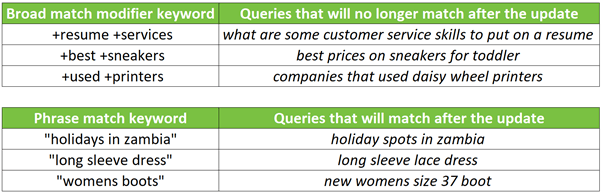
However, the recent announcement from Google states that the new behaviour for phrase match will be as follows: “phrase match will expand to cover additional broad match modifier traffic, while continuing to respect word order when it’s important to the meaning.” This means that under the new behaviour, our “ppc agency leeds” keyword may serve for someone looking for ‘ppc agency east leeds’, because it can now expand to cover additional traffic, and the word ‘east’ disrupting the word order does not disrupt the meaning.
Below are some further examples provided by Google to illustrate this new behaviour:
Why is this happening?
The move to cut down on the number of available match types coincides with Google’s recommendation to consolidate our PPC activity into fewer campaigns and ad groups and avoid over segmentation. In recent years Google has advanced its smart bidding capabilities, and since automation is at its most effective when dealing with bigger data sets, more traffic will be driven through a smaller number of keywords when BMM is sunset and phrase match expanded. This should help the algorithm make better decisions, as it has access to more data, but advertisers will have to monitor the effects of these changes closely to make sure they are setting their accounts up for success in this new landscape.
What should we do?
- Don’t create new BMM keywords in your accounts – they will be redundant before you know it.
- Export your keyword performance data and analyse how your phrase and BMM keywords are currently performing and try to gauge how the changes may affect you – for example, if you are quite reliant on BMM keywords, you might see your traffic decrease.
- Pause existing BMM keywords – they will soon have identical matching behaviour to phrase keywords so you don’t want to split your data across them both.
- Don’t pause a BMM keyword without checking you have a phrase match equivalent live – you might have previously paused a phrase match keyword if the BMM equivalent was outperforming it.
- Consider adding broad keywords or dynamic search ads to your account – this should help you discover new search queries, but make sure you are vigilant in adding irrelevant terms as negative keywords.
- Remember if you import a Google Ads campaign into Microsoft Advertising there will be no BMM keywords – as BMM is currently supported by Microsoft you may wish to add these keywords in
If you’re looking for an expert PPC agency who can help guide your paid strategy in an ever-changing digital landscape, then please get in touch today for a free account audit.
Diversifying Your PPC Spend
In the paid search arena, Google Ads dominates, and is the cornerstone of PPC strategy for many marketeers. With an 85% share of mobile search traffic globally, Google is the most popular search engine, and users are 4x more likely to click on a paid search ad on Google compared to their competitors. However, some businesses may find that their Google Ads activity has become saturated, and rather than reach a point of diminishing returns, their hard-earned money could be better invested elsewhere. Even if you feel you could invest more in Google, there are a plethora of other channels out there which can also connect you to your customers of tomorrow.
Bing
With 963 million unique monthly visitors, and the option to import your Google Ads account directly into the platform, Bing is the obvious starting point when looking to diversify your PPC spend. Whilst there is not complete parity between the two interfaces, savvy marketeers will be able to make the necessary adjustments to their campaigns to see success on Bing. A real highlight of the platform is the ability to target consumers based on their LinkedIn profile information, with job function a particularly useful option, since spending habits tends to differ between those in entry level roles vs company heads.
Amazon
For many consumers, the journey from research to purchase occurs entirely within Amazon, and in 2019 Amazon’s share of ecommerce sales was 38%. This is a substantial proportion of revenue, therefore if you are serving ads in this space and your competitors aren’t, you will have the edge. With a variety of ad types available, such as Sponsored Brand Ads which occupy a prominent position at the top of the page, there are many ways to get your products in front of a ready-to-buy audience.
With over 22 billion ad clicks occurring on the site per year, Facebook is a big player in the digital marketing world. Due to users self-reporting their own data, you can achieve a supreme level of granularity with your targeting, and layer interests, behaviours, demographics, age ranges, connections, languages and locations on each other to serve ads to your target audience. Once you’ve found a top converting audience, you can create a lookalike audience who are similar to that audience, which helps take some of the guesswork out of new customer acquisition.
Acquired by Facebook in 2012, Instagram is also able to tap into Facebook’s advanced audience targeting capabilities. With an average user age of 34, Instagram skews slightly younger than Facebook’s 40.5 years, which makes it a strong channel for marketers who want to tap into a younger demographic. Instagram is a very visual platform, which makes it ideal for generating exposure for your brand, as humans are said to remember 80% of what they see, and 62% of users surveyed have reported that they became more interested in a brand or product after seeing it on Instagram stories. The swipeable carousel ad format (also available on Facebook) is perfect for showcasing multiple shots of the same product, or several products from your range, and should leave consumers with a better understanding of your offering.
A social network that is solely career focused, LinkedIn is the prime place to engage with users based on their professional interests. Though it hosts less users than platforms such as Facebook, you can still reach many relevant, highly qualified audiences with targeting options such as skill set, degree, industry, company size & name, job title and job function. LinkedIn profile information is likely to be more authentic than other platforms, as members are quick to update their profile when they receive a promotion or move to a new company. The Sponsored InMail ad type is particularly strong, as it delivers a direct message to active target users, regardless of whether they currently follow your company.
A recent study found that 84% of Pinterest’s weekly users use the app before deciding what to buy next, with the same study uncovering that 83% of these same users have made a purchase based on content they found from brands advertising on Pinterest. The inherently visual nature of Pinterest means it is great for generating brand awareness, however you can cover the full marketing funnel and nurture a customer from discovery, to intent to purchase, to completed purchase, entirely within the bounds of Pinterest.
Whilst by no means an exhaustive list of the ad platforms available, the above channels are excellent starting points for those looking to reach new customers and broaden their paid search horizons past Google Ads.
If you would like further guidance on how best to diversify your PPC spend, then please get in touch today for a free account audit and find out how Circus can help you achieve your business goals.
Circus Helps Prep for Black Friday Success
Last year UK shoppers spent a reported 1.49bn on online retail sites – a 7.3% rise on 2017. No longer isolated to a single day, 67% of all discounts offered were active between the Monday and Thursday preceding Black Friday. The extension of deals into Cyber Monday week may give the impression that Black Friday is a 2-week shopping event, but in reality it is a month-long affair. Consumer savviness is increasing and non-brand search volumes are strongest at the beginning of November as users identify what they want – and once they become informed about their product choices they will search for the best deals on branded terms.
With this is mind, online retailers need to ensure they have implemented their paid search strategy ahead of time if they want to beat the competition and enjoy Black Friday success.
What worked
Black Friday is a highly competitive landscape for PPC marketeers and through effectively implementing the below features and channels we helped ensure our clients were there (and with their best deals) when customers were searching.
Responsive Search Ads
Last year Google released Responsive Search Ads (RSAs) which allow advertisers to create up to 15 headlines and 4 descriptions within an ad, which are then automatically rotated to find the best creative for each individual user and their specific query. The more unique your headlines and descriptions are from each other, the greater your chances of being able to serve a hyper-relevant ad to a potential customer. Through analysing their Combinations Reports, advertisers can identify the most successful messaging and use their findings to help inform their Black Friday copy.
Catch-all Dynamic Search Ads Campaign
Ensure full coverage of your entire product inventory by creating an ad group set to target ‘all web pages’ and fill any gaps in users’ searches left by keywords you’re not actively bidding on but are relevant to your business. If ‘all web pages’ is to broad, specific pages can be chosen, as you may not wish to pay for clicks to certain pages if your goal is to spend your budget maximising sales.
Promotion Extensions
Google have reported on average a 10-15% uplift in click-through rate when promotion extensions are shown, and with the option to select Black Friday and Cyber Monday as occasions, these extensions are a must for all online retailers. Supply your promo code if applicable and set your sale dates to remind customers that this is a limited time offer.
Countdown Timers
Much like promotion extensions, countdown timers create a sense of urgency as the ad copy dynamically updates to display the time left for an offer, e.g. 3 days or 12 hours. Although not currently compatible with RSAs, countdown timers can be deployed in expanded text ads and dynamic search ads.
Amazon
In 2018 Amazon held 26% share of the Black Friday Market, up 3% from the previous year. For many consumers Amazon is akin to a search engine as millions of products from a huge range of retailers can be browsed and compared. It is likely this year Amazon will choose not to wait for Black Friday proper to release deals, and consumers will be able to purchase at a reduced price from the start of November.
What could do well this year
A new year means more new features and advertising channels to weave into Black Friday planning and listed below are our top picks for our paid strategies this year.
Smart Shopping
Google Smart Shopping campaigns were released last year and in early testing advertisers drove over 20% more conversion value at a similar cost – this figure is now closer to a 30% average increase in conversion value. Smart Shopping campaigns combine standard shopping with display remarketing and utilises automated bidding and ad placement to promote products across various Google networks. Advertisers can set a target return on ad spend which the Google Ads system optimises towards whilst aiming to maximise conversion value.
Smart Display with Pay for Conversions
In December 2018 Google released the option to pay for conversions, rather than clicks, when using a Smart Display campaign. Advertisers set a target cost-per-acquisition and only pay when a user converts; a CPA Target of £10 and 10 conversions in a month would result in a £100 overall spend. This is a great proposition not only for meeting ROI targets but also for brand awareness as users can click through to your site, and become familiar with your offering, for free.
LinkedIn Profile Targeting
Microsoft’s acquisition of LinkedIn allows advertisers on the Bing Ads platform to target potential customers based on their LinkedIn profile information. In particular, job function is useful to optimise against as spending habits tends to differ between those in entry level roles, compared to company heads.
Shopping Ads on Pinterest
Pinterest brands itself as a visual discovery tool, and although advertising on the platform has existed for many years, the introduction of Shopping Ads via the Ads Manager interface allows advertisers to launch Shopping campaigns and promote their products to an engaged audience. One study found that 84% of Pinterest’s weekly users use the app before deciding what to buy next, and the same study found that 83% of the same users have made a purchase based on content they found from brands advertising on Pinterest.
The Circus Method
Through a combination of early preparation and analysis, we helped our clients see on average a 50% revenue increase on Black Friday 2017, and this year we expect this to rise even further.
Shopping Feed Health
You lose 100% of the ad auctions you don’t enter – so make sure you have fixed any disapprovals in your Merchant Centre well in advance of Black Friday. Also make sure to complete as many of the columns in your product feed as possible – including information such as colour, size and gender helps shoppers evaluate your products. Use feed rules to strengthen your titles and descriptions – add the product’s brand to the start of the title, or test appending the size and colour to the end of the title.
Smart Shopping
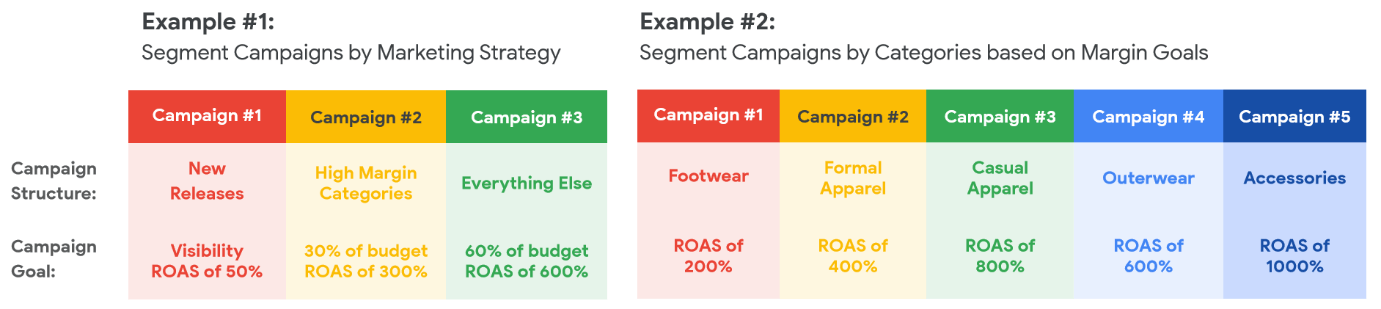
If you’re not already utilising Smart Shopping, testing should begin at a minimum 5 weeks before Black Friday to allow enough time to evaluate the results. Avoid over segmenting your campaigns as this is likely to undermine performance since the algorithm will have less data to work with. A successful strategy could include segmentation by marketing strategy, or by category and margin goals:
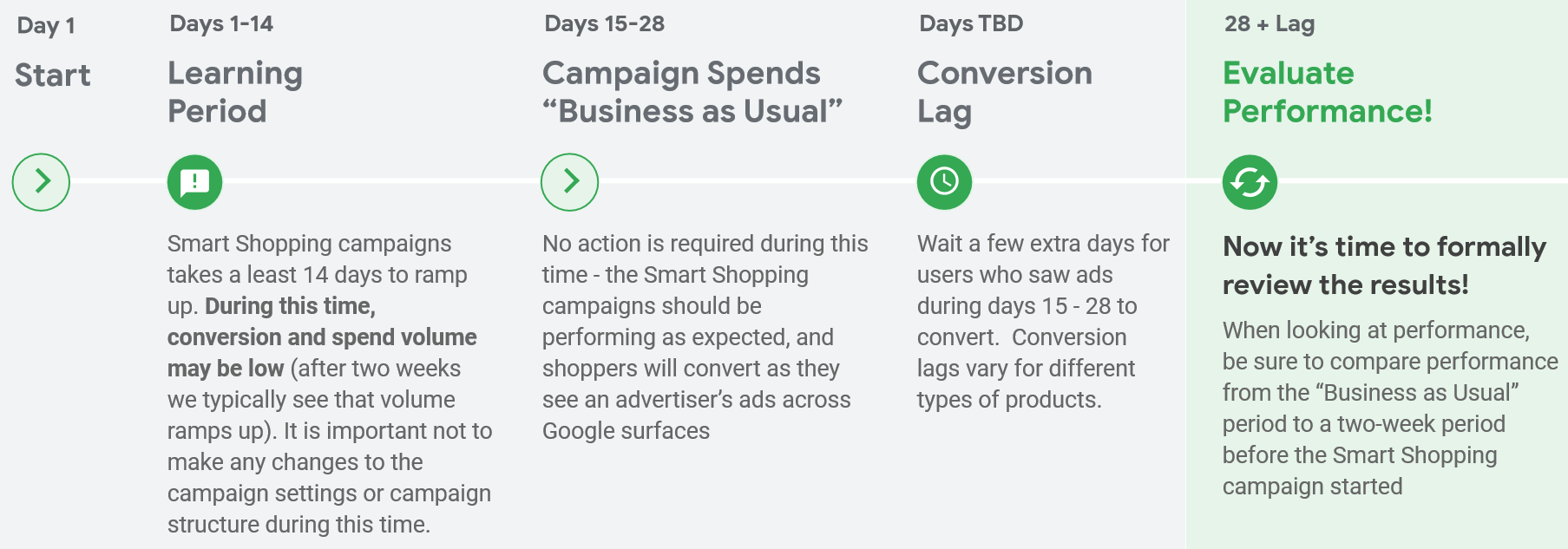
Once you’ve selected and set up a campaign to test under Smart Shopping, you should allow your campaign to run for at least 14 days without making any changes, as this is the learning period. Remember to pause the original campaign to prevent any interference. After the initial period is complete, run your campaigns for days 15 – 28 as ‘business as usual’ – the campaign should be optimising and performing towards the targets you’ve set. Then wait several days for any conversions that may have occurred during days 15 – 28 days to convert – this conversion lag will vary depending on the product. After allowing for your conversion lag, you can evaluate performance. Compare the ‘business as usual’ period to the two-week period before the Smart Shopping campaign started. Remember to judge performance on the right metrics such as total conversion value or ROAS, don’t focus on metrics such as impressions and clicks as these do not reflect real business outcomes.
Optimising Smart Shopping for Black Friday
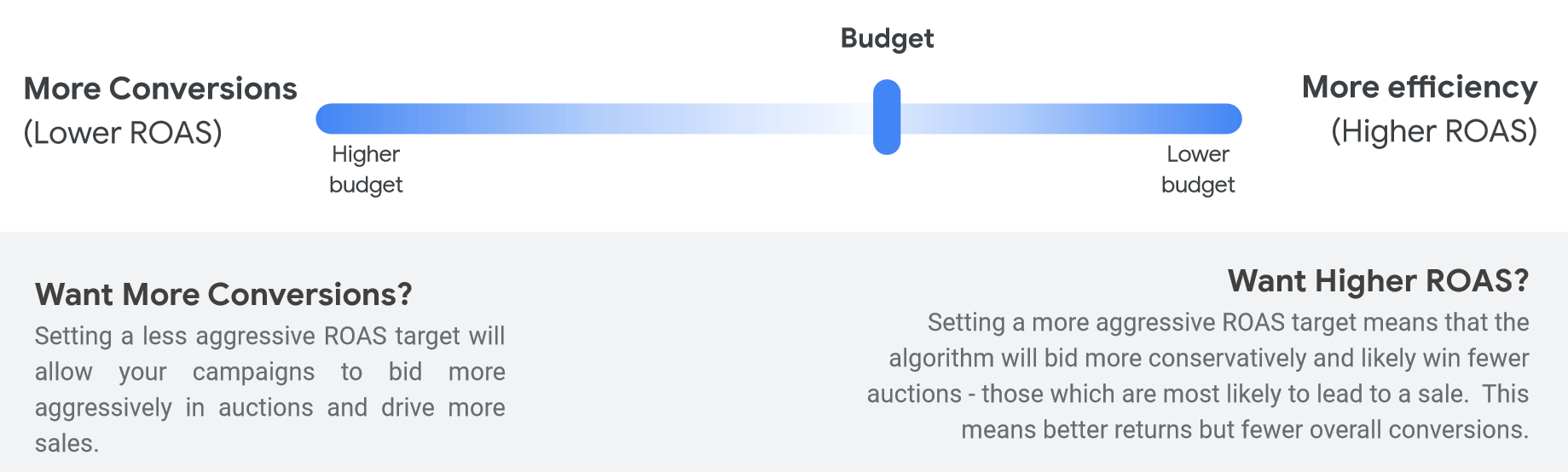
Adjust your ROAS targets to capture the extra demand – by decreasing your ROAS target it will be easier for the algorithm to respond to accelerating sales volume. Set the lowest ROAS you are willing to accept and where possible use an unlimited budget to make sure you’re not missing out on traffic later in the day.
Smart Bidding for Search
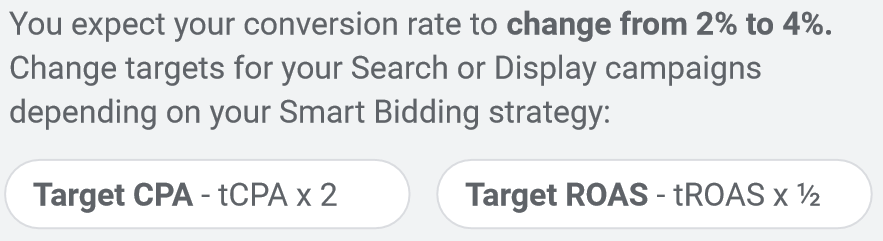
Many ecommerce clients are using Smart Bidding strategies such as Target CPA for their Search campaigns and it is important these campaigns are set up to cope with the increased traffic, increased conversion rates and increased competition we experience around Black Friday. If you expect more traffic to your site you will need to make sure budget is uncapped, but providing your conversion rates don’t change drastically, Smart Bidding will optimise as normal to achieve your goals. However, if conversion rates are expected to change significantly, slightly more action will be necessary. For a gradual increase in conversion rates over a period of 3+ days, no immediate change is required, but you may wish you make slight adjustments to the Target CPA/ROAS depending on your seasonal marketing goals. If your conversion rates are expected to spike in under 3 days, such as a flash sale, you can consider using seasonality adjustments or changing your target goal. To apply a seasonality adjustment, simply tell the system when and how to adjust for your sale. For example, if you expect conversion rate to increase from 5% to 10%, increase your conversion rate adjustment by 100%:
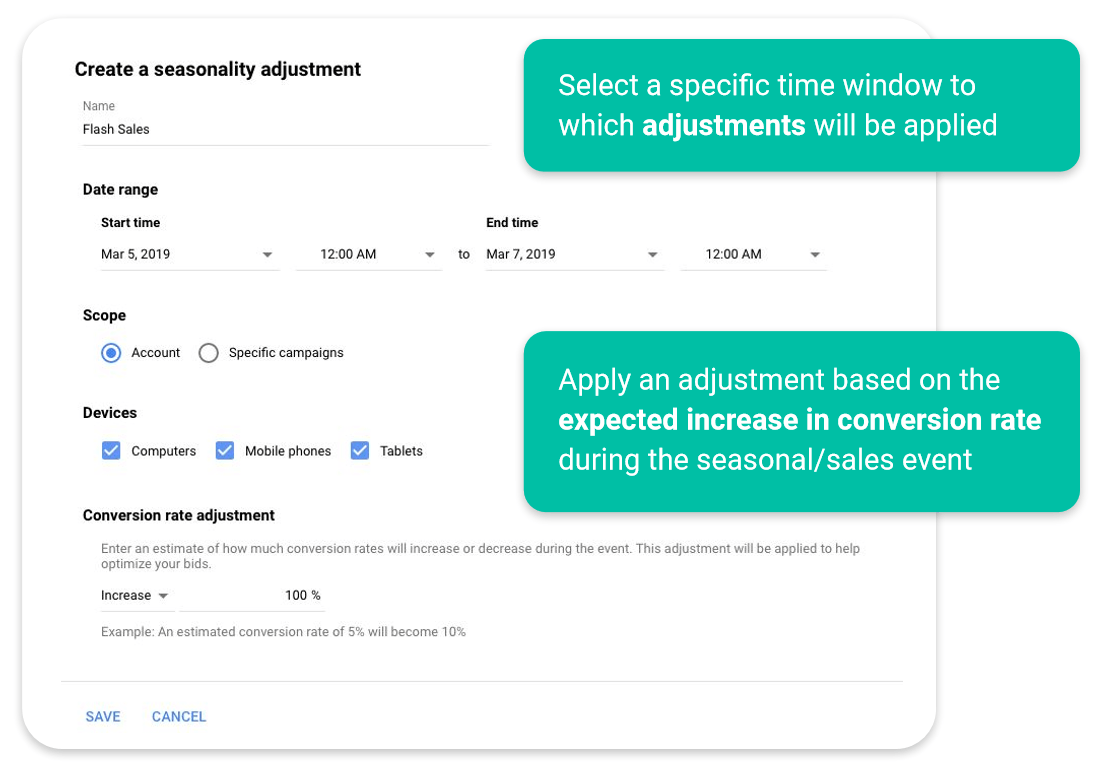
Alternatively, increase your CPA target by 2, or relax your ROAS target by half:
Analyse Previous Data
Review your 2018 Black Friday data and identify where you saw spikes in traffic so that you can adjust your budgets and smart bidding strategies accordingly this year. Review which products delivered strong sales and identify which offers you were running – if you plan to offer a less competitive discount this year be prepared that sales may not be as strong, since shoppers will be searching for the best deals. Review your ad copy and aim to improve and build on your messaging – incorporate this into an RSA ad and it will automatically rotate to find the best combination.
Key Dates
W/c 21st Oct – Final date for testing Smart Bidding and Smart Shopping
Black Friday Week Begins – 25th November
Black Friday – 29th November
Cyber Monday – 2nd December
End of Cyber Monday Week – 8th December
Treat Black Friday as a marathon, rather than a sprint, and you will see a greater return than if you rely on one day to drive all your success.
2018 PPC Rewind – Circus PPC
It’s been another exciting year in the paid search stratosphere with Google debuting a host of new features designed to help advertisers get their products and services in front of the right customers at the right moment. Join me as we look at 2018 PPC and review some of the biggest changes this year!
Google Ads Rebrand
In the year 2000 Google released their online advertising platform – AdWords. This year marked their 18th birthday and with this came an image revamp. The name change to Google Ads aligns them with two of the other big players in PPC advertising – Bing Ads and Facebook Ads – and also signifies how far they’ve come from relying purely on keywords to attract users. Once a platform for text ads, Google Ads now utilises a variety of ad formats and targeting options which help advertisers reach their audience in multiple ways across the internet.
Responsive Search Ads
The arrival of Responsive Search Ads (RSAs) brought with them many benefits for advertisers; description character limits were extended from 80 to 90 characters, plus you can now create up to 15 headlines and 4 descriptions within an ad, which the system then rotates. This automatic rotation allows the system to learn which ad copy combinations work well together and which messaging is most relevant for a potential customer’s search. Whilst performance reporting is a little less clear-cut than with text ads, the ‘Assets’ view allows you to see how many impressions a given headline/description has received, and ‘Combinations’ shows the percentage of times an ad combination appeared together.
Expanded Text Ads Update
RSAs are not yet available in all languages but in the interim Google have applied updates to expanded text ads. The introduction of a third headline and a second description line, and the extension of the description character limit to 90 characters (same as RSAs), means everyone can create larger, more informative text ads. Truncation can occur based on device size and Google states the third headline is more likely to appear on wide mobile devices. Bing now has support for the second headline/third description line which means ads can be seamlessly imported from Google, allowing continuity of messaging across networks.
Exact(ish) Match
This year exact match lost its literal meaning; the match type now includes close variants which can be triggered if the search intent is considered to be the same. To provide an example, the search [free copyright images] may match with your keyword [images royalty free]. These close variants of your exact match keywords allow your ads to show for a broader spectrum of searches and negate the need to create exhaustive keyword lists. Check in on how these close variants are performing by regularly running Search Terms Reports and if necessary add searches that are spending without converting as negatives.
Search Ad Position Metrics
Gone are the days where you rely solely on average position as the indicator of where your search ads might be appearing on the results page; in November Google introduced four new position metrics which help advertisers better understand the placement of their ads against the organic listings, and not just their competitors. With average position an ad might be stated as appearing in position 1 but that could potentially be below the fold and under organic entries. However, with the metric Impr (Top) % you can see the percentage of times your impressions appeared at the top of the page, and Impr (Absolute Top) % shows for what percent of the time your ad occupied the very first spot on the page. Accompanied by Search (Absolute Top) IS and Search (Top) IS, these metrics can better diagnose issues advertisers commonly face, e.g. a high average position but a low click-through rate, which could be due to ads appearing at the bottom of the search results page.
Automated Bidding
Accompanying the aforementioned new search ad position metrics is a new automated bidding strategy – Target Impression Share. This strategy joins Maximise Clicks, Maximise Conversions, Target CPA, Target ROAS and Enhanced cost-per-click as bidding options which leverage machine learning to help advertisers achieve their campaign goals. Automated bidding can account for auction-time signals which cannot be manually adjusted for, such as internet browser and operating system, so by utilising these strategies the process of targeting the customers most likely to convert is even more sophisticated. For Display campaigns an exciting new strategy has been added – Pay for Conversions. Here you set a CPA target and you are only charged for the conversions you drive, e.g. a CPA target of £10 and 25 conversions would equate to an advertising cost of £250, with an actual CPA of £10. Unlike other bidding strategies, you only pay for conversions, not clicks or impressions.
Smart Shopping and Smart Display
Automated bidding really comes into its own in Smart Shopping and Smart Display campaigns. These campaign types rely on automated bidding plus automated ad creation and placement to help simplify the process of expanding reach, broadening your customer base, and maximising conversion value. After the initial learning period has completed (typically 15 days) your Smart campaign should begin to optimise and you can start evaluating performance. In addition, it’s worth remembering that if you have products in a standard Shopping campaign and a Smart Shopping campaign the Smart campaign will take priority, thus it is recommended the standard campaign is paused to minimise interference.
If you would like to update your PPC strategy please get in touch for a free account audit and see how Circus can help 2019 be your best year yet.
Know Your Audience: Remarketing the Right Way
Are your PPC ads driving traffic but not leads? Does your click-through-rate feel disproportionately high in comparison to your conversion rate? If so, updating your remarketing strategy might help generate more valuable onsite actions. You have an interested audience, and now it’s time to re-engage with them in a smart way.
Audience Depth
You may already utilise Remarketing Lists for Search Ads (RLSA) to group all visitors to your website together. This will be in the form of a remarketing list entitled something like ‘All Users’ and should have a positive bid adjustment to help bring them back onsite. However, this list is very broad as it does not differentiate between the types of user, for example a homepage visitor is not as far down the conversion funnel as a cart abandoner.
In order to make your remarketing strategy more effective you should segment your users into specific lists based on intent. From here you can personalise ad copy, optimise your bids, broaden your keyword lists, and even layer audiences together to help the consumer on their journey.
RLSA for Lead Generation
The behaviours people exhibit onsite can be used as an indicator of how far down the conversion funnel they are, and how aggressive you should be with your bidding strategy in order to attain their business:
- Homepage Visitors – by viewing your homepage these users now have some familiarity with your brand however they did not continue any further so this is the list you should apply the least aggression to.
- 1+ Page Visitors – navigating between pages suggests that the user’s interest has been piqued therefore you can apply more aggression than you would for someone who only reached one page and then bounced off.
- Important Page Visitors – the content of these pages will be important because they indicate intent, for example a visit to a pricing page or a list of services. More aggression can be applied here as these visitors are likely much closer to converting.
- Converters – if a user converted then you want to retain their loyalty so you should make sure you are always there when they require your service by applying the highest bid adjustment to this group.
RLSA for Ecommerce
| Website Behaviour | Remarketing List | Suggested Bid Adjustment |
| Visited homepage only | Homepage Visitors | 40% |
| Visited a category page | Category Page Visitors | 60% |
| Visited a product page | Product Page Visitors | 80% |
| Reached shopping Cart | Cart Abandoners | 200% |
| Converts onsite | Converters | 100% |
RLSA for ecommerce follows a similar bidding strategy to lead generation. However, you will notice in the table above that ‘Cart Abandoners’ rather than ‘Converters’ are remarketed to the most aggressively. Although ultimately leaving the site without converting, these users reached a significant point in the funnel therefore a strong effort should be made to target their custom.
Smart Uses of RLSA
- As mentioned above, make sure you apply different bid adjustments to your lists. There’s no point going to the trouble of segmenting your users if you continue to target them with the same level of bid aggression.
- Try customising your ad copy to reflect where your user is in their journey; the RLSA list they belong to lets you know what stage of the conversion funnel they’re at and you can tailor your ads to speak to that specific moment. See below for an example of how to combine bid adjustments and ad copy for your RLSA lists:
| Bid Adjustments | Page Visited | Ad Customisation |
| 50% | Homepage | “Discover New Deals” |
| 100% | Category Page | “25% Off Today” |
| 150% | Product Page | “Limited Time Offer” |
| 400% | Shopping Cart | “Free Shipping” |
| 200% | Thank You Page | “Have you tried…” |
- Experiment with the membership duration of your lists e.g. 0 – 7 days or 0 -30 days. For example, you might discover that if someone doesn’t come back to your site within 14 days of their first visit then they are unlikely to return. In this instance you might amend the membership duration of your list to 0 – 14 days.
- Bidding on broad keywords can often be expensive and lead to low conversion rates as they are quite unspecific. However, with RLSA you can test bidding on these broader keywords as your audience will be smaller and users have already proven interest in your products/services by paying a visit to your site.
- Consider using negative audiences since some users will belong to multiple lists and you want to show them the content that is most relevant to them. For example, if you have a campaign or ad group solely targeting ‘Homepage Visitors’ you could add the ‘Converters’ list as a negative audience; this will allow you to personalise ad copy, bid on broader keywords etc.
If you would like help with remarketing or any aspect of your PPC strategy then please get in touch and see what our dedicated experts can do for you.
Written by Megan Wilson-Taylor, PPC Analyst at Circus PPC Agency