


As a PPC agency, we always aim to deliver the best possible ROI for every client campaign. We obsess over keywords, ad copy, bidding strategies, and conversion rates. But there’s a silent ROI killer undermining these efforts: invalid traffic in PPC.
Many advertisers assume Google’s built-in filters are enough to handle the problem. And yes, Google has systems that detect and block a significant portion of invalid clicks. They use automated filters, machine learning, and even manual reviews to spot everything from bots to accidental double-clicks. They’ll even credit your account for some of these invalid interactions.
But the truth is… Google doesn’t catch everything.
Why Google Alone Isn’t Enough for Invalid Traffic in PPC
Think about it from Google’s perspective. Their goal is to maintain a functioning ecosystem for advertisers and publishers, not to provide bulletproof invalid traffic prevention. Sophisticated click fraud often slips past their filters, draining budgets without advertisers even realising.
Here’s why relying on Google’s systems isn’t enough:
- Evolving Tactics: Fraudsters constantly adapt, creating bots that mimic human behaviour to avoid detection.
- Grey Area Clicks: Competitors clicking your ads or low-intent users may not register as ‘fraud,’ but they still waste spend.
- Data Silos: Google only monitors its own ecosystem, lacking the full picture external tools provide.
- Reactive Approach: Google often flags invalid activity after the spend is gone, meaning the damage is already done.
The Impact of Invalid PPC Traffic
When invalid traffic in PPC slips through the net, it doesn’t just waste budget – it distorts performance data and damages growth.
- Skewed Analytics: Inflated CTRs and distorted CPAs lead to poor optimisation decisions.
- Lower ROI: Every invalid click is a missed opportunity to connect with a genuine customer.
- Quality Score Damage: Fake traffic can lead to lower engagement, higher CPCs, and weaker ad positions.
- Wasted Budgets: Invalid clicks drain ad spend, leaving less for high-value traffic that actually drives sales.
For ecommerce PPC agencies, the risk is even higher. Fast-moving budgets, competitive niches, and high CPCs mean even small volumes of invalid traffic can have a big financial impact on their clients.
How a PPC Agency Can Defend Against Invalid Traffic
The solution? Go beyond Google with a dedicated invalid traffic protection software. External platforms provide advanced features that better protect campaigns and maximise ROI.
Key Benefits of Third-Party Invalid Traffic Tools:
- Deeper Behavioural Analysis: Tracking mouse movements, session duration, device signals, and more to identify suspicious patterns.
- Real-Time Blocking: Stops invalid clicks before they hit your site, preventing wasted budget.
- Granular Control: Custom rules let advertisers fine-tune protection for their campaigns.
- Cross-Platform Protection: Unlike Google’s siloed system, some tools protect across search, display, and social channels.
- Transparent Reporting: Clear visibility into the type and source of invalid traffic impacting your ads.
Why Our PPC Agency Partners with Lunio
We refuse to let invisible enemies drain client budgets. That’s why, as an ecommerce PPC agency and trusted partner to brands across industries, we use Lunio to protect against invalid traffic in PPC.
Lunio combines AI and machine learning to analyse every click in real-time, using hundreds of behavioural data points to determine validity. Unlike Google, Lunio proactively blocks invalid traffic before it costs you money.
With Lunio, our clients benefit from:
- Proactive Protection: Invalid traffic is stopped before it consumes spend.
- Actionable Insights: Detailed reports empower smarter targeting and strategy.
- Improved ROI: Eliminating wasted spend improves CPAs, conversion rates, and ad efficiency.
- Multi-Channel Coverage: Protection across Google Ads, Paid Social, and Display campaigns.
Case Studies: Real Results from Invalid Traffic Protection
We don’t just talk about preventing wasted spend – we measure it. By partnering with Lunio, we’ve been able to significantly reduce the impact of invalid traffic in PPC campaigns across different industries.
- Fashion Brand Success Story: For a leading global fashion retailer, Lunio prevented an estimated 9.4% of ad spend from being wasted on invalid traffic. That’s budget reallocated to genuine shoppers with high purchase intent, driving stronger ROI and revenue growth.
- Homeware Sector Impact: Across our homeware portfolio, Lunio delivered a 6.1% average saving, helping brands reinvest spend into campaigns that genuinely converted.
- Total Client Protection: Across our full protected client base, Lunio helped to save an average of 9% of total ad spend – proving that invisible click fraud is widespread, but preventable with the right technology.
These results highlight a consistent trend – invalid traffic in PPC is a silent but significant cost for advertisers. By partnering with Lunio, our clients not only preserve their budgets, but also unlock new opportunities for scalable growth.
Final Thoughts: Stop Invalid PPC Traffic from Killing Your ROI
In today’s competitive ad landscape, advertisers can’t afford to ignore invalid traffic in PPC. Google’s systems provide a baseline protection, but it’s not enough for brands that are serious about growth.
Working with a specialist PPC agency that leverages third-party protection tools ensures your ad spend works harder, your data stays clean, and your campaigns achieve their true potential.
If you’re ready to safeguard your campaigns, improve ROI, and gain a competitive advantage, contact us today to learn how Lunio can transform your PPC strategy.
How To Choose The Right PPC Specialist
Circus PPC Agency’s Chief Strategy Officer, Ahmed, speaks about how businesses can effectively evaluate their current PPC specialist agency or in-house team. Read on for his tips on how to identify when it might be time for a change.
This article has been edited from the original version, which initially went live in November 2023.
The Importance of the Right PPC Specialist Agency
When it comes to evaluating current PPC specialist partnerships, businesses will likely be experiencing one or more of the following issues:
- Poor PPC performance
- Lack of adequate data/reporting
- Lacklustre communication
- Being reactive, rather than proactive
- Resistance to new ideas and collaboration
Ideally, you should be auditing your partnership with a PPC agency on a regular basis, but there are some tell-tale signs that highlight that it might be time to look for someone more suited to your needs.
5 Signs You Should Change Your PPC Specialist
Sign 1: Lack of Initiative and Proactivity
Where are ideas coming from?
Is there uneven split of who’s coming up with ideas? Ideally, your partnership with a PPC specialist will be a collaboration, and should never rely on one-sided idea generation. Whoever you’re working with should always be exploring opportunities and presenting ideas on how to better drive performance in your account.
Is activity slowing down?
How often are changes occurring in the account? PPC doesn’t slow down, and there’s always something that can be improved, optimised, and reviewed. Any sort of stagnation that means that nobody is looking at your account for longer periods of time is a real issue.
Sign 2: Missed Opportunities and Gaps in Expertise
Do you constantly have to get involved?
If you find yourself constantly taking the lead and contacting your PPC specialist to inform them of potential changes and ideas regarding your account – this is a red flag. You’ve chosen to work with a specialist for a reason, and that means that you should be able to rely on them for idea generation and recognising growth opportunities – not the other way around!
Are missed opportunities being flagged elsewhere?
Your chosen PPC specialist shouldn’t have to be informed of any missed opportunities, and if anyone but them are flagging gaps between you and your competitors, something isn’t right. Often, after first auditing accounts for clients, we find issues and mistakes that haven’t yet been flagged by their existing PPC specialist, leading to those clients re-considering if who they’re working with is truly right for them.
If you did want to find out if your current PPC specialist has been missing anything in your account, contact us for a free audit carried out by an experienced member of the team.
Sign 3: Inadequate Communication
How often do you hear from your PPC specialist?
One of the most important parts of the partnership between you and your PPC specialist is communication. If communication is irregular or you feel like you’re always the first to reach out, this is a huge problem. You should be kept up-to-date with what’s going on in your account with regular and consistent communication – whether this is through weekly calls, reports, or email conversations.
When performance isn’t great, how does communication change?
If things are going badly, you should know about it. Not communicating issues or potential risks can be extremely detrimental to both account performance and partnerships. Ideally, communication will be stepped up when things might not be going as well, keeping you in the loop whilst they work to fix any issues.
Sign 4: Stagnant or Declining ROI
Is performance dropping without explanation?
Performance can and will fluctuate. However, if this happens suddenly or without explanation, this is a huge red flag. If your PPC specialist avoids highlighting this, this is an even bigger red flag. In order to know what does and doesn’t work, everyone involved needs to understand what’s going on in the account, so that effective solutions can be explored.
Or, is performance stagnating with no real growth?
The whole purpose of PPC is to help drive business growth, so if your account isn’t growing, then it’s important to find out why. Again, there’s always something that can be improved in an account, so if your PPC specialist isn’t always looking to inspire growth, then they’re not doing their job properly.
Sign 5: Mismatched Goals and Expectations
Have there been multiple counts of miscommunication?
Miscommunication can happen at the best of times, can come from either side, and doesn’t initially have to be a big deal. However, if this becomes a regular occurrence or an issue, this is a big red flag and should be addressed immediately.
Are you working towards the same goals?
The most likely cause of mismatched goals and expectations is miscommunication, which is why regular communication is so important. By reviewing and discussing goals regularly – whether through scheduled calls or weekly reports – you can make sure that your goals and expectations remain aligned with your PPC agency.
Making The Switch: Finding A PPC Specialist That Fits
Switching agencies, admittedly, can be a pain. However, it can’t be anywhere near as painful as the potential damage that an agency that aren’t doing their job could be doing to your account in the long run.
When you do decide to make the switch to work with a PPC specialist that better suits your needs, re-addressing the above points will help you to weed out those that don’t align with your goals and expectations.
Once you’ve chosen a new PPC specialist, reiterate the value and importance of communication and make sure that this is made a priority.
Conclusion: Choosing A PPC Specialist To Drive Success
There isn’t a clear right or wrong answer regarding who the best PPC specialist for you is. However, data will tell a strong side of the story, with face-to-face meetings being important when it comes to understanding who could be your best fit and how you might work together moving forward.
What To Do Next
Stay Up To Date
We publish expert insights like this every month. Follow us to stay up to date: LinkedIn, Facebook, Instagram
Make The Switch To A Qualified PPC Specialist
As a PPC specialist agency, we offer a free account audit that will identify where in your account you could be driving better performance when you work with the right people. Contact us now to find out more.
The Best PPC Platforms To Drive Success
When working out your PPC strategy, it’s important to investigate and understand the PPC platforms that will work best for you.
It may come as a surprise to some, but whilst Google definitely monopolises the market when it comes to search engines – it isn’t the only platform you should be considering.
What Platforms Should I Be Using?
PPC can be extremely effective and drive significant business growth for your brand, but not without monetary investment. Finding the right PPC platform will help you to make sure that your investment is attributed to the channels that lead you towards your desired goals and objectives.
The Top 3 PPC Platforms
There are several different PPC platforms designed to help brands and experts get the most from their investment into paid advertising. For some, all of these platforms will be beneficial, and for others, it might only be one. Read on for the platforms that you should be utilising to optimise your efforts.
Google Ads
When it comes to reaching a vast audience, Google is the go-to search engine for advertisers due to its leading share of the market – a whopping 83.5%.
But that’s globally.
When it comes to the UK alone, Google have even more of a monopoly, with a market share of almost 94%.
Google Ads have a plethora of products and services available to advertisers including Search, Shopping, Display, Video and Performance Max. Due to Google’s popularity and the results we’ve seen it deliver, we have all of our client’s accounts live on Google Ads, and have seen specific campaign strategies work well for different industries.
For example, with retail accounts we’d typically be live on Performance Max whilst testing Shopping, and for clients with other assets, we’d look at more upper funnel activity with Video and Display ads. Ultimately, we find that most of our clients drive 95% (if not more) of their paid traffic from Google, so getting your strategy right is essential.
Microsoft Advertising (formerly Bing)
Bing is the second biggest search engine to Google in the UK, delivering paid listings and search results across the Microsoft Search Network.
Following in the footsteps of Google, Microsoft Advertising have also announced their own version of Performance Max – a newer campaign type designed to ‘convert more customers across the entire network’ and using AI to find asset combinations that best execute the desired strategy and reach desired goals.
Typically, we find that Bing brings in below 4% of our client’s paid traffic. However, given that partner sites are controlled, this often comes with a higher conversion rate. Bing may not be the biggest fish in the pond, but it can certainly help towards achieving your overall business goals. Kind of like Ron from Harry Potter – not the star of the show, but a key player!
Amazon
Amazon is fast becoming one of the biggest search engines for retailers and despite the fees that might come with it, clients can see great account performance to help drive towards over-arching growth goals.
“Amazon’s advertising revenue has grown 26% YOY, reaching $12.6bn in Q3 2023. I expect this trend to continue into 2024 and beyond with further ad revenue growth. They are going to be developing more and more opportunities for advertisers and will eventually overtake Meta as the second largest advertising platform in terms of ad revenue spend.”
Rick Tobin, Managing Director at Circus PPC Agency
Ready To Explore PPC Platforms?
As a specialist PPC agency, we’re not only aware of the tools you need to drive your PPC strategy – we also know how to use them! If you’re looking for an experienced PPC agency to help you to effectively utilise different PPC platforms, get in touch with our experts today for a free account audit.
How To Reduce The Cost Of PPC
PPC is an extremely effective way of driving growth and raising awareness for your business. However, as the famous saying goes ‘you have to spend money to make money,’ and unfortunately, PPC is no exception to the rule.
What Is The Cost Of PPC?
There’s no one-size-fits-all package when it comes to PPC, and rather, it depends on the budget and needs of your business. Different goals, industry benchmarks, and competitor behaviour can all have an impact on the cost of PPC.
Effective Ways To Reduce The Cost Of PPC
Whilst PPC does require an investment, there are ways to ensure that you’re not spending unnecessarily on activity that doesn’t work for your brand. We’ve listed some of the things that you can do to reduce the cost of PPC as much as possible, whilst still seeing improved performance for your business.
Remove Budget Waste
As an agency, the first thing we do when looking into an account is identify areas of budget wastage. When identified, this is one of the quickest – yet often overlooked – ways to improve ROI.
For example, in almost every audit we conduct, we find that brands are spending money in countries that aren’t actually being targeted, essentially wasting budget. Immediately, this is an area where we would take the budget and re-allocate to high-performing areas that work for the client.
In many scenarios, brands and advertisers might not recognise exactly where spend is being wasted, which is why it’s important to keep a close eye on performance of individual ads, campaigns, and assets.
Defend Against Click-Fraud
Did you know that fraudulent clicks can account for around 20% of a brands website traffic?
Fake traffic can hugely affect a brand’s ROAS, with fraudulent clicks never converting and therefore warping analytics and actual profitability from credible sources.
Whilst Google claim to remove these clicks, we still find unusual activity within accounts all the time. This is similar across Microsoft and Meta.
Lunio, a click-fraud protection tool, assists advertisers in catching ad traffic data to build exclusion audiences, and in turn, block invalid traffic that can damage campaign data.
Optimise Your Website Experience
One of the other key elements to help drive solid performance and improve ROI is conversion rate, which can be optimised by focusing on enhancing the customer journey on your website, especially once a potential customer has clicked on an ad.
Aligning the messages that your ads and landing pages are conveying is super important to ensure that the user journey is as seamless as possible.
Platforms such as Salesfire have been designed to help brands increase website conversion rates, and provide advice and guidance on how to best set up your ecommerce website for success.
Work With A Specialist Agency
Whilst typically, having an agency manage your PPC ads comes with a management fee, which might be seemingly counter-productive to reducing the cost of PPC – it’s the best thing you can do to hit your long-term goals and save money.
Specialist PPC agencies have the insight and knowledge available to hit the ground running and recognise straight away where spend can be reduced or reallocated. Their expertise and resources means that they can help reduce the cost of PPC through:
- Experience working across different brands and industries;
- Remaining up-to-date with PPC trends and updates;
- Knowledge-sharing amongst a team of PPC experts;
- Access to a network of important partners, professionals, and training.
Ready To Drive Growth With Effective Budget Management?
Circus PPC Agency are focused on identifying and removing wasted spend, reallocating budget to high performing areas to drive ROI and business growth. To find out how you could reduce the cost of PPC and see a better return on investment, contact us for a free account audit.
Maximise ROI Through PPC: Strategies For Ecommerce Brands
Contrary to popular belief, having a set PPC budget doesn’t mean that you can’t see growth from PPC activity. Read on to discover the steps you can take to maximise ROI within a set budget – ultimately helping you to deliver better business outcomes, and prepare you to invest more into PPC in the long run.
Typically, the challenge of any PPC campaign with a set budget is working out how to best and most efficiently use the budget to maximise ROI. It can be challenging to balance a set budget across product inventory, categories, and associated keywords. Often, the quest to ensure coverage across everything, this can often result in not-enough coverage for anything, negatively impacting overall ROI as inefficiency creeps into campaigns.
Where to Focus Set PPC Budgets
Despite the challenge that comes with working with a set budget, there are a number of things that those working with set budgets can do to optimise ROI. Here are some of the non-negotiable steps we take as a PPC agency:
Remove Budget Wastage
Review where budget is being wasted/misdirected. Doing so can help to maximise ROI through intricate management of budget inefficiencies. This can be done by using your KPI’s e.g. COS, CPA, CPC or any other key business outcome metric and reviewing your PPC performance against that KPI across the following areas:
- Data attribution
- Automated bidding
- Network selection
- Devices
- Days of the week/hours of the day
- Locations
- Campaign view
- Keyword view
- Search term view
- Product view
Look for areas of high variance from your KPI, whether good or bad. Good represents pockets of opportunity, whilst bad represents areas of budget inefficiency. Don’t forget to watch out for telltale warnings such as campaigns that are limited by budget or spend on search terms that don’t relate to what you’re offering.
Cost-Effective Keyword Research
When building an account up, it’s important to conduct intensive keyword research in order to find what works best for your business and your budget. Limited funds mean that you may not always focus on all of the keywords you want to show for, so exploring more refined keywords might be a more cost-effective way of reaching the right audiences and seeing desired CVR.
For example, you might not have the budget to appear for ‘buy laptops,’ but you may have the budget to appear for ‘buy dell 15inch laptops.’
However, recent Google changes mean that it doesn’t have to be a case of bidding on longtail keywords or nothing – you can still appear for shorttail, high volume keywords at certain times at a cost-effective level. The best way to do this is to ensure that automated bidding is set at the right levels.
Another way to avoid wasted budget is to keep an eye on, and continuously update, negative keyword lists.
Due to the need for accuracy, the keyword selection journey does take time and testing, but once this is complete, you’ll have a much clearer, much more effective keyword strategy in place.
Maximise ROI With Competitor Analysis
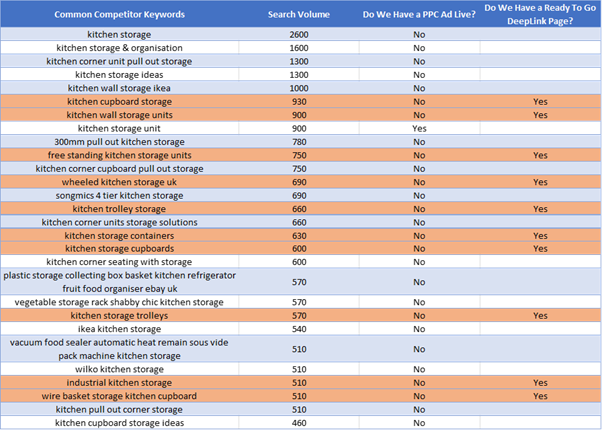
As part of your cost-effective keyword research, it’s important not to forget about the power of competitor analysis. Having a list of 5+ competitors allows you to utilise research tools such as SpyFu and ahrefs to discover the PPC and SEO keywords that your competitors are displaying for.
Export these into an excel document, and filter out the keywords that more than 60% of competitors are displaying for. These are the keyword candidates that can and should be tested in your PPC campaigns to drive incremental volume and maximise ROI.
Don’t Forget About Bing
Naturally, a lot of focus and spend will be directed towards Google due to its monopolisation of the market. However, it’s important not to forget about Bing, as it can deliver a high ROI at a low cost – with some smaller budget businesses spending a significant percentage of their budget on Bing due to a lack of competition.
In fact, we’ve seen some clients’ accounts perform much better on Bing than on Google.
The Most Important Step to Maximise ROI
There’s no replacement for regular data-led reviews and adjustments. Whilst the previous steps will help to maximise ROI, constant monitoring of your account is essential to continue to drive growth and remain ahead of the game. As a specialist PPC agency, we regularly review keywords, and audit data frequently to ensure that accounts are running as efficiently as possible. Ideally, as a brand owner, you’d partner with an agency that has the resources to deliver this. However, if you’re looking to audit your PPC internally, these kind of reviews should be carried out on a monthly basis.
Case Studies: How We Maximise ROI
As a PPC agency working across a range of brands from different industries and with varied budgets, we’ve seen that budgets of all sizes can benefit from this approach to maximise ROI.
The Lighting Co
Circus PPC Agency recently began working with The Lighting Co – the UK’s premier lighting retailer – on their PPC strategy, taking over the account at the beginning of Q2 2023 and already seeing some incredible quarterly uplifts in both spend and ROI.
During our first full month of account management, we drove more revenue than in the previous four months combined, making it the highest months for sales in 2023 by 192%. Since then, we’ve further surpassed this record sales month by another 46%. So far, we’ve reduced COS by a whopping 50%, and are continuing to work towards our client’s goal COS.
Comparing Q1 and Q3 2023, we’ve seen:
- 200% spend increase
- 78% ROI increase
- 331% sales increase
- 434% revenue increase
Read more about how we’ve helped our client to drive growth and maximise ROI here.
Spirits Kiosk
Since August 2020, Circus PPC Agency and Spirits Kiosk – a one-stop drinks distributor – have worked together, seeing gradual YOY growth ever since.
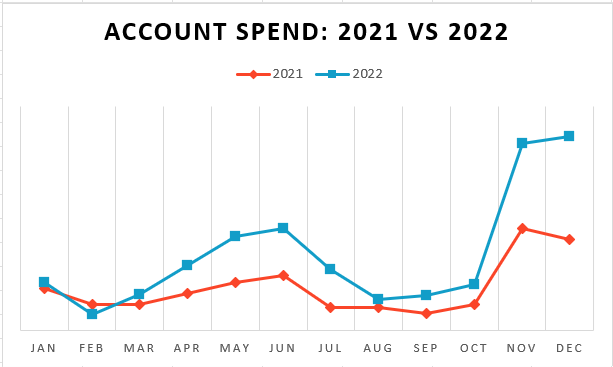
During Q1 2021, we exceeded the client’s ROI expectation by 60%, leading to a 49% increase in spend for Q2. Since then, we’ve continued to deliver on KPIs, driving growth for the brand and to this day still work on the account – which has hugely increased monthly spend over the past couple of years.
The growth we saw when comparing our first full year of work in the account (2021), and our second year (2022) included:
- 36% ROI increase
- 78% spend increase
- 143% revenue increase
- 162% conversions increase
Essentially, proving ROI for Spirits Kiosk drove business growth and helped the client to better trust the results that can be garnered from PPC, leading them to increase budgets and continue to grow.
Final Thoughts: Maximise ROI Optimisation with Limited Funds
Understanding and applying the most effective methods of budget management when it comes to set budgets within PPC can be a long, and often tedious, process. However, it takes an intricate and detailed strategy to work with set budgets without wasting spend.
Unlike bigger or uncapped budgets, there’s much less room for error than limited budgets, so getting it right first time and then staying on top of the developing data trends is important in order not to waste budget and resources.
This can be achieved internally through structured and repeated diligence on a monthly basis, but having expert guidance from experienced professionals will save you time, effort, and money in the long run due to the knowledge needed to develop an intricate strategy that works for you and your business in the ever-changing landscape of PPC.
What To Do Next
Stay Up To Date
We publish expert guide content like this every month. Follow us to stay up to date: LinkedIn, Facebook, Instagram
Let Us Help You To Maximise ROI
Everyone is busy – if you are stretched too thin to be able to audit your own activity, let us help! We offer a complimentary world-class PPC audit that will benchmark you against 15 key pillars of PPC success. It’s packed full of actionable insights and will categorically highlight your areas of PPC inefficiency and opportunity, getting you on the road to better ROI. Contact us now to find out more.
PPC Tips For A Successful Strategy
There are a number of different techniques behind a successful marketing strategy – one of the most effective being PPC. However, it’s essential to know the best practices and PPC tips behind creating a strategy that can assist in driving sales, revenue, and growth for your brand.
Ahmed Chopdat, Commercial Director at Circus PPC Agency, shares just a few of his countless tips and learnings during his career.
Ahmed’s Top 10 PPC Tips
1. Don’t get SEO and PPC confused
Many people confuse SEO and PPC, which leads them to missing out on the opportunities offered by PPC experts. Whether you have an in-house team, work with a full-service, or work with a specialist agency – be sure that they are fully aware and clear on the differences between SEO and PPC, and why PPC in particularly is an important individual component of a marketing strategy.
2. Work with an expert
Finding an expert to manage your account is crucial. PPC is a very complex subject and needs an expert approach to drive real results. Don’t leave your marketing to chance!
If you had a really nice car, would you trust yourself to manage it? There’s no doubt you’d get the job done with huge investments of both time and money, however would it be at the same level as an expert whose job is to do this all the time?
3. Make sure the PPC specialist you’re working with is ACTUALLY a specialist
Many people, including the likes of web developers or marketing generalists, claim they know how to set up an effective PPC strategy. However, generalists are not PPC experts – so be wary of a “know-it-all” approach. You wouldn’t put a professional footballer in your all start cricket team no matter how great they are at football.
4. Prioritise detailed reporting
For an effective PPC strategy, you need detailed reporting, so make sure that your agency offers this. It’s also important to ensure that you maintain access to your accounts. In the past, I’ve seen reports that simply state the amount spent on PPC, with the amount made back – which isn’t enough to know what is and isn’t working. At the bare minimum, ROI should be provided on PPC specifically.
5. Ensure your website is ready
Ensure your website doesn’t contain errors, is fully updated and has been completed. If your website can’t handle the traffic driven by PPC, then investing in this type of marketing is a waste of money for now. However, improving your website is an ongoing project.
6. Have KPIs in place
If you don’t have KPIs in place, there is no way of measuring the success (or failure) of an account – or anything for that matter! Setting a KPI should come from considering your business needs, and you and your team should understand why it has been set. Rather than choosing a KPI for the sake of it, make sure it’s something that is beneficial for profitability and business growth.
7. Set a budget
Always agree on a budget! A good agency will work with your budget, but a great agency will discuss budgets and realistic, achievable results, even if you don’t go to them with a set budget in mind. Keep an open mind and keep some budget spare for the good months. Some months, performance could increase significantly, and with more budget comes the opportunity to drive even better results.
8. Take a hard look at your ad copy
Effective ad copy is crucial for any PPC marketing strategy, and should always be targeted to your audience to deliver your message loud and clear to the right people. Also – it may sound like ad copy 101, but it’s important to avoid spelling mistakes – which never look great.
9. Nail down PMax
Performance Max has combined a lot of the previously separate strategies, meaning that the way you think and manage campaigns is very different now. Previously, you might have had separate search and shopping budgets, but unless you go ‘old school,’ this isn’t realistic anymore. Make sure you’re aware of the changes that have come with PMax so that you understand how campaigns are effectively managed.
10. Test, Test, Test
Testing is integral, and can spell the difference between a quickly progressing account, and a stagnant one. Preferably, have a separate budget for testing alone to ensure that it remains a priority. Sometimes, testing might reveal some things that are unexpected and go against your original beliefs about the account, but in the long run, will be extremely valuable for the progress of your account.
These are just a few of the PPC tips that can be utilised to ensure that your PPC account is best set up for growth, and there are many more things that would give help your progress your business, and your PPC account performance, even further.
For more information and PPC tips, visit the Circus PPC blog here.
5 Reasons Why You Should Hire A Specialist PPC Agency
As the age-old saying goes, ‘a Jack of all trades is a master of none,’ which in some cases, can work just fine, and allow businesses and individuals to branch out and increase their service offering.
However, when it comes to the growth and success of a business, is working with anyone less than an expert a risk you’re willing to take? We’re here to tell you why working with a specialist PPC agency can yield results that you might not be able to see elsewhere.
1. Specialists Are… Specialists
Would you hire a handyman to fit your boiler?
One of the reasons why those working with specialist PPC agencies see such impressive results is because specialist agencies are exactly that – specialist. Due to their experience across a number of different accounts and challenges, they are incredibly knowledgeable, and incredibly good at what they do.
For brands and companies that are looking for specific results in PPC where they might need help, a specialist PPC agency can work closely with clients on that single area and drive them towards success.
2. Industry Expertise
Due to their extensive experience in PPC alone, specialist PPC agencies remain up-to-date and aware of the changes and trends that might be going on in the industry. This gives them a leg up when it comes to testing new technologies and finding ways to help grow client accounts more effectively.
Recently, we conducted some testing within one of our high-spending, high-profile client accounts – find out more about the work we did here.
3. Trusted Partnerships
Specialist agencies PPC work closely with fellow agencies who specialise in other marketing sectors such as SEO, web development, design and more – and can refer their clients to trusted and talented experts that can help them to drive success across all aspects of their marketing.
For some who require expertise across multiple aspects of marketing, working with multiple agencies might sound daunting. However, individual specialist agencies can both provide more accurate reports on attribution, and work closely with fellow agencies to inspire the best possible growth for clients.
4. Wider Support Network
Clients working with a specialist PPC agency can be sure that even if their account manager isn’t available – the entire team are experts in PPC that support one another to deliver the best possible service. Close communication and a transparency within the agency means that the whole team are kept updated with what’s going on across each and every account, and are able to provide support to colleagues where needed.
5. The Proof Is In The Pudding
Still not convinced that working with a specialist PPC agency is the best route for you? Let us prove it to you.
We began work with a retail client of ours in July 2022, taking over the account from a full-service agency.
Q3 2022 (Jul-Sept) was the best performing quarter on record, which compared to the previous period (Q2 2022) saw a 73% increase in sales, £100k increase in revenue, and an average ROI of 5.7x, compared to 5.3x.
In addition, we saw the highest performing month on record in October 2022, which saw milestones including:
- Highest revenue on record;
- Highest AOV since over a year prior (September 2021);
- Increased sales on previous month by 22%;
- YOY ROI increase from 3.1 to 7.9.
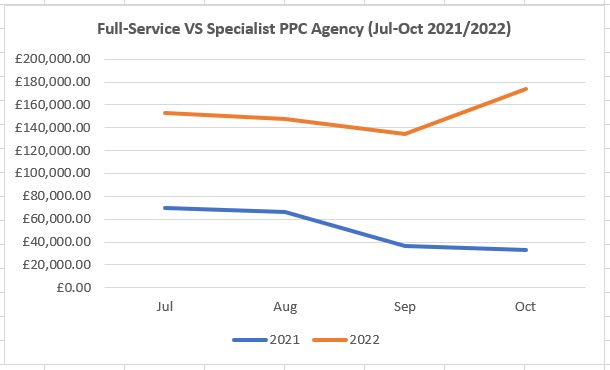
Since October, we’ve continued to see huge improvements within the account and in H2 2022, we saw overall revenue of £625,000 – an increase of 116% YOY.
During January 2023 alone, the account has seen their biggest sales on record, which is currently 22% higher than the account’s previous highest sales month, and has driven the second-highest revenue month on record so far.
So, whilst we may be a little bit biased, if you are on the market for some expert PPC management, look no further than a specialist PPC agency. From fantastic communication and close relationships with fellow agencies, to the ability to closely track attribution and test new methods using industry knowledge and expertise – specialist PPC agencies can help you to grow your business and reach your business goals.
For more information around how a specialist PPC agency can help to take your business to new heights, contact us at info@circusppc.com or call 0113 887 7285.
Meet The Team – Abbie
During the pandemic, PPC Manager Abbie was the first, and remains the only member, of the Circus team to work fully remotely down in London! We caught up with Abbie to find out more about her likes, dislikes, PPC pet peeves and more!
Get to know Abbie here…

Name: Abbie Hampson
Date Started at Circus: August 2018
What first made you want to pursue a career in PPC?
Doing an English literature degree made me want to get into marketing, and I thought I’d be able to write some epic copy. Little did I know that the part of the job I’d actually begin to enjoy more would be the numbers and the stats!
What’s your favourite thing about working at Circus?
Obviously the team, but that goes without saying. On a personal level, the support given to me by the directors and the team when I decided to go fully remote was amazing.
Who is your dream client?
Gotta be Nintendo – maybe they’d give me early access to Breath of the Wild 2? 👀
If you could solve one PPC issue forever, what would it be?
Tracking is a big one, and I know everyone says that. I’d also love to be able to see all our search terms again but I think that’s a thing of the past now ☹
What’s your dream holiday destination?
Caribbean island hopping is on the bucket list!
What would your desert island meal be?
Okay, I’m gonna go full Off Menu for this one. Anyone who knows me knows I’m thinking about food approximately 80% of the time so won’t come as a surprise. Don’t worry, I wont bore you all with the drinks pairings (although best believe I have em!!!)
To start lets do some chicken wings… specifically the fish sauce wings from Smoking Goat in London. Then would be a big bone in ribeye, done to medium rare, with a side of creamed spinach, beef dripping chips, Roquefort sauce…. Anyone else drooling? Just me?
Then a classic finisher would have to be some sort of set custard situation… crème brulee, flan, anything. Maybe one of each? Can I have cheese too? It is a desert island after all. I gotta fill up – god knows when my next meal will be.
Tell us something about you that might surprise people.
I went through a huge pop-punk/emo kid phase between the ages of about 10 and 14. We’re talking full length fingerless gloves, THAT black and white checkered scarf (IYKYK), skinny jeans in every colour under the sun. Still know all the words to most of the My Chemical Romance/Fall Out Boy/Panic! At The Disco catalogue.
If you could guest star on a TV show, which one would it be and why?
I would guest star on the news, having won the lottery. So that I could win the lottery.
Home or Office?
Office
Morning or Evening?
Evening
Dog or Cat?
Dog
Countryside or City?
City
Spender or Saver?
Spender
Coffee or Tea?
Coffee
Summer or Winter?
Winter
Remote Work Diaries: Abbie Hampson
Remote work, as a result of the pandemic, has become a staple in the way that many businesses work, and since then, has continued to introduce more flexibility into the way that team members can and want to work.
Abbie Hampson, PPC Manager at Circus PPC Agency, talks about how the pandemic changed the way she works completely, and how Circus supported her in moving fully remote and how she handles working remotely on a permanent basis.
Please detail how you came to work remotely/how Circus supported this/how this helped you in both your professional/personal life at the time?
During the pandemic, like the majority of other businesses, our entire company went remote. We’re lucky to work in an industry where almost all of our work – except from face-to-face meetings – can be conducted online, so the move was relatively seamless.
For me, it changed a lot and as I grew up in London, the pandemic made me really miss my family down there. My younger brother was only 5 at the time, and I felt like I was missing out on a big part of his life. A few months after we went fully remote, I approached my manager to ask whether it would be possible for me to move home but continue working for the company, and work remotely on a permanent basis. They were super supportive and encouraged me to go, which made me feel so valued as an employee.
How have you set up your personal space to help you to work comfortably and productively? What did this entail?
I actually move around the flat quite a lot depending on the season and how I’m feeling. In the winter, we have an office upstairs that stays nice and cosy and warm, but in the summer, I like to move downstairs into our living room for a bit more natural light and a lovely breeze. I find that having different workspaces in the house helps get me motivated and a change of scenery can really help creativity.
How do you ensure that you stay connected to colleagues/motivated when working by yourself?
One of my favourite parts of the month is travelling up to Leeds to see the team – which is definitely one of the best ways to remain connected to the team. I also make sure I’m really present on office group chats, getting involved in social planning, chatting with team members and offering help/advice when people need it.
What does a day in your life working from home look like? Is there anything that you prioritise as part of your daily routine?
I usually start the day around 8am with a coffee, pottering around and attempting to properly wake up. Depending on the day, I’ll usually have at least one Zoom call, which motivates me to make sure I don’t look half asleep.
There are also two main things I make sure to prioritise during my day. One is going for a lunchtime walk with my mum and her dog. Family was the motivation for my move, so I’m glad I get to see her and spend time with her every day. The second is making an elaborate lunch afterwards… I earned it right? Plus, you can’t have a homecooked two-course lunch in the office, can you now?
What steps have Circus taken to help you to settle into remote working?
Circus have been amazing with helping me settle into remote working in a different city from where the agency is based. When I first moved, they gave me some budget to buy office essentials such as a chair, desk, laptop stand etc.
I’m also lucky to have paid travel up to Leeds on a monthly basis to spend quality time with the team and get involved in social events outside of work. In terms of how I’m supported on a daily basis, all of the agency’s important meetings are done over Zoom so I can always be involved, and I’m often involved in projects that purposefully get me talking to other team members.
Is there anything you miss about working in an office?
My setup us a bit individual as I’m the only completely remote worker. I do miss being in the office with everyone, and the team spirit that comes with being all together. It can be a little bit lonely when you’re the only one dialling into a Zoom call when everyone else is in the office. I also miss going for a pint after work!
What advice do you have for anyone that might be struggling with remote work?
I’d say the most important thing is to reach out to your team and lean on them for support. It can feel a little bit lonely at times, and if you’ve changed from being office-based to remote work, it can be a bit of a culture shock! Staying in communication with your team means can really help to dispel those feelings of loneliness and support your setup.
Our hybrid working model is ‘work from anywhere’ – which means that if it’s all getting a bit quiet and I need some outside inspiration, I’ll take myself to a coffee shop or even to a friend’s house who also works remotely. Having a change of scenery sometimes can really help.
How has having the flexibility to work remotely benefitted your life both in and outside of work?
The level of flexibility that I have at work has made me much more efficient, and no longer having to commute means that I can get things done during the day that I might not have had the time to do before. I eat much healthier (no Greggs near me for a cheeky elevenses sausage sarnie), exercise more frequently, and in general, feel a lot better in myself. I’m also much more proactive with getting in touch with the team, and feel motivated to create more meaningful relationships than just relying on proximity within the office.
What are your predictions for the future of remote work? Why do you think it’s important for businesses to be more flexible when it comes to remote and hybrid working models?
For me, working for a company that embraces hybrid working has improved almost every aspect of my life, so I do hope that more businesses look at how they can use a hybrid working model to benefit their team.
It’s also a great perk that more and more people are looking for and unwilling to compromise on, so in terms of hiring, I’d say its important to take into consideration if you want to attract the right talent. It’s definitely one of the things that a lot of our recent hires have said attracted them to the company.
Meet The Team – Ahmed
Ahmed Chopdat, Commercial Director at Circus, has been working at the agency for over 10 years, and is known amongst the team for his love of chips and car snacks – we spoke to Ahmed about all things PPC, dream holiday destinations, and of course, desert island meals!
Find out more about Ahmed here…

Name: Ahmed Chopdat
Date Started at Circus: March 2012
What first made you want to pursue a career in PPC?
I landed in PPC by chance when I was actually pursuing a career in design and dev but quickly realised I found that way too boring and actually prefer to deal with numbers and spreadsheets.
What’s your favourite thing about working at Circus?
Too many to chose just one but the team, the culture, the excitement for the future and the ability to be able to navigate this ship quite easily still whilst we are still a fast growing agency.
Who is your dream client?
I have so many! I was in talks with Man Utd at one point before the contact left which would have been a great client. Household brands are great to work with too.
If you could solve one PPC issue forever, what would it be?
Tracking is the obvious one however in the current climate, it would be good to find a way for everyone to understand that cutting your marketing costs is actually going to have adverse effects, contrary to popular belief.
What’s your dream holiday destination?
I love an all inclusive holiday where I can just relax in one place. However, more recently, nature walks are appealing – but I’m still going to go with anywhere warm which is all inclusive.
What would your desert island meal be?
I would avoid going to a desert island as it wouldn’t be all inclusive 😊 Assuming I can eat as much as I want – a nice juicy beef burger, a couple of samosas and seekh kebabs, a couple of slices of pizza and chicken masala with naan. And of course, anyone who knows me knows I love a side of chips.
Tell us something about you that might surprise people.
I am in various classes 5-6 days a week, learning a language, memorising the Quran (which isn’t easy at this age), learning the translation with the background of where and why each verse was revealed.
If you could guest star on a TV show, which one would it be and why?
I was hooked to both Suits and Mad Men at one point so one of them (although they stopped making both of them now).
Home or Office?
Depends on the day. I love to just wake up and decide where I will work on that day.
Morning or Evening?
Evening
Dog or Cat?
Cat
Countryside or City?
Depends on my mood on the day. Can you ever only choose one?
Spender or Saver?
I like to think I am a saver with days where I go crazy with spending.
Coffee or Tea?
Coffee
Summer or Winter?
Both. Depends where I am on the day. If I am at picnic obviously summer. If I am busy in the office, I love a bit of rain (also nature needs its water).