


Last year, global marketing spend saw a decline, with many businesses looking to cut budgets, and reducing marketing spend as a result. It’s true that marketing can be expensive, however by looking at your current PPC budget efficiency, it’s possible to save money without completely cutting out one of the most successful sales-generating channels.
PPC, unlike other marketing channels, is extremely tangible, with platforms able to report on exactly where budget is being spent effectively. Or more importantly, where budget is being spent ineffectively.
Through consistent analysis and optimisation, PPC can be an extremely cost-effective way to continue marketing your brand and see heightened return-on-investment.
Discover where your PPC budget efficiency could be improved with a free account audit.
The Cost-Saving Potential of PPC
The transparent nature of PPC means that we are given insights into what’s going well, and also what isn’t. These insights allow brands and advertisers to recognise where budget is being wasted, and where it can be better allocated to improve efficiency. In addition to these insights, there are a number of best practices and possibilities that allow for optimal PPC account health.
Precise Targeting
Effective targeting is crucial to ensure that every pound spent is directed towards reaching the most relevant and high-intent audiences, reducing wasted spend on uninterested users.
Using demographic and geographic targeting can filter audiences by location, age groups and user behaviours, whilst utilising keyword targeting allows you to use high-intent, long-tail keywords so that only those actively searching for your product or service see your ads.
Additionally, audiences segmentation allows retargeting to previous site visitors, and segmenting audiences based on behaviours such as cart abandonment can often lead to heightened CVR.
Budget Control
Being able to see where budget is being spent effectively, and where it’s being wasted, means that brands and advertisers can optimise accounts reactively, taking budget from where it might go to waste and reallocating it to high performing areas.
Additionally, daily and lifetime budget caps are in place to ensure that your ads spend only what you want them to, with the ability to change these caps when necessary.
Testing & Optimisation
Ever heard the phrase ‘try before you buy?’
PPC allows for testing, and whilst some additional budget is required to go towards trialling new strategies, it’s an effective way to explore previously untested strategies and activity that could work for your account.
Without testing, it’s hard to uncover the true potential of your marketing as there could always be something out there that works even better than what you’re already doing. And hey, if you find out something doesn’t work, it means that no additional budget needs to be put towards it!
Key Metrics for Budget Efficiency
Certain key metrics indicate how well PPC is performing, and the continuous measurement of said metrics provide insights to brands and advertisers around account changes that might need to be made to increase budget efficiency.
CPC
CPC (or cost-per-click), is the amount of budget used each time someone clicks on a PPC ad.
Lower CPCs mean that you’re getting more traffic for less money, whilst higher CPCs could indicate high competition or inefficient targeting. Regardless of whether CPCs are high or low, focussing on the quality of traffic from PPC ads is essential to drive conversions.
By optimising keywords, improving ad relevance, and adjusting bidding strategies, CPC can be reduced whilst driving and maintaining traffic quality.
Conversion Rate
Conversion rate is the percentage of users who complete a desired action after clicking an ad. Depending on the business, some examples of this could be making a purchase, submitting a form, or signing up to a newsletter.
The higher your conversion rate, the more value you’re getting from your ad spend, whereas if conversion rates are low, this highlights potential issues with ad messaging, landing pages, or audience targeting. Once these issues have been identified, optimisations can be made to improve conversion rate and in turn, increase budget efficiency.
ROI
ROI (or return-on-investment) measures the revenue generated from PPC spend. For example, if you spend £100 on ads that generate £500 in revenue, this is a 5X (or 500%) ROI, as you’ve made back 5 times as much money as you’ve invested.
Often, brands have a specific ROI they want to meet in order to be profitable, and ROI is a good indicator of whether PPC is performing efficiently – as it shows exactly what return is being made from PPC efforts.
Want to see a better ROI? Contact us for a free account audit.
Real Examples of Efficient PPC Campaigns
Last year, Circus PPC worked with Booths, a luxury supermarket chain based in the north of the UK.
For Booths, the festive period is extremely busy, and they utilise PPC to promote specific online services available during this time.
By focusing on budget efficiency and making the most out of a lower yearly spend, Circus were able to drive impressive improvements to Booths’ PPC performance, including YOY increases in ROI (return on investment), AOV (average order value), CvR (conversion rate), and revenue.
Daily optimisations and precise targeting put the account in optimal health, driving relevant and intentional traffic, and ultimately leading to a YOY ROI increase of 96%, despite a 29% decrease in spend.
Read more about how we drove budget efficiency to increase ROI for Booths here.
Final Thoughts: Optimise for Better Results
By regularly analysing and optimising your PPC campaigns, you can maximize efficiency and reduce waste without cutting a key sales-driving channel. With its clear measurability, PPC offers a cost-effective way to maintain brand visibility and achieve a strong ROI, even in a tighter budget landscape.
Ready to take your PPC strategy to the next level? 🚀
Register to download our free budget efficiency focussed whitepaper for expert insights and techniques to optimise your ad campaigns and make your PPC budget work harder for you!
How To Find The Right PPC Keywords
PPC keywords are the bread and butter of a PPC campaign, and a great keyword strategy can be the difference between high-performing campaigns that drive awesome results, or budget-wasting ads that aren’t performing to standard.
We’re giving you a sneak peek into our Comprehensive Guide To PPC Keywords, which explores all things keyword-related and essential to drive the results you want to see from your paid search efforts.
What Are PPC Keywords?
At the core of every successful PPC campaign lies a crucial component – PPC keywords. These keywords are the backbone of your paid search strategy, helping your ads show up when users search for specific terms related to your business.
Understanding how to choose, optimise, and leverage PPC keywords can make or break your campaign’s success. But what exactly should you be doing to find and optimise the right PPC keywords to drive traffic and boost conversions? Let’s dive in!
PPC Keyword Basics
So, where should you start when first crafting your PPC keyword strategy?
Keyword intent, match types, and keyword relevance all play a huge role in ensuring your keyword strategy is up to par.
Understanding Keyword Intent
Keyword intent is one of the most important factors to consider when crafting your keyword strategy for PPC. The intent of the keyword, sometimes referred to as search intent or user intent, represents the reason for the user’s search and the results the user expects to find with their search.
Keywords fall into four main categories for intent – informational, navigational, commercial, and transactional.
| Informational | Users are looking to learn about a certain topic, such as ‘what is an MOT?’ |
| Navigational | Users are looking for a specific webpage or address for a location such as ‘Mikes garage MOT address.’ |
| Commercial | Users are researching their options and gathering necessary information to make an educated decision such as ‘best value MOT garages,’ or ‘average price of MOT.’ |
| Transactional | Users are looking to take a specific action and are ready to make a purchase, such as ‘book MOT test Dewsbury.’ |
As we move down the above categories, we see the different part of the sales funnel, with users more likely to take action or ‘convert’ in the commercial and transactional intent phases.
In our latest whitepaper, we discuss how you taking intent into consideration when conduction your keyword research can help you to best meet your business goals and objectives – find out more here.
Ultimately, understanding the intent behind different keywords and keyword types can be hugely helpful when it comes to targeting the right audience.
PPC Keyword Match Types
Keywords can be added to ad groups as 3 different match types. The match types dictates how closely a search term needs to match the keyword for the ad to be considered in the auction. The match types are Broad Match, Phrase Match, and Exact Match.
| Broad Match | Broad Match keywords are the most flexible and allow Google to use intent signals, landing page content, and other data points to determine when your ad will be considered in the auction. For example, a broad match keyword such as ‘pink trainers’ will trigger for the same searches as phrase and exact match, plus a wide range of other terms including ‘sports trainers for women,’ ‘comfortable trainers under £200,’ and ‘trainer store UK.’ |
| Phrase Match | Phrase Match keywords allow for a little less flexibility and can trigger ads to show for keywords that include the meaning of of your keyword. For example, ‘pink trainers’ will trigger for the the same searches as exact match, plus ‘trainers for tennis pink,’ ‘sports sneakers,’ and ‘comfortable pink shoes.’ |
| Exact Match | Exact Match keywords are the most strict, with ads only showing search terms that match or have the same meaning as the keyword. For example, ‘pink trainers’ will trigger for that exact keyword, or small variations such as ‘trainers pink’ and ‘pink sneakers.’ |
Keyword Relevance For Quality Score
Keyword relevance is one of the three key components of quality score, which is an extremely important tool giving advertisers an indication of how well their campaigns and website match with keywords.
Quality score is calculated from three core metrics, which are:
- Ad relevance: how closely your ad matches to what the user is searching for (keyword relevance)
- Expected CTR: how likely users are to click on your ad when shown
- Landing page experience: how relevant and useful your landing page is for the user once they have clicked on your ad
Each of these metrics can be optimised to obtain a higher quality score, which in turn, can lead to a better ad rank, higher position and increased ad performance.
Optimising PPC Keywords
So, you’ve done your research and found your keywords – now what?
High-performing keyword strategies are constantly being monitored and improved, refined and updated – all to ensure that the right keywords, reach the right people, at the right time.
Keep on scrolling for some of the ways that you can optimise your keywords to drive the results that you want to see.
Strategies To Refine PPC Keywords
There are so many strategies and preferred ways of working when it comes to developing a keyword strategy, so we’ve shared just a few of the ways in which you can work on refining your strategy to best drive performance.
Monitor Keyword Performance
Regularly check the performance of your keywords to avoid budget being wasted on keywords that aren’t performing, and just as importantly, to allocate additional budget to keywords are driving conversions. If a keyword hasn’t converted but is showing a high CPA, low ROI, or is still spending your budget within timeframe that doesn’t add up to your forecasted trends, make sure these are paused as to not waste any more resource on underperformers.
Avoid Keyword Cannibalisation
Don’t add the same keyword to multiple ad groups. If you do, these keywords can compete against each other in an auction and drive up cost-per-click (CPC). It could also cause you to lose track of the performance of that specific keyword, due to performance data being split.
Consider Campaign Goals
Ensure the keywords you’re using are also relevant to the goals of your PPC campaign. For example, if your goal is to increase revenue from selling protein powder through non-branded keywords, include keywords that would indicate that those searching are ready to buy, such as ‘protein powder for muscle gain.’ More specific, targeted searches like these indicate a user with high intent to purchase.
Using Negative Keywords
Of course, targeting the right audience with your PPC campaigns is key – but so is excluding the wrong audience.
This is where negative keywords come into play. Negative keywords are terms that prevent your ads from appearing in irrelevant searches, saving you from wasting ad spend on clicks that won’t convert.
Some of the ways that using negative keywords in your campaigns can help improve your campaign performance include:
- Improving relevance: by filtering out unrelated search terms, negative keywords ensure your ads are only shown to users with genuine interest in your products or services.
- Maximising budget efficiency: instead of paying for clicks that don’t drive value, your ad budget can be allocated more strategically toward potential customers who are more likely to convert.
- Boosts click-through rate (CTR): when your ad appears in relevant searches, it increases the likelihood of clicks from users genuinely interested in what you offer, ultimately improving your CTR and quality score.
By strategically incorporating negative keywords into your keyword strategy, you can refine your targeting, improve your ad performance, and get the most out of your PPC budget.
We talk more about negative keywords and their impact in our PPC keyword guide, designed to help advertisers to harness the power of their keyword strategy and drive results. Download it here.
A Comprehensive Guide To PPC Keywords
This Q4, we’re leaving no stone unturned and revealing our top PPC tips, tricks, and tactics!
Introducing ‘A Comprehensive Guide To PPC Keywords’ – containing all of the insights you need to have your keyword strategy one to go down in history. Put together by our experienced team of PPC experts, it has everything you need to craft a performance-driving, conversion-boosting keyword strategy.
And we’re sharing it… with you… for free… no strings attached!
Download your copy here.
Black Friday PPC and SEO: Guest Blog
Adam Foster, Director and Founder of Proper Mint Marketing and SEO consultant, talks about the importance of aligning your PPC and SEO strategies – especially during seasonal periods – to drive the results you want to see.
Top Tips To Align PPC and SEO
Utilise shared keyword research from PPC conversions – and look to optimise your black friday pages based on this data where relevant. If you have multiple black friday pages for PPC, make sure they’re canonicalised to your main SEO page. You don’t want duplicate pages and keyword cannibalisation.
Find out more about how you can elevate and align your Black Friday PPC strategy here.
PPC and SEO: Things To Consider
So many brands leave this till last minute. It’s common to hear that marketing planning for Christmas begins in Summer for big brands. But when it comes to Black Friday SEO, i’ve worked with so many businesses who only start to think about creating content the week before. This simply is not enough time. My advice would be to have a permanent URL for Black Friday. This can be removed from navigation out of the holiday season. But this URL can build age over years, build links, and can be indeed in Google.
Final Thoughts
Plan early and have blog content linking to your black Friday URL. Continue to build links and market your black friday page year round – every year. Partner with relevant affiliates, influencers and other partners from a link building perspective. If you’re a retailer selling other brands, make sure you have the relevant pages setup to target black friday + brand/product terms. Don’t expect your regular category pages to rank well for Black Friday deals just by adding “black friday” to them. Create dedicated black friday deal pages.
The thought and preparation that needs to go into your Black Friday campaigns is often underestimated, with many people starting later than ideal and also forgetting about cross-channel alignment. By starting early and ensuring that your marketing strategies are aligned, you’re in with the best chance of driving the results you want to see.
As a specialist PPC agency, Circus PPC are well versed in strategising for clients to ensure that they are best set up for success during peak periods such as Black Friday. From cross-channel alignment and effective tracking, to budget efficiency and ad copy – Circus PPC Agency are experienced in helping clients to see desired results, often exceeding expectations.
For more on ensuring your PPC strategy performs effectively during the Black Friday period, download Circus PPC’s Black Friday Blueprint here.
Black Friday PPC and CRO: Guest Blog
Emma Foster, Head of Brand and Communications at Salesfire, talks about how to effectively optimise conversion rates alongside your PPC strategy during seasonal periods such as Black Friday.
What is CRO?
CRO, or Conversion Rate Optimisation, is the method of implementing intentional and specific strategies to best improve the percentage of users who complete a specific action on your website. When it comes to Black Friday, this is usually the act of making a purchase or ‘checking out.’
The Importance of PPC and CRO During Black Friday
To optimise conversion rates for Black Friday success, brands must address abandoned carts effectively.
With a multitude of Black Friday deals across various eCommerce sites, you should implement an abandoned cart email sequence that re-engages shoppers and recovers lost sales.
Offer incentives such as free delivery to entice customers back to complete their purchases, maximising conversion rates during this crucial Q4 sales period. Don’t forget to personalise your emails with product recommendations to make users 4x more likely to complete their abandoned purchase.
You can also take the opportunity to make the most of your Black Friday traffic by displaying on-site messaging that encourages users to share their email addresses for future communication, increasing the likelihood of later purchases. We recommend offering a monetary incentive, such as £5 off, to experience a higher email sign-up rate of up to 8.27%.
Find out more about how you can elevate and align your Black Friday PPC strategy here.
PPC and CRO: Things To Consider
Conversion rate optimisation (CRO) allows retailers to maximise revenue from new customers and make the most of the surge in site traffic during seasonal sales periods. By optimising your site, you can effectively navigate the competitive Black Friday landscape, improve the user experience, and increase conversions during peak traffic season.
Black Friday discounting now begins earlier and lasts throughout November and Cyber Weekend. To fully capitalise on this extended sales period, it’s crucial to distinguish your site from others with an optimised customer journey that responds to individual users’ actions – resulting in increased conversion rates.
Final Thoughts
With 70% of Black Friday 2023 orders coming from mobile traffic, retailers need to ensure these shoppers are at the forefront of their Q4 campaigns this year. Optimise the buying process for your mobile shoppers by making sure the buying process is simple – catering for quick purchases. You can do this by streamlining the path to purchase with product recommendations that connect browsers with their perfect match.
By optimising your website, you can more effectively set up your PPC efforts for success, ensuring that from clicking on an ad right through purchase, customers are receiving a seamless user experience.
As a specialist PPC agency, Circus PPC are well versed in strategising for clients to ensure that they are best set up for success during peak periods such as Black Friday. From cross-channel alignment and effective tracking, to budget efficiency and ad copy – Circus PPC Agency are experienced in helping clients to see desired results, often exceeding expectations.
For more on ensuring your PPC strategy performs effectively during the Black Friday period, download Circus PPC’s Black Friday Blueprint here.
Black Friday PPC and Call Tracking: Guest Blog
Matt McGillicuddy, Head of Growth Marketing at Infinity, talks about how the implementation of call tracking can work alongside PPC to provide additional insights into user behaviour, and how this valuable information can be used to identify ways that the user journey can be better optimised, and customers better nurtured.
What is Call Tracking?
Call Tracking is a way to gain clarity over the online journey customers are taking prior to picking up the phone. This, in turn, helps businesses to make intentional rules and strategy updates to better identify high-intent customers, and approach and nurture them with this in mind.
How To Successfully Align PPC and Call Tracking
With call tracking, you get granular insights into which keywords and PPC ads are generating those all-important sales calls. With this intel, you can plough more resource into the activities you know will generate a return, and press pause on those that won’t, so your precious budget will work harder for you during this critical period.
You can take this a step further with a solution like Infinity’s Smart Match, which accurately links positive sales call outcomes to the PPC ads that drove them. Using this conversion data, you can guide the algorithm to get your top-performing ads in front of more customers that are likely to convert, guaranteeing a solid Black Friday return.
Find out more about how you can elevate and align your Black Friday PPC strategy here.
PPC and Call Tracking: Things To Consider
If we look at the Infinity Hub call data for the retail sector, there have been significant increases in call volumes over previous Black Friday periods with 2023 seeing a 41% increase in call volumes compared to the 2022 Black Friday period. What’s important to note is that, inevitably, not all these calls will be sales enquiries. Because Black Friday is so time-critical, you want to ensure agents are laser focused on converting callers to customers.
With call tracking, you have full visibility over the online journey customers are taking before they pick up the phone. With that intel, you can set up rules to identify the high-intent customers and push them to the top of the queue to complete their sale. On the flipside, you can also use call insight to identify friction points in the online journey to optimise customer experiences and self-serve options online, freeing up more of your agents to close more of those all-important Black Friday sales.
Final Thoughts
Failing to prepare is preparing to fail! Get to grips with what’s driving your most valuable sales calls ahead of the Black Friday deadline so you can ensure campaigns are totally optimised and your budget will work as hard as possible for you. With tools like Infinity’s Conversation Analytics, retailers can get their hands on the unfiltered truth from customers. This helps you understand what’s driving interest as well as highlighting any common doubts or barriers to purchase that might exist This helps you continuously refine messaging to create harder hitting campaigns that will ultimately drive more conversion.
By implementing call tracking, businesses can get a better idea of the pre-call journey that customers are taking, and use this information to best optimise the journey going forward, understanding and nurturing customers effectively.
As a specialist PPC agency, Circus PPC are well versed in strategising for clients to ensure that they are best set up for success during peak periods such as Black Friday. From cross-channel alignment and effective tracking, to budget efficiency and ad copy – Circus PPC Agency are experienced in helping clients to see desired results, often exceeding expectations.
For more on ensuring your PPC strategy performs effectively during the Black Friday period, download Circus PPC’s Black Friday Blueprint here.
Black Friday Ads: Your Strategy Guide
Want to level up your Black Friday ads? There’s no better time than now to do so!
We know that Black Friday is a few months away yet, but the earlier you start planning, the better!
Read on for three of the most important steps when it comes to planning for your Black Friday ads strategy, and hear from our experts about their must-dos and no-go’s for a successful seasonal period.
Three Steps for Black Friday Ads Success
There’s no one-size-fits-all strategy when it comes to PPC, never mind during Black Friday. However, there are a few things that anyone running Black Friday ads should be considering to drive success.
Preparation
When it comes to preparation for Black Friday, there truly is no time like the present.
One of the biggest mistakes made in the run up to Black Friday is leaving planning to the last minute – failing to be prepared is preparing to fail!
Our comprehensive Black Friday Checklist can help you to start the planning process before it’s too late, download it here.
Budgets
Due to the uplift in shopper intent during Black Friday, many businesses choose to invest more in PPC during this period.
In the past, we’ve seen budgets for Black Friday increase significantly in order to adhere to demand and an uplift in buying intent from shoppers, and having these budgets agreed on in advance is important to both drive the best possible performance through budget allocation, as well as making sure that budget doesn’t run out on Black Friday.
Timeframe
Despite Black Friday being advertised as a one-day event, it’s not uncommon for businesses to spread Black Friday activity over a full week, month, or sometimes even longer.
Search behaviour has evolved, and shoppers are doing more research before purchasing than ever before. In the run-up to Black Friday, this research could be the difference between a conversion for your business, or a competitor, so ensuring that you’re visible in the run up to (not just on) Black Friday is essential. Additionally, continuing promotions following the ‘official’ Black Friday period could improve your conversions as you pick up on those who may have missed the peak sales period.
Expert PPC Tips for Black Friday Ads
Having been through the Black Friday preparation period plenty of times already, our experts have shared their tips that will ensure your Black Friday ads are effective. Read on for more.
“My biggest tip for a successful Black Friday would be to not leave preparation for the last minute, because there are so many things you have to align. What are the promotions going to be? How much do you expect to sell? This is to ensure that the client orders the right amount of products to meet that quota. My first conversation about Black Friday this year was in February, which is quite early, but when you take into account all of the months of preparation needed internally to accommodate something as big as Black Friday, then sometimes the conversations have to happen pretty early.”
“My biggest piece of advice for Black Friday would be to get all budgets approved well ahead of time, and implemented as early as possible.”
“My biggest tip for a successful Black Friday would be to get started way earlier than you think. Now more than ever, it’s not just a single day – it’s a month, or sometimes even more than a month. Start looking at your budgets early, start looking at what you want to capture early, and most importantly make sure your tracking is working as attribution can take us back as far as 90 days. Make sure you know what you want to achieve, and that will lead to a key bit of performance over the month.”
“My biggest piece of advice for Black Friday would be to plan your promotions in advance. Make sure you know all the ins and outs of your promotions including when they’re starting and when they end. A lot of people leave it to the last minute, which means that they can’t get a lot of the activity approved that they need to get approved. It’s such a busy time and you want to make sure you’re taking as much real estate up on the search results page as you can.”
What Now?
To get your hands on our exclusive PPC Black Friday Blueprint – jam-packed with practical advice from our PPC experts, real-life case studies, and marketing insights from partners including Salesfire, Lunio, Shoptimised and Infinity – download here!
Google Marketing Live 2024: An Overview
Yesterday evening, marketers all over the globe gathered to tune into the highly anticipated Google Marketing Live 2024. And it’ll be no surprise to anyone that there was a huge focus on… AI.
Now in its 11th year, Google Marketing Live’s first ever focus back in 2013 was the ‘shift to mobile,’ whilst now, we’re faced with the ‘most transformative moment yet’ – the new era of AI and the possibilities that come along with it.
The conference focused on the ways in which different Google products and services are harnessing the power of AI to help consumers, businesses and agencies alike, and how we can make sure we’re ahead of the curve by utilising these new technologies.
Google Marketing Live 2024: Our Top Takeaways
We’ve condensed the event to bring you 5 of our biggest takeaways, and provided our thoughts on how each of the products could help both brands, and advertisers, going forward.
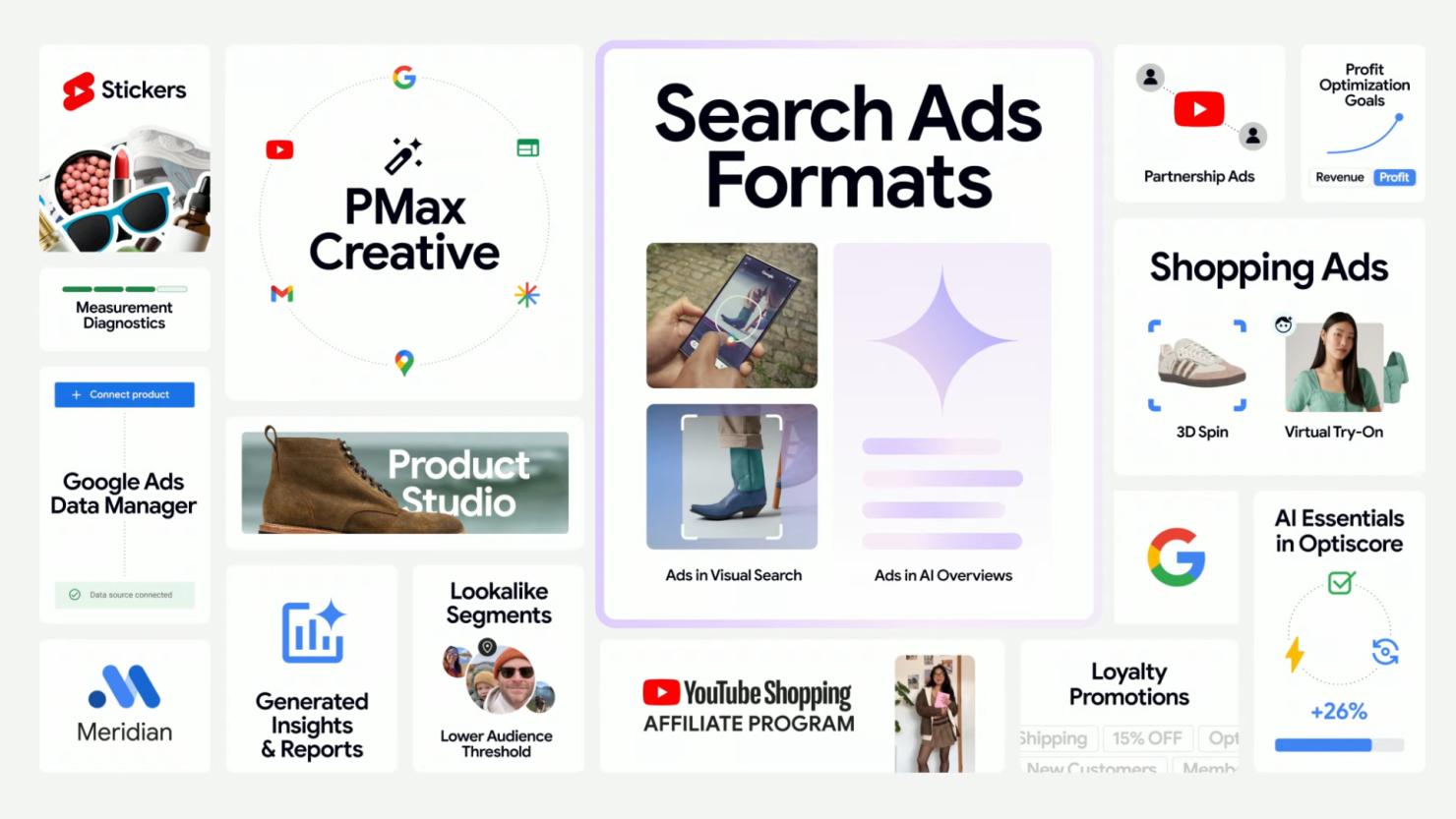
Profit Optimisation
The new ‘Profit Optimisation’ goal for PMax and Shopping campaigns was introduced, with claims that it will help enhance the effects of Smart Bidding to maximise profit, and according to Google, ‘advertisers who use this see a 15% uplift in campaigns compared to revenue-only bidding.’
“Profit Optimisation is something Google have been pushing for a while in terms of understanding which areas companies make most profit, so it’s been a long time coming that profit based goals are now at the forefront of PMax optimisation. It’ll be interesting to see how Google facilitate fleshing out profit margins for individual products to help companies achieve their business goals in the current economic climate. With users researching at the same rate but taking longer to convert, it’s costing companies more to bring users back to site, so focusing only on higher profit products is a great way to combat this.”
Chloe Tetmajeris, PPC Manager
Google Ads Data Manager
Self proclaimed ‘data guy’ at Google, Gaurav Bhaya, spoke about – you guessed it – data, and the importance of good first-party data in order to maximise AI performance. He also announced the rollout of Google Ads Data Manager worldwide, which simplifies the process of bringing first-party data together in one place, redacting the need for manual data cleansing, organising, and uploading.
“The Google Data Manager dashboard will be a huge benefit to us to collect our data in one place quicker than ever. Google’s dashboard is always evolving, making it harder to find what you’re looking for with every update. The slight increase in visibility to PMax performance alongside this this will also be beneficial, and having quicker generated insights will help with all areas of management. However, as with any AI tool, I believe the prompts and requests will need to be finetuned, which is where we’d come in to make it work.”
Ru Watt, PPC Analyst
Brand Profiles
Going back to the constant evolution of the way consumers search, it was revealed during GML that ‘60% of search queries include the brand name.’ Brand Profiles focus on a higher level of customer engagement during the shopping process, allowing brands to showcase their ethos through images, videos, reviews, deals, shipping and more, with ads continuing to appear alongside these profiles.
“Brand Profiles are an interesting new feature, and are slightly reminiscent of Amazon Storefront. Brands will be able to highlight key merchant information on Search, featuring brand imagery, videos, customer reviews, deals, and more. Advertisers who take the time to curate their Brand Profile will hopefully build more trust with their customers and create a better online shopping experience.”
Meg Wilson-Taylor, Operations Manager
Shopping Ads
The way Shopping ads work have been further revolutionised, with features such as ‘3D spin’ and ‘virtual try-on’ introduced to drive engagement, as well as ads highlighting key attributes from descriptions and reviews.
“New advances in Shopping ad functionality means that companies are going to need to provide more interactive video assets to ensure they’re not left behind. Users want to see products and even try them on virtually before they buy – mistakes could be made if companies underestimate the power of creative assets that could be pivotal for the future of Shopping ads.”
Chloe Tetmajeris, PPC Manager
YouTube Shopping
Google stated that ‘in 2023, people watched over 30bn hours of shopping-related videos on YouTube, a growth of 25% year-on-year.’ Now, YouTube has made it possible for creators to tag products in their videos, shorts and live steams, and alongside this, have partnered with Shopify to eventually allow Shopify merchants to connect their product catalogue to YouTube shopping. This will provide better insights into the creators and products that are driving sales.
“The video content market is huge as evidenced by stats given by Google, so to enable shopping feed integration is massive. Having this as a tool to offer clients generative feed placements, reverse image search and video snippets will be a boost to sales and platforms with deliverables on quick to purchase ecommerce products. Combined with higher quality first-party data captured across the board, online shopping will change drastically.”
Ru Watt, PPC Analyst
What’s next?
Towards the end of the conference, we heard some final thoughts, with the core message that AI isn’t going anywhere, and that there still needs to be a mindset shift when it comes to the way we work alongside AI.
Whilst it’s no surprise that this year’s event was heavily focussed on AI and its capabilities, we were waiting and left wanting for a little more around the daily issues we’re facing as advertisers, such as high CPCs. The event was also honing in on solutions for travel and ecommerce businesses, and limited in terms of lead generation updates.
Despite not getting everything we wanted from this year’s conference, the deep-dive into both AI and data painted a clear picture of the direction that Google continues to move in, and it’s time for advertisers and brands to strap in and utilise the technologies available to see the best possible results.
We’ll leave you with a final quote from Google Marketing Live 2024, which I’m sure will resonate with many as we go forward and put everything we’ve heard into practice.
‘The secret to getting ahead, is getting started.’
PPC Strategy 101: Setting PPC Goals
Whether you’re starting from scratch, or looking at implementing a new and improved strategy, there are a number of factors that can help you to understand how to reach your PPC goals.
From budgeting and audience targeting, to keyword research and testing, we’ve helped scale and grow hundreds of brand accounts, helping them to reach their PPC goals and even win an award or two along the way.
Now, we’re sharing our insights for success, and in this first instalment, discussing the key components of a successful strategy, and what your first steps should be as you start planning.
Key components of a successful PPC strategy
Every strategy is unique, but there are some components that can be applied across all accounts and can help to drive your business forward. We’ve defined ten steps to success:
- Understanding PPC account strategy
- Setting goals and objectives
- Audience targeting and persona development
- Keyword research and selection
- Ad copy and creative development
- Budget allocation and bid management
- Landing page optimisation
- Tracking, measurement and analysis
- Testing and iteration
- Scaling and expansion
Getting to grips with these areas will help you on the way to a successful strategy that delivers your PPC goals.
Before anything else, understanding strategy and defining said goals should be at the very top of your to-do list when it comes to implementing a successful (and maybe even award-winning) PPC strategy.
Defining short-term and long-term PPC goals
PPC, whilst known for being able to drive quicker conversions in comparison to SEO, shouldn’t only be considered as a short-term strategy or ‘quick fix.
In fact, laying solid foundations for a long-term PPC strategy is a great way to make sure that your account is set up for success, and can deliver both quick wins and sustainable growth.
For example, having worked with our client, Miele, since 2015, we considered both short-term and long-term goals, remaining focused on their core goal of improving ROI and driving business growth. Some shorter-term goals have included testing new strategies, measuring specific KPIs, and adapting to market fluctuations, peak seasonal periods, and changing consumer behaviour and demands. All of these short-term goals helped us to build a strong foundation for the account, which then led to performance improvements over time.
Miele Account Manager, Donya Broadhead, spoke about the importance of understanding the client’s account through initial short and long-term goal setting:
“The first and most important task for me was to understand what Miele wanted from their PPC strategy, which then helped me to make suggestions to reach their desired goals. Our long-standing relationship with this client means that we’ve not only seen wins over shorter periods such as Black Friday or peak sales, but also incremental growth over a number of years. It also means that we better understand our client’s market and industry, and have adapted where the client needs us to in order to deliver the best possible results.”
Getting Started
Our most recent whitepaper dives into the ten steps to success, with advice and insights from our team of PPC experts, practical guidance on how to implement your own strategy, real-life examples of success, and so much more. Get your copy here!
Creating An Award-Winning PPC Strategy
What’s the best course of action when it comes to creating a successful, or even award-winning, PPC strategy?
From budget allocation to goal setting, and keyword research to tracking – we’re here give you an overview of the ten areas of importance you need to know about when it comes to creating an award-winning PPC strategy.
Why PPC?
Many businesses see significant improvement in revenue, sales, and return-on-investment after implementing a PPC strategy, and alongside the use of other marketing channels and strategies, PPC can be an essential ingredient in a recipe for success.
In our latest whitepaper, we’ll be deep-diving into our work with high-end household appliance brand, Miele, and how we helped them to drive profitable growth with award-winning PPC strategies.
Our Guide To A Successful PPC Strategy
Keep your eyes peeled for upcoming whitepaper, where we’ll walk you through our ten steps to developing a successful PPC strategy:
- Understanding PPC Account Strategy
- Setting Objectives and Goals
- Audience Targeting and Persona Development
- Keyword Research and Selection
- Ad Copy and Creative Development
- Budget Allocation and Bid Management
- Landing Page Optimisation
- Tracking, Measurement and Analysis
- Testing and Iteration
- Scaling and Expansion
Read on as we take a dip into each of the above areas, and talk about why they’re so important to drive success.
The Ten Steps To Success
We’ve put together an overview of each of our steps to an award-winning PPC strategy, and why they’re so important in helping you to see the results you want for your business.
Understanding PPC Strategy
What do you want to see from PPC? How will it work within your business? Who will be managing your account? Will you be running it in-house, or working with an agency?
These are just some of the questions you should be asking yourself in order to understand how to correctly produce and implement a PPC strategy that works, and drives the results you want to see.
Setting Objectives and Goals
What’s a strategy without an end goal?
Your goals and objectives are the driving force behind your strategy, and should be one of the first – if not the first – things you consider before beginning to build out your PPC account.
Audience Targeting and Persona Development
One of the biggest mistakes that a business can make when it comes to their PPC strategy is not successfully defining their target audience. After all, what’s the use in driving traffic to your website if it isn’t the right traffic.
By defining and understand your target audience’s demographics, interests, and behaviours, you’ll be one step closer to creating ad campaigns that reach the right people, in the right place, at the right time.
Keyword Research and Selection
Research to find the right, relevant keywords to bid on as part of your PPC strategy is essential to understand where you should be focusing your efforts.
When selecting keywords, it’s important to keep your target audience in mind, as well as relevance and intent in order to drive conversions.
Ad Copy and Creative Development
Your ad copy is one of the key factors in what will help you to stand out against competitors, and like with everything else throughout your strategy, should be carefully considered against the message you want to portray, your brand, your product, and your target audience.
Your ad copy should also reflect the promise or sale information on the accompanying landing page, and vice versa, in order to remain trustworthy in the eyes of both your customers, and advertising platforms.
Budget Allocation
One of the first things we do when auditing an account is identify where budget is being wasted, and where it can be better allocated to drive performance.
When performance is going seemingly well, you might not realise that it could be going even better by reallocating budgets from lower-performing areas, so carrying out regular account audits is a great way to remain aware of what exactly is going on in your account.
Landing Page Optimisation
Your landing page should be a combination of everything you know about your product or service, your ads and ad copy, and your target audience.
This is the first thing your consumers are going to see when they click on your ad, so your landing’s page job is to keep your potential customer interested, and hopefully, push them to convert.
Tracking, Measurement and Analysis
Faulty tracking can be a real problem when it comes analysing and understanding your results from PPC, as this can skew numbers, and paint the wrong picture of what is actually working – which can lead to wasted budget.
Having fully working, correct tracking in place can help you to further measure and analyse the correct results, and produce reports on the right information to help guide your strategy going forward.
Testing and Iteration
Test, test, test!
Continuous testing in PPC campaigns can help you to recognise what works, and equally as important, what doesn’t work. Without testing, accounts can become stagnant, peak, and reach the limit of what they could possibly achieve by exploring new activity.
Following any successful test, activity can then be implemented in other areas to carry on testing and hopefully, drive similar results.
Scaling and Expansion
Ultimately, the goal of PPC is growth, which can be achieved through implementing a strong foundation and having both short-term and long-term plans in place.
Previous points such as testing, budget allocation, and keyword research can assist with balancing growth and campaign efficiency, as they provide the essential insights into how your account works, what helps, and what hinders performance.
Your Next Steps To A Successful PPC Strategy
We’ve developed a whitepaper taking a comprehensive deep-dive into our ten steps to success, with practical advice on how to carry out keyword research and audience profiling, tips and tricks from our PPC experts, and real world examples from our own award-winning client, Miele.
Circus PPC Reveals Office Move
Circus PPC Agency have announced their plans to double the size of their office as a result of team growth, just two years after originally moving into their Leeds City Centre headquarters.
The specialist PPC agency, which resides at the recently refurbished Tailors Corner in Leeds, won’t be moving too far afield, and rather taking over the entire 3rd floor of the building.
Rick Tobin, Managing Director, said of the move:
“We made the huge decision to upgrade our office space back in 2022 – despite many other businesses downsizing due to the popularity of remote working – and it’s helped us to drive further agency growth. Regardless of the move, we’ve continued our completely flexible hybrid working policy, which everyone in the agency hugely values.
Tailors Corner is a fantastic space, which is why rather than moving elsewhere in the city centre, we’re jumping down a couple of floors to take over the entire 3rd floor.”
Circus PPC have once again enlisted Ben Johnson to bring their new office space to life, which includes an extendable boardroom, additional dining area, extra single-person meeting rooms, and a large open plan workspace.
In addition to the move, the agency is also hoping to grow the team by another 30%, bringing in 5 new PPC experts to help them take the business to the next level and facilitate their rapidly-growing client database.