


With all the updates we have recently seen from many different data sources on how the markets are changing, this resource from Bing is a hidden gem. Whilst it isn’t the first place people normally go to look for insights, this data is fairly detailed and is available by industry and specific to the locations. https://about.ads.microsoft.com/en-gb/insights/covid19-insights-for-advertisers
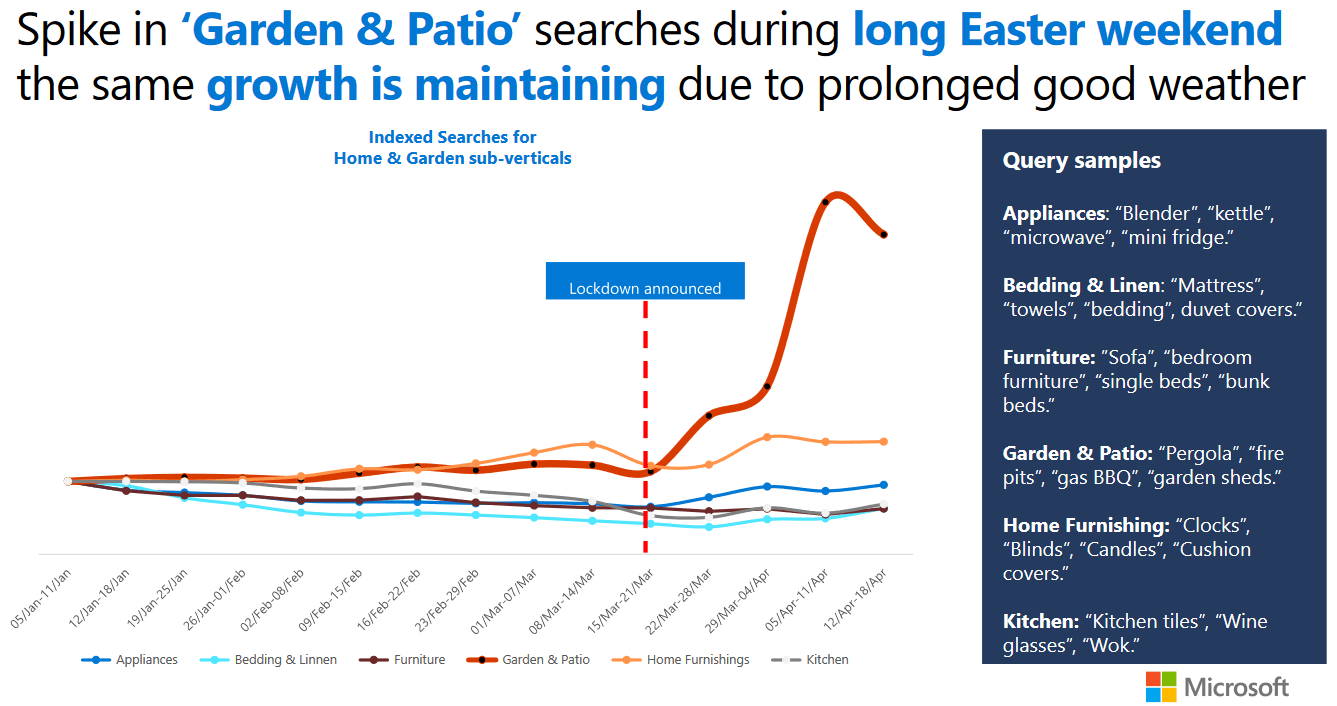
With some great information available like the below as an example showing the impact on garden and patio furniture in recent weeks.
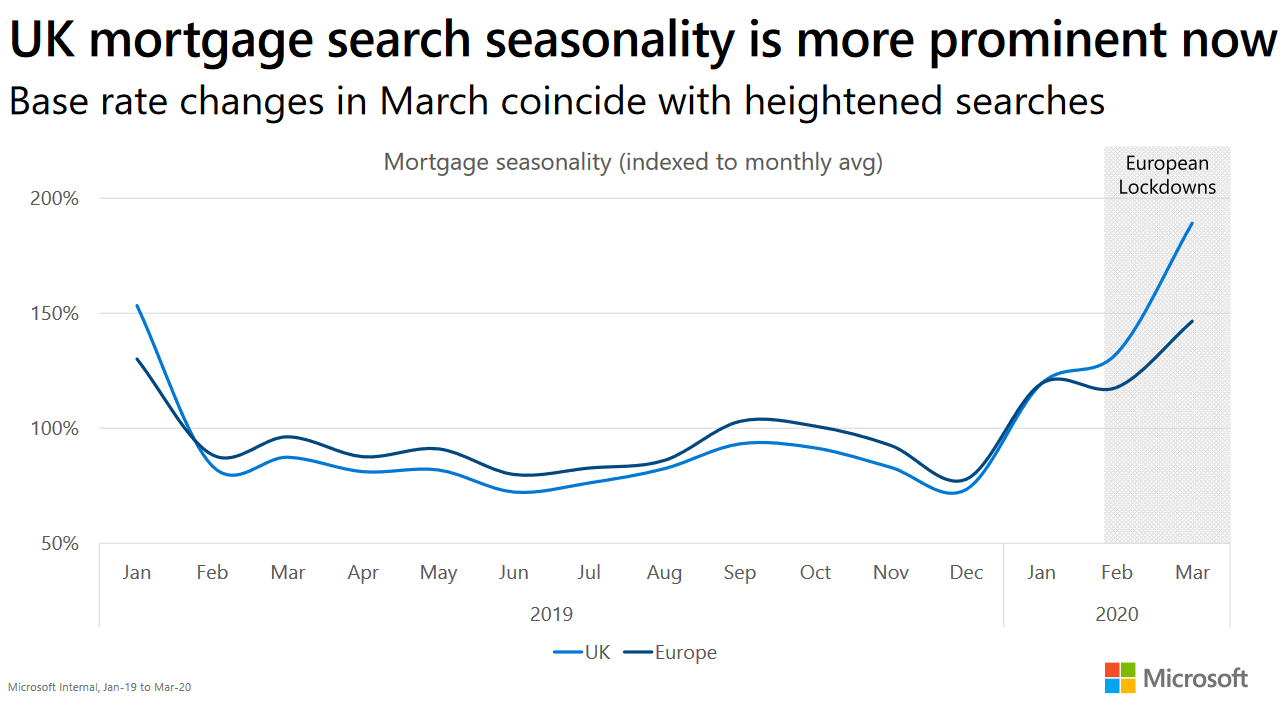
Or the below which shows, contrary to what people may think UK mortgage search actually picked up around the same time the European lockdown started.
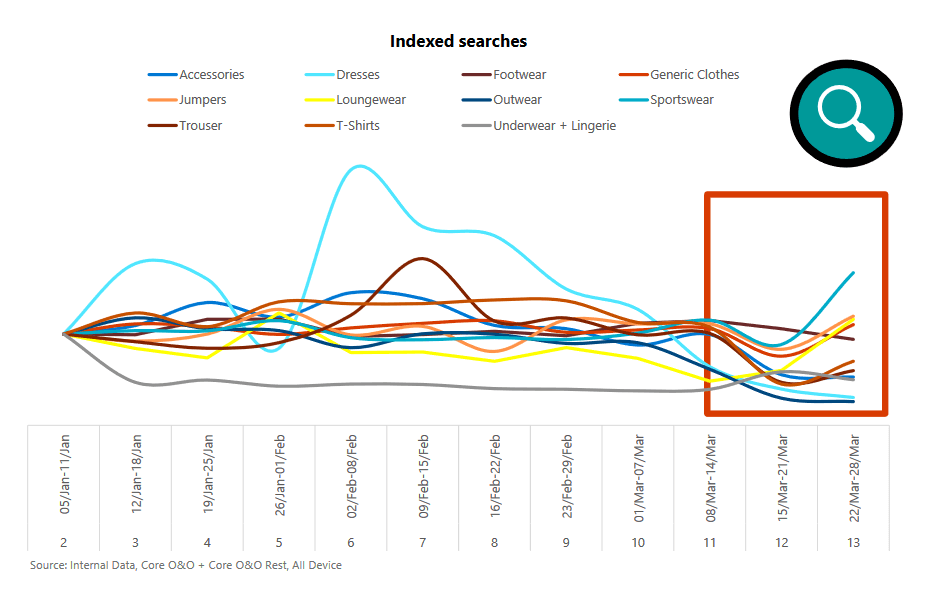
Whilst online retail has generally seen a positive impact some fashion brands have seen a more positive impact then others and the below chart explains why.
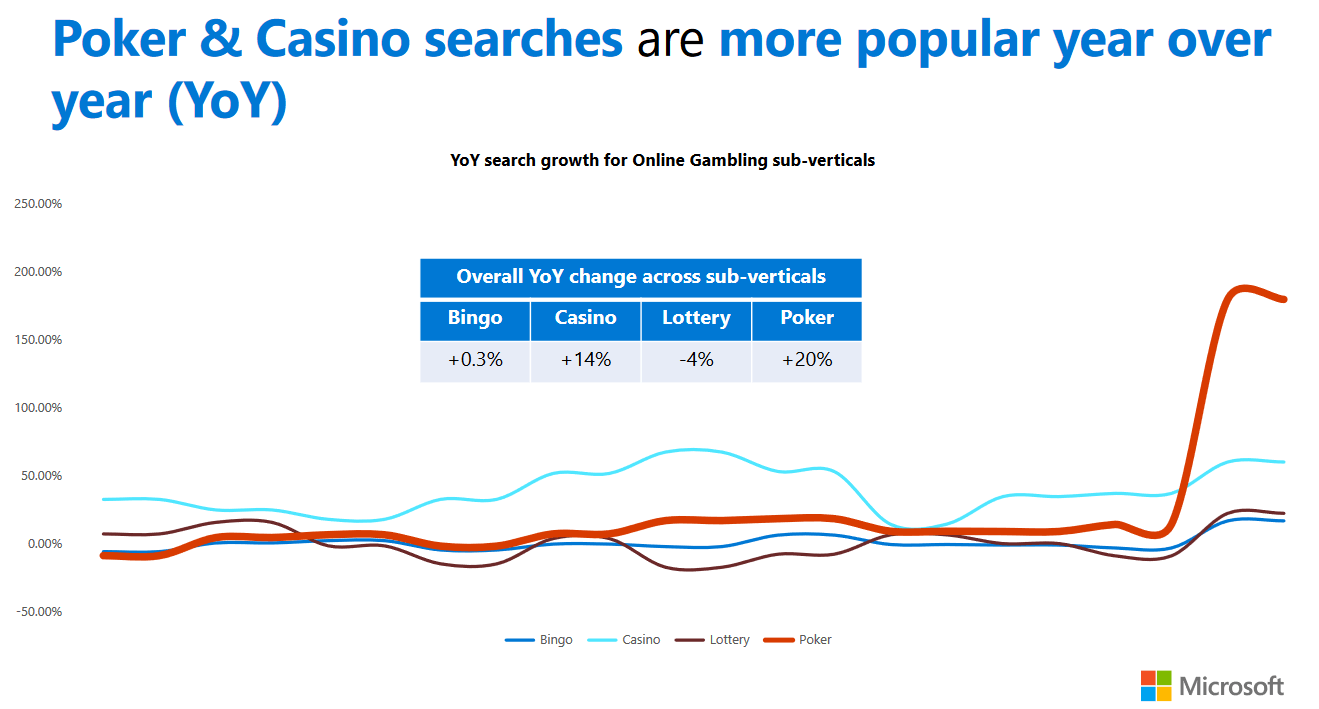
For anyone in the iGaming sector, this would be the perfect time to put more budget into your accounts and despite the usual summer dip, the year is highly likely to be different.
One of the documents to really keep an eye on is this one: https://advertiseonbing-blob.azureedge.net/blob/bingads/media/insight/co/may4/microsoft-advertising-insights-travel-marketplace-recovery-gauge-may4-update-global.pdf. Whilst it is US focussed initially it gives strong signals on how the other markets are doing and which ones look to be recovering.
All of this is very top line a generic data and as we know from our own clients, not every account follows the trend exactly. We have seen the majority of retail flourishing through this period however and expect this to continue for the next few months in the UK whilst restrictions are still slowly being lifted.
For a more detailed chat about how your specific market is doing in the realm of PPC please do get in touch.
Google announces free Google shopping listings again – soon
Some people will remember Google shopping listings being free. This all then became part of the paid search hemisphere. Google have again now announced that there will be some free Google shopping listings again.
Based on the announcement this was in the pipeline anyway but due to the pandemic Google are fast tracking this process. In the US this will happen before the end of April whilst the rest of the world will see this rolled out before the end of the year.
Google believe this will give consumers more options of retailers with extra retailers coming into the Google shopping realm with the free listings. This however will be a great benefit for those already using google shopping who will not need to spend any extra time managing this. Rather can open how shopping is used with the extra free listings on how much additional traffic they can get from here.
The full details of exactly how this will roll out and any tactical strategies Circus PPC are using to get the most of out of this for clients will be shared in a later blog however there are a few things that you do need to prepare in advance:
- A feed – if you haven’t been live on Google shopping for a while – you can do a lot more with a feed now than you could 5 years ago which help from a paid perspective but will also help from an organic perspective.
- Knowledge of which products are your best performing products which will work well on Google shopping vs the competitor listings.
- Be on top of any promotions you are running.
Circus PPC’s preferred feed management partner Shoptimised will help manage the paid for and free shopping listings. Shoptimised have been keeping an eye on the US shopping movements and have said:
“Not ‘All Shopping’ is free is from next week in the US.
Merchants selling in the US have already been picking up a small number of free shopping traffic for some time if they have opted-in to the ‘Surfaces across Google’. But this will increase next week and we currently estimate this change will make up to 10% of Google Shopping free.
Google Shopping is split into two main areas and a few more smaller areas. The main area and responsible for approximate 85% of all Google Shopping are these ads in the Search Tab, they will remain paid for. Later in the year when this launches in the UK, CSS discounts will still apply to these ads.
Then there is the Google Shopping tab. However, you may have also noticed they are testing Paid Ads in the Shopping tab too (in the US). This is why Google state: The Google Shopping tab will consist primarily of free product listings.
There are also other places where you can pick up free/organic Shopping Traffic (only in the US) such as Google Images, Gmail & Display. You can also pick up Paid Google Shopping Traffic in those places too.
So, all in all, we expect up to 10% of what you currently pay for will become free in the US to begin with before making its way over to the UK and Europe later in the year.”
John Cave – Director at Shoptimised
Circus will continue to provide regular updates on this as and when the new announcements are released. In the UK nothing has changed for now and we will keep you all updated as and when they do.
For further information on Google shopping or the new announcements please do get in touch.
How the coronavirus has been impacting PPC accounts
We are still managing many different clients through this pandemic. We thought we would highlight some industries and platforms and the impact they are having along with the solutions we would propose or are using.
This has been kept brief and we haven’t gone into every industry and sub industry and platform or else we would end up with a lot of reading which people will not necessarily be interested in. We would advise you to get in touch if you do want more details specific to your industry.
Industry
Travel
The Impact:
This is one of the hardest hit industries at the moment. With the uncertainty hardly anyone is booking any holidays or even if they are, they aren’t booking anything for the near future.
Solutions:
Whilst we do not know how long the pandemic will last, we do expect this to end by next year, so maybe start selling holidays for next year for now and come back stronger with some last-minute deals when the epidemic ends.
Finance
The Impact:
Another hard-hit industry is finance. However, with the category Finance being very wide ranging from debt management companies to banks to lenders the performance is different for different businesses. Some businesses in this industry have had to pause their PPC as it has been impacted that much whilst others are taking advantage of the current situation.
Solutions:
If you do have the technology and budget to keep going then the marketplace is seeing cheaper CPCs at the moment. It all depends on the individual business however and the conversion rates you are seeing.
B2B
The Impact:
With many businesses working from home, staff on furlough, and general office requirements put on hold somewhat, this industry has also seen a downturn. A lot of time however is going into research and buying things for when people are back.
Solutions:
If you can afford to keep going at the moment, potential customers are bookmarking pages, highlighting products they want to buy and come back later.
iGaming
The Impact:
With more people being at home this industry is working really well at the moment. With the restrictions in place and the government guidelines we will see some impact. Sports betting however has seen an impact due to the lack of sports.
Solutions:
Sports betting budget should be added to the casino alternative. These players do overlap so you will see them crossover when sports do start again.
Retail
The Impact:
With stores being closed most retailers are doing very well online. Obviously, it does depend on what you are selling, and people are basing things on the needing things or wanting things at the moment but even luxury items are doing well at the moment.
Some shipping companies are having an impact however which ultimately has an impact on performance. The key is to make sure communication is kept on top of, so you do not end up with any negative reviews.
Solutions:
With the strong results we are seeing retail is an area where if you can continue to push and even increase aggression to get more out of the industry then we would advise to keep doing so. The opportunity is definitely there to take advantage of and as long as your warehouse and delivery can meet all the guidelines then we would advise to push on.
However, if you are seeing a dip in your conversion rate, with retail again being very vast, then obviously we wouldn’t advise the above.
Platforms
The Impact:
The traffic on Google is only increasing at the moment with more people online with stores being closed. Not only is there an increase in traffic potential on Google search but also on display and video. The performance we are seeing across all the different areas of Google (search, shopping, display and Video) is varied based on the industry and client.
Solutions:
The performance here varies based on your market and the advice therefore is very tailored.
Bing
The Impact:
Bing is pretty much exactly like Google however we are finding certain clients are picking up a lot more on Bing then on Google at the moment.
Solutions:
Again, like the above the performance is very varied and the solution is very tailored based on this.
Amazon
The Impact:
Amazon is continuing to dominate a lot of product searches however Amazon have had to put restrictions in place for large item deliveries which means anyone selling items which require more than one person to deliver it they won’t be delivered at the moment. All smaller goods however are continuing to sell despite Amazon prioritising the products which customers need most at the moment.
Solutions:
This is an area if you are already set up in, we would advise to keep pushing if it is working. To get setup on Amazon as a vendor at the moment will be difficult, as a seller not so much but still more hurdles to jump through with many of the Amazon staff working from home at the moment as well. Unless if you speak to an agency who have an Amazon representative like Circus PPC which does make life a lot easier.
Facebook and social
The Impact:
With a lot more time spent online at the moment. A lot of the time is spent on social media. Advertisers are seeing an increase in competition with more people advertising and some people starting to di toes into this platform as well.
Solutions:
The strategy you use on social for paid activity needs to be chosen very carefully. Whilst the opportunity is there at the moment, it isn’t there for everyone and certain markets are seeing the CPCs increasing.
Criteo
The Impact:
As with the above, a lot of time is spent on browsing other websites. With an engine like Criteo, we are seeing many competitors dropping off and the traffic opening up further alongside the actual traffic generally increasing anyway.
Solutions:
For clients who are continuing to sell and do well, we would advise to keep pushing on Criteo.
For clients not doing so well at the moment we would advise getting the codes live on site as a lot of potential customers are spending time researching at the moment with the view to buy in the future.
For more information or if you want our help to plan your strategy please do get in touch.
Top Tips for Successful Franchise PPC Management
Are you a franchisor who is struggling to make your PPC campaigns work well? Centralised marketing works well for projects such as branding and more traditional advertising where bigger budgets are needed, such as TV. However, PPC requires a finer eye to detail, and what works well in one location for one franchise may do poorly for another.
In the past year, we’ve increased lead volumes for a franchise client of ours by over 140%, whilst cutting CPA by 60%. Here we’ve picked out the main differences in building your franchisee campaigns and given some of our top tips for how you could see similar success.
How are franchisee campaigns structured differently?
- Creating your PPC campaigns in the more traditional, thematic structure can lead to problems for franchisors. Targeting large swathes of the country can mean that budget is easily eaten up by cities and towns, leaving little left over for franchisees who are in less heavily populated areas. In this way, your overall campaign and account stats could easily be hitting your company KPIs, but leaving individual franchisees with little in the way of concrete leads for their business.
- The solution? Breaking out each location into it’s own campaign, and using Google’s accurate location targeting to nail down each franchisee’s catchment area down to the postcode. Structuring this way means that individual campaigns will be more like accounts, with ad groups holding each keyword theme.
- This way, it is still possible to control your brand identity and consistency across all franchise locations. Ad copy can be the same across the board, maintaining a united front for your brand online.
- Unlike traditional account builds, this will mean that there is more focus on individual campaign and location performance rather than overall account stats.
- As each franchisee will be wanting to hit their specific KPI, you have to think strategically about volume for your company VS price efficiency for your franchisee.
Top Tips
- You will notice different trends across locations, but this doesn’t mean that you shouldn’t be using your learnings to improve performance across the board. This is a huge benefit of managing all your franchisee PPC campaigns in one place – optimisation and development can happen much more quickly, with far more data available than in just one location.
- As mentioned above, as you are managing multiple locations, you will have to learn to balance the over-arching company’s needs against individual franchisees. Never assume that strong account performance translates directly to strong franchise performance. Overall stats could be hitting or even outperforming your given KPI, but this could be masking a franchisee who is seeing double the target CPA. Always investigate and optimise to campaign level to minimise any friction you may receive from poor performing franchises.
- At the end of the day, two franchisees in near-by locations are direct competition to one another, and you have to be mindful of this when creating keyword lists and setting up your location targeting.
- When it comes to large cities, you could very easily have two, three, maybe even four franchisees right on each other’s doorstep – all wanting to bid on the keyword ‘car wash bristol’, for example. You can minimise competition by keeping your location targeting as tight as possible. We recommend using Google’s postcode targeting, as targeting whole cities can leave you bidding against yourself – or leave you with the hard decision of deciding which franchisee gets these higher volume keywords. Therefore, both campaigns can contain these volume keywords, but will only trigger in their specific area.
- Leverage Google’s Smart Bidding solutions. Having separate campaigns for each location can lead to a lot of work, with your account split up into potentially over 100 campaigns, and hundreds of ad groups. Smart Bidding looks at your complete account performance to determine bids, so learnings from your campaign in Newport can and will inform decisions in Newcastle – just as you would do!
If all of this sounds daunting, why don’t you get in touch with us today for a free account audit? We’re highly experienced in complex franchise account builds and have driven fantastic growth for some nationwide brands – seeing quarterly year on year growth of over 270%.
Circus wins prestigious northern digital award
On a fantastic evening organised by “Don’t Panic” Circus PPC wins “Best Digital Marketing Campaign – Retail” with their entry “Circus PPC & Miele – Immer Besser, Forever Better”.
Following the fantastic year of growth, with 26 new clients and 5 new members of staff in 2019 and already a running start in 2020, it is indeed a very exciting time at Circus PPC.
Having already been praised by Google for being one the top agencies of the UK based on skill score and being commended for 2 awards at the Dadi Awards, winning this award has set the path for the year ahead.

“We are very happy to have been awarded “Best Digital Marketing Campaign for Retail” last night at the Northern Digital Awards for our work on the Miele UK Google Ads account.
Our team of PPC experts managed to increase Miele’s Revenue by 500% whilst increasing profitability an amazing 200%.
Using our innovative approach combined with consistent, experienced and real-world optimisation we continued to improve, test and grow the account.
Immensely proud of the team and overjoyed for the client”– Rick Tobin, MD Circus PPC
If you want Circus to apply it’s award winning strategies to your account then do speak to us.
Get Ready For The January Sales
Get Ready For The January Sales
Whilst in the US Black Friday is the biggest sales event of the year, Christmas & January sales continue to come out on top in the UK. January 2019 drove, on average, 4.5% more consumer spending year on year across all UK retailers – the highest year on year growth across retail sectors since December 2016. Despite this, surveys ran by Barclaycard indicated that over half of UK adults believe that January sales are less important than they were a few years ago. This could be because more retailers are offering discount periods throughout the year, and so holding off until January isn’t as important to consumers as it once was.
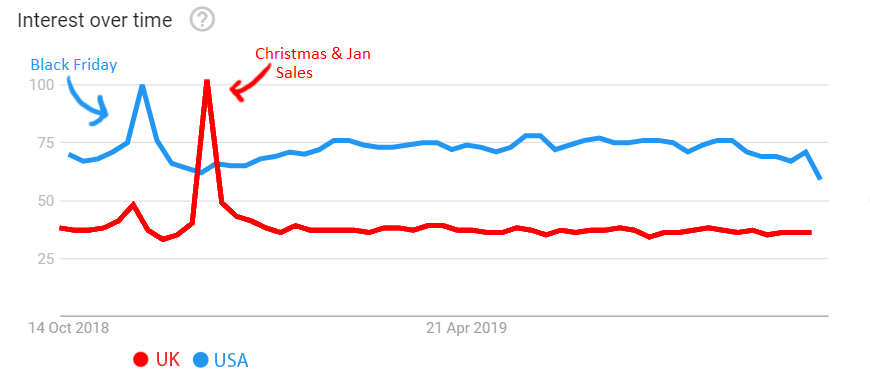
Trend data comparing US & UK interest in ‘sales’ keywords over the past year
When taking these statistics into account, it becomes more and more obvious that competition is going to be high during this time. Planning ahead means that your business can monopolise on all this increased intent, and, by tailoring your Search, Display and Shopping campaigns to your marketing goals early, you can see the maximum returns on your investment.
Top Tips For January Success
- Review Last Year’s Stats
Even if you didn’t run any specific January Sales focussed activity or promos last year, have a look to see how you performed. Perhaps stats dropped as you weren’t running offers, or maybe you were able to ride the January Sales wave without this and saw an increase in traffic and conversions anyway. Either way, this is something you can learn from for this year’s activity.
- When did traffic begin to pick up from? Getting ahead of the curve here can mean that you’re in front of customers at the very first touch point, which can influence consideration.
- Sales are beginning earlier and earlier, with many retailers deciding to start promotions as early as Christmas Day.
- With Mobile traffic growing more and more year on year (predicted to ‘increase seven-fold between 2017 and 2020’), consumers no longer have to be holed away in an office or computer room to browse online sales – meaning purchase can happen at any given time.
- Did a certain type of ad perform best? Use only the highest performers for a basis for your 2020 ads.
- If you’re not utilising Smart Bidding, what level were your CPCs at, and what impression share did this gain? You can use then use this as a benchmark during the sales period.
- Using Smart Bidding during this period is highly recommended. We’ll go into more detail about benefits of Smart Shopping later on, but in short, Google’s algorithms are able to adapt bids on an auction by auction basis, using over 7 million signals that we are not able to manually optimise for. Your competitors will be making use of all this extra insight, so you should too!
- What was your increase in spend?
- Did you hit your KPIs and spend all your allocated budget? Consider increasing budgets this year to see where your top ceiling lies.
- What was your budget split across channels?
- Did any channels perform particularly poorly? Consider pulling back on these and funnelling budget back into your top revenue drivers.
- Equally, did you leave any avenues unexplored? Could you add them into your media mix this year?
- Set Up A Catch-All Dynamic Search Campaign
However much keyword research you do, there will always be gaps in your keyword-based campaigns. 15% of all searches made every day are brand new, never been seen before, and it would be impossible to predict all of these. Dynamic Search Campaigns can help you capture this traffic if it is still relevant to your business and landing pages.
- DSA campaigns have been known to run away with themselves (and your budget), especially if you have a very large website with a lot of content (blogs, etc).
- To avoid this, set up your DSA to only “target landing pages from your standard ad groups”. This saves you valuable time in sifting through content and only sends traffic to pages already within your Google Ads account.
- Set Up Smart Shopping Campaigns
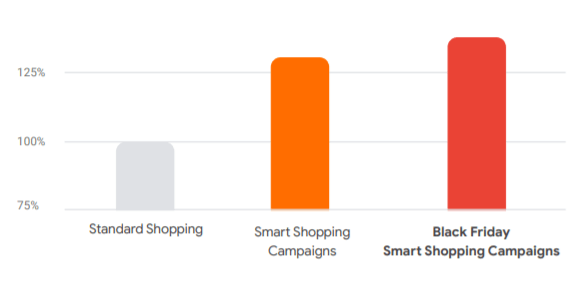
Smart Shopping campaigns have been around for a while now, and they’re only continuing to get more and more powerful. Advertisers typically see more than a 30% increase in conversion value on average when using Smart Shopping campaigns, and during black Friday weekend 2019, Smart Shopping further increased this uplift. This success can be mirrored in your January Sales period.
Smart Shopping campaigns encompass all types of networks, combining classic Search-based shopping with Dynamic Remarketing, use of the Display Network, Youtube & Gmail.
- These campaigns optimise to spend your budget in real time between each channel, meaning if conversion rate suddenly drops off on the Display Network, budget within the campaign will reallocate to the Search Network, or Youtube, or wherever is performing best. This saves both on wasted spend and man hours spent moving budgets between campaigns.
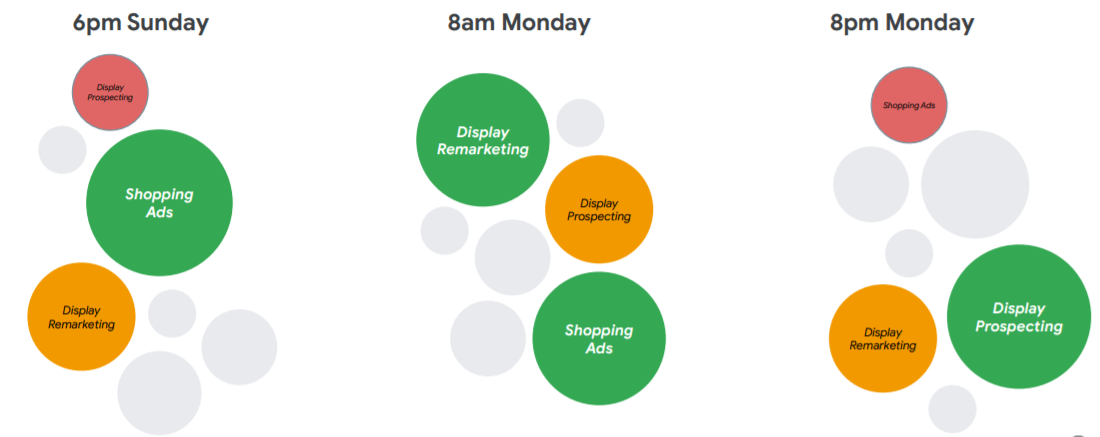
- Avoid oversegmentation when setting up your Smart Shopping campaigns. The more data the algorithms have to work with, the better results they can produce, so try to avoid product groups with fewer than 20 conversions in a 15-day period. Try to only segment Smart Shopping campaigns into multiple campaigns where your business goals require it (i.e. product lines with different ROAS targets due to higher/lower profit margins).
- Help Google Help You
As remarkable and advanced as Google’s Smart Solutions are, there is only so much that they can learn from machine learning. Whilst Google recommends that Smart Solutions should be able to notice and adapt to changes in conversion rate and traffic volume, there are a few things you can do to help push things along.
- Make use of Seasonality Adjustments. This is a feature where you can tell Google what you expect your conversion rate to increase to over certain time period. If you’ve already reviewed last year’s stats, you should have an idea of what this will be. This adjustment is perfect for short events between 1-7 days, but no more than 14.
- If you’re using Smart Bidding, consider adjusting your targets during your sales period to maximise on traffic volume. Lowering your Target ROAS or increasing your Target CPA will allow your campaigns to bid more aggressively in auctions and drive more sales. Remember to increase your budget in line with these adjustments.
- Set Up All Smart Campaigns 4 Weeks Early
All of Google’s Smart Solutions undergo an initial learning period when first set live. Performance may not be great during this time – conversion volume and spend may be low as Google’s algorithms adjust. It is important to not make any changes to your campaign during this time. If you’re planning on utilising Google’s Smart Solutions to boost your January sales performance, you need to ensure that all campaigns are out of the learning period and are performing at a good level already. This will give you time to evaluate performance and tweak as necessary before the sales season hits, hopefully making sure that you’re maximising on your exposure and profit.
- All Campaigns Are Only Ever As Good As Their Assets
Google’s Smart Solutions are impressive, but they’re not magic. They need great assets to push to begin with. Writing effective copy for your Search & Display campaigns and setting up all relevant ad extensions will get you on the path to success.
- Set up promotion extensions in your Search & Shopping campaigns – for Shopping, you’ll have to apply and send off a form to gain access to these features, so ensure you do this well before sales period.
- Set up a Countdown for when your promotions end. This adds urgency to your ads and could improve conversion rate.
- Add your offers into all your ad copy in either Headline 1 or Headline 2 – this will make sure that your offer will always be visible, as Headline 3 will sometimes not show.
- Add your new ads into your account at least a week in advance of your promotional period, and give yourself time to correct any disapprovals.
January sales continue to be one of the biggest consumer events in the UK. These are only a few of the things that you can do to ensure your PPC campaigns see success during this highly competitive time. If you’re unsure of where to begin, don’t hesitate to get in touch for a free account audit, and see how Circus can help you.
What PPC tools are you using?
With 100’s of different tools available out there how do you decide what to use?
There are some which are free and some which are paid for. Google have plenty of free tools available which you will want to investigate.
Below are some of the ones that will be very handy in your day to day PPC life.
Search |
||
| GOOGLE TRENDS google.com/trendsChart the relative popularity of search terms and topics.When do people tend to search for information about baby gifts? |
GOOGLE CORRELATE google.com/trends/correlateIdentify correlations between different search terms.What search queries tend to follow the Christmas trend? |
KEYWORD PLANNER goo.gl/HYFvQkGet keyword ideas and historical performance statistics.What search terms do people use when looking for a new blender? |
Research |
||
| CONSUMER SURVEYS g.co/consumersurveysRun surveys of a representative audience with a fast turnaround.What words come to mind when consumers think of my brand? |
CONSUMER BAROMETER consumerbarometer.comUnderstand how people use the internet across the world.How many people use mobile devices in Kentucky? |
|
Other |
||
| THINK WITH GOOGLE thinkwithgoogle.comRead up on the latest trends, insights, and best practices.What are examples of great mobile advertising campaigns? |
YOUTUBE TRENDS youtube-trends.blogspot.comDiscover what videos are most popular with your audience.What videos are women 18-24 sharing with their friends today? |
NEW MARKET INSIGHTS marketfinder.thinkwithgoogle.comTap into public data across a variety of metrics and countries.How has the US population changed over the last 10 years? |
We have only just touched the surface with these tools. There are plenty more that can help improve the account performance, but we cannot give away all our secrets, can we?
Feel free to get in touch to have a further discussion on this.
Monthly Updates – March 2019
Welcome to a new series of blogs which we will do at the end of every month. We will look at some of the latest tests we are running and analyse some findings.
Automated Bidding
This is a huge area but for this month lets focus on target CPA bidding. This is an area which can help elevate your accounts performance quite drastically overnight almost however there are quite a few elements you need to be careful of:
- Do you have the correct tracking in place? This is a key area. If you are tracking extra conversion points the technology will try and get more of these conversions as well which may be not what is worth anything to you. E.g. if you are tracking newsletter signups as well as sales the software would try and drive more of all conversions.
- Is your account CPA focussed? Retailers wont always care about CPA as much as they do about ROI or cost of sale. A ROAS strategy may be better in this case.
- What campaigns drive the higher value conversions?
- Do you need to consider using different targets for different campaigns?
- This is especially more relevant for lead gen campaigns.
- The account can go from spending £100’s to £1000’s overnight if you are not careful. Whilst you would still expect a strong CPA, the spend can increase quite drastically which may not be your goal. Having campaign budgets in place will help control this as well as monitoring this closely.
- Do you need to consider using different targets for different campaigns?
What results have we seen for this:
In February we saw a 23% increase in leads with a 19% reduction in CPA. For March we have already seen a further an increase of 100% in leads from February with a further reduction in CPA by 18% from February. – Simon Wells
In the first month of using target CPA bidding we saw a 26% increase in sales with the ROI improving by 38%. This has improved further this month with a 59% increase with the ROI continuing to improve. – Meg Wilson-Taylor
Amazon Advertising
Whilst we have been doing this for a while, we thought it would be worthwhile highlighting this, this month. Amazon advertising is something we have ran a series of blogs on separately. It is slowly becoming a key area for retail clients.
We have seen 5 times the ROI on Amazon than that on Google Ads (case study coming soon). However, there are other chargers that can incur which do need to be considered when looking at cost of sale.
This month on Amazon there have been 2 recent changes that are being tested. These are detailed below:
Bidding Strategy BETA
- Old bidding strategy options
- Fixed bids (equivalent to Manual CPC)
- Dynamic Bids – Down Only (only to lower bids when a conversion is less likely to happen)
- New bidding strategy BETA
- Dynamic Bids – Up & Down (equivalent to Enhanced CPC in Google Ads, increases/decreases based on how likely a conversion is)
- This is very new so next month we will cover some results on this.
Sponsored Products Campaigns – Product Targeting
- Old SP targeting option
- Target search keywords
- New SP targeting option
- Target specific product(s)
- Again, this is very new so next month we will cover some results on this. Anna Wood
Shopping Feed Optimisation
This has been extensively covered in our guest blog last month, so I won’t go into detail here however it is worth looking at this in more detail as it can totally change the game for you when it comes to shopping ads. The link to the blog is below:
Guest Blog: Product Feed Optimisation
If you sell products online, then the chances are that you have a Product Feed and utilise Google Shopping within your Paid Search strategy. In this case, it’s important to look at Product Feed Optimisation.
In December 2018, retail related Google Shopping traffic overtook retail related search traffic for the first time and has shown no sign of slowing down ever since.
Merkle’s recent Q4 2019 marketing report further highlighted this trend:
- Google Shopping Ads accounted for 89% of retailers’ non-brand ad clicks in Q4
- Spending on Google Shopping ads grew 42% YoY in Q4 2018
But there is more to Google Shopping than just managing Google Ads. Every search term your Shopping Ads appear for is solely dependent upon the information within your Product Feed.
Therefore, the quality and the content of your Product Feed has a huge impact upon your overall search terms, product visibility and ultimately your performance.
You wouldn’t run a race with untied shoelaces so why would you expect to get the most out of Google Shopping with a poorly optimised feed?
But to optimise a product feed to industry best practise standards, you have got to take control of your Product Feed. Once you have control you can focus on two of the most important areas within Google Shopping that exist outside of Google Ads.
1 – Product Feed Optimisation
Regardless of how much you bid or how you structure your Shopping Campaigns. Around 80% of all the search terms you appear for are based on the words in your Product Titles. 15% are based on the words in our Product Descriptions and 5% are based on the words in your Product Titles.
You should ensure that you have the right product attributes appear within these areas for each variant as well as your high converting search terms.
Product Feed Optimisation can also help you to expand your reach with the introduction of new search terms. Try being very narrow and specific with product variants whilst using more generic terms with parent products.
Ensure you’re constantly adding high converting terms into your Product Descriptions. But keep it sensible with well written, well-formed sentences. Don’t just keyword stuff!
Make sure your Product Types have a minimum depth of 5 and that they contain the key attributes of your products. Don’t be lazy and just copy your website navigation.
Product Type Examples
Trainers
Category > Sub Category > Brand > Style > Gender/Age Group > Colour > Size
Trainers > Running > Nike > Waffle > Ladies > Red/Blue > 7
TV
Brand > Style > Size > Technology > Resolution > Colour > TV Style
Sony > Bravia > 50 Inch > LED > 4K > Black > Curved
We’d even recommend adding in the GTIN & MPN where relevant which will help you pick up more highly relevant traffic.
If you’re fan of segmenting your Shopping campaigns by Product ID, we’d recommend adding your Item Group ID as the last level of your Product Types, so you can group your products together, before splitting out by Product ID. For example:
Brand > Style > Size > Technology > Resolution > Colour > TV Style > MPN > Item Group ID
Sony > Bravia > 55 Inch > LED > 4K Ultra HD > Black > Smart TV > KD55XF9005 > SB55LED4KUH
2 – Product Feed Management
Without having control over the Product Feed, you can only structure your Google Shopping campaigns based on the quality of the existing feed.
However, if you control the Product Feed, your Google Shopping campaign structure and strategy can be based on far more than you imagined.
Any PPC Manager can create Google Shopping campaign structure that focuses on Brands or Google Categories such as Jeans, Toys, Pens etc before segmenting further in Ad Groups.
But only those with control over Product Feeds can use Custom Labels to add Stock Value/Quantity, Price Bands, Product Margins, Top Seller Labels, Sales Labels and much more.
Google Shopping is essentially about driving the best possible ROAS for your products, so spending your budget on campaigns which are focused on Price, Stock and Margin will always provide far better returns.
If you want to make sure your Google Shopping strategy is fully managed from start to finish, you need to ensure you work with an Agency like Circus PPC who can manage your Google Ads and your Product Feed.
Don’t pay anybody to do half a job.
Author: John Cave Profile
John Cave has 12 years of experience within Paid Search, Ecommerce & Travel. Having held senior positions both in-house and within agencies. He founded the dedicated Paid Search agency Biddible, before moving on to co-found Shoptimised, the UK’s fastest growing Product Feed Optimisation platform.
Circus PPC Agency Earns 5-Stars on Clutch
As a PPC management agency, it’s not every day that we talk about ourselves. In fact, what we usually do is boast about our clients, develop their online identities, and make sure that they are getting the recognition they deserve in their markets.
The team at Circus PPC Agency is pleased that since creating a profile on Clutch and joining their list of the best PPC agencies in our area, we’ve gotten our own fair share of positive recognition. Clutch is a ratings and reviews platform for businesses, with coverage that ranges from the IT and development space all the way to the digital marketing, design, and creative industries. Their segments for PPC and SEO are some of the largest and most competitive on their platform, and Circus PPC Agency is proud to stand out amongst so many distinguished agencies.
To be included, our team was put to the test. At first, Clutch analysts evaluated our market presence by looking at our established client base, examples of projects we’ve completed for our partners, and our overall expertise in the PPC industry. The next, and possibly most important, component of our evaluation was generated from the reviews our clients have given us through first hand interviews conducted with analysts at Clutch.
Our clients, as awesome as they are, have taken the time to speak about their experiences working with Circus PPC, providing direct context about our ability to deliver as a service provider. Take a look at the first 5-Star review we have on our profile so far:
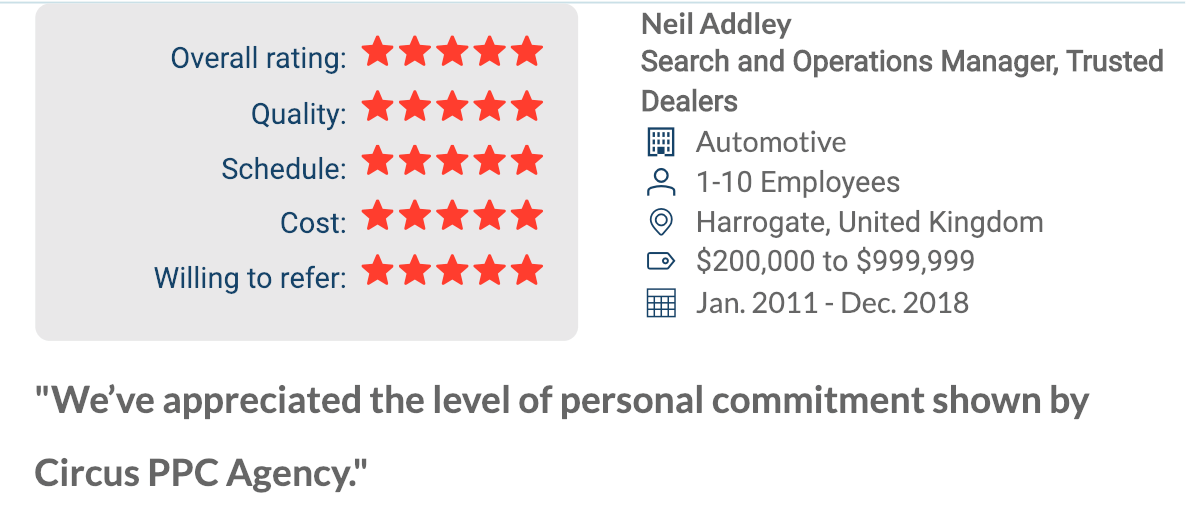
It’s because of our positive client reviews and our high score on Clutch that we’ve also been able to be featured on their sister website, The Manifest, amongst the best PPC companies in the United Kingdom. It’s amazing being recognized on these third-party sites!
We would like to thank our clients for taking the time to reflect on their work with us. With the projects we’re working on now, we are confident that our profile on Clutch will only continue to expand and our placement in their rankings will rise to the top.