


Unlike Rome, not all roads lead to a career in PPC. However, I believe your degree will have provided you with many of the necessary skills to succeed on this path. Read on to find out why you’re qualified to be a PPC Account Manager…
- Able Researcher
 To be successful at PPC you need to research your client, their target market, and their competitors effectively, as well as discovering keywords and ad copy that are suitable for them. Graduates are used to spending hours in the library investigating niche topics and ideas so conducting thorough, comprehensive research should come naturally to you.
- Excellent Communicator
The ability to write in a clear and concise manner is paramount for creating adverts, and for delivering reports to your clients. Most graduates will have articulated themselves within set word counts – so writing for fixed character limits shouldn’t be a problem. When producing reports for clients it is imperative to be coherent and straight-to-the-point; if you can communicate the same information in fewer words you should. You also need to be able to express yourself verbally, whether this is pitching your services to a prospective client or explaining something complicated in simple terms to someone outside the PPC world.
- Attention to Detail
Arts and STEM graduates alike are well practised in examining either text or numbers closely and looking for something significant or anomalous. Proofreading ad copy is a key task where this skill comes into play because you are far less likely to allow spelling mistakes to escape through the net. This attention to detail is also valuable for data analysis, as your brain is more attuned to patterns so you are able to home in on anything unusual or noteworthy.
- Organised
PPC account managers need to be able to manage their time effectively so that their clients are receiving the attention they deserve. Whilst at university you will have balanced your workload against other commitments and structured your days accordingly; the ability to independently organise yourself is beneficial for a career in PPC as only you know how best to prioritise your tasks to meet the needs of your clients.
- Creative
Graduates are well-placed to create compelling and inspiring ad copy as throughout their degree they are likely to have been challenged to think outside the box and solve problems in an original, creative manner. Ads usually receive more clicks if they appeal and engage the reader so it is extremely advantageous if you can produce innovative ad copy suitable for your target audience.
- Adaptable
PPC is a dynamic and ever-changing industry so you need to be able to adapt to changes in technology as well as willing to alter your approach to account management if stats are not heading in the direction you want. At university you are likely to have been pushed out of your comfort zone and this also happens to PPC Account Managers – no matter how experienced they are.
- Analytical
Some graduates will be more comfortable working with numbers than others however it is well within everyone’s capabilities to perform data analysis. No one is born with an innate skill for Excel but with practise and patience you will be examining and manipulating data to help optimise your accounts in no time.
- Keen Learner
By gaining your degree you have evidenced that you enjoy educating yourself and a career in PPC offers continuous learning since new features are frequently launched which you need to get to grips with. Furthermore, there are Google AdWords and Bing certifications to study for and attaining these assures clients that you are up-to-date with the latest industry developments.
However, none of the above skills matter unless you are passionate about PPC!
Satisfy your PPC cravings by reading more articles written by the Circus team on our News & Blog.
Ok, Google: Should I Plan for Voice Search in my PPC Strategy?
Last year we wrote a blog about how to incorporate Voice Search into your PPC Strategy. We identified the need to include long-tail keywords in your account as research suggests voice searches tend to be lengthier – partly because we often adopt a conversational approach to our spoken searches whereas typed queries are more direct, often comprising of a few key words.
In this blog I want to investigate whether the number of words in a search term increased from quarter to quarter in 2017, or if the Voice Search epoch is still to come.
So, what is Voice Search?
Voice Search allows you to speak to an electronic device in order to perform various functions, such as calling a contact in your phone or seeking information from a search engine. Many of the leading technology giants (Amazon, Apple, Google, and Microsoft) are investing heavily in virtual assistants and home technology hubs which are designed to be controlled via voice, rather than text input.
Voice Search is often cited as a growing market which was certainly reflected in the types of products shoppers chose to purchase over the most recent Black Friday shopping period. Amazon stated that its Echo Dot and Amazon Fire TV Stick with Alexa Voice Remote were the best-selling products from any manufacturer in any category on their site during this sales holiday. Google recently reported that 72% of people that own a voice-activated speaker say that their devices are often used as part of their daily routines and 41% of voice-activated speaker owners say that it feels like talking to a friend or another person.
With this in mind, I have pulled data from three accounts to look for evidence to see if the number of searches being conducted by voice is on the rise.
Data
On average, search terms are typically 2-3 words long for a typed query so for this study I decided to look at search terms greater than 5 words in length, to see if Voice Search technology led to lengthier searches. Below I have analysed data from three accounts to see what percentage of search impressions fall into the 5+ words category:
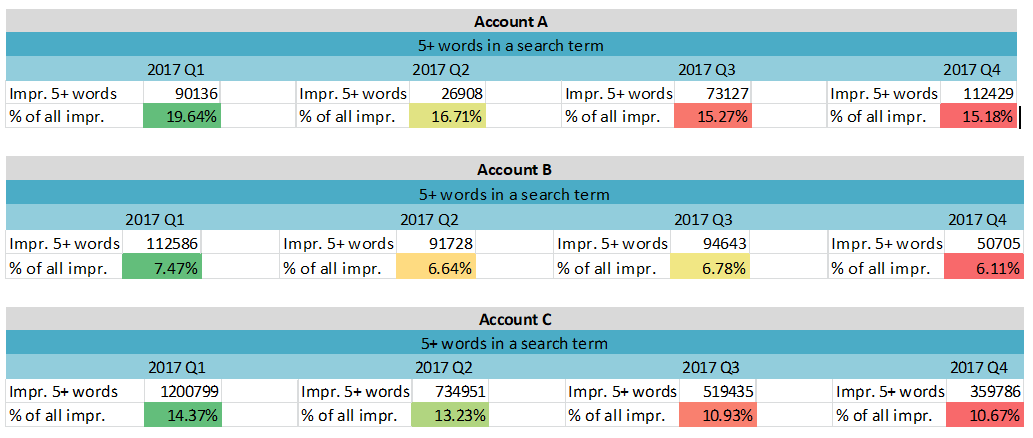
As you can see, the overall trend is that 5+ word searches actually decreased quarter on quarter in 2017. Across the board Q1 displayed the highest percentage of 5+ searches and Q4 the lowest, which is contrary to our expectations as we anticipated that the rise in the number of people owning Voice Search enabled devices, would correlate with longer search queries.
However, this data does not necessarily indicate that voice searches are decreasing. It is possible that within the percentage of all impressions in Q4 a larger number of searches could have been spoken when compared with Q1, even if overall the number of impressions from 5+ word searches fell. This data also doesn’t account for shorter searches that could have been performed by voice, for example “Who are Circus PPC?” To get a more complete picture it would be useful to perform this analysis on all our accounts to see if they reflect or contradict the above data.
Whilst my findings here do not suggest Voice Search has had a significant impact on our PPC accounts just yet it is certainly a development we need to keep an eye on so that we can adjust our digital strategies accordingly. Because who knows, 2018 might be known as the Year of Voice Search!
If you would like help planning for Voice Search in your account, or any other aspect of PPC activity, then please get in touch with us for a free, no obligation PPC review and consultation with one of our PPC specialists.
Written by Megan Wilson-Taylor, PPC Assistant at Circus PPC Agency