


Q5 presents a tempting opportunity for ecommerce brands, bringing cheaper CPMs and shoppers looking to spend their Christmas gift cards. But cheaper reach alone doesn’t guarantee results, and without a clear post-Christmas marketing strategy, it’s easy to waste budget.
So, is Q5 really a hidden goldmine or just fool’s gold?
What is Q5 and Why Do CPMs Drop?
Q5 is the post-Christmas period that runs from Boxing Day to early January, when many big advertisers have already spent their annual budgets and choose to pull back or go dark. But consumers don’t stop scrolling. With many people off work and school, screen time stays high over the holidays, while gift cards and Christmas money give shoppers extra spending power.
With fewer advertisers competing in the auction, CPMs on Meta and TikTok often drop well below October levels and sit far below BFCM, creating an opportunity for brands to reach audiences more cheaply.
Goldmine or Fool’s Gold? Weighing Up a Post-Christmas Marketing Strategy
The Goldmine Case for Post-Christmas Marketing
Q5 brings motivated buyers and New Year’s resolution makers. After spending December shopping for others, consumers are actively looking for ways to spend their Christmas money on themselves. As the New Year rolls around, fitness, wellness, home organisation, self-improvement and travel brands have a natural opportunity to tap into seasonal demand.
With cheaper reach, the same budget can buy more impressions, making prospecting campaigns that were too expensive in November more viable. A strong post-Christmas marketing strategy also gives you a head start on Q1. New customers acquired in January can be nurtured through CRM-based marketing throughout the rest of the year, turning a seasonal sales opportunity into longer-term value.
The Fool’s Gold Case
Cheaper CPMs don’t automatically mean cheaper sales. Lower advertising costs only matter if conversion rates hold, so any post-Christmas marketing strategy needs to look beyond reach and impressions to understand whether campaigns are actually profitable.
There’s also the risk of discount fatigue. After weeks of Black Friday, Cyber Monday and Christmas promotions, shoppers expect a deal. Deep January discounts can help win sales but also erode margins and train customers to wait for the next promotion.
Returns season is another consideration. Revenue in Ads Manager can look strong while net revenue after returns tells a very different story, so brands need to measure actual profitability rather than just initial purchases. Plus, not every category benefits from Q5. Gift-led brands, for example, can see demand fall off a cliff after Christmas, regardless of how cheap CPMs become.
How To Build Your Post-Christmas Marketing Strategy for Q5
- Don’t go dark on Boxing Day. Keep campaigns live on a low budget so you’re not restarting the learning phase just as CPMs bottom out.
- Plan the creative in November. The brands that win plan their Q5 budget and creative in November, not on Boxing Day. Have your ads ready before the team takes time off. Fresh angles will work better than recycled BF ads.
- Retarget your BFCM audiences. Engagers that didn’t convert are your cheapest wins.
- Use Q5 for prospecting tests. Lower CPMs make it a good time to test new audiences and creative concepts ahead of Q1.
- Protect margin. Lead with value, bundles or free gifts rather than another deep discount.
- Judge Q5 on actual revenue and new customers. Don’t just rely on platform ROAS as it only tells part of the story. Factor in returns, discounts and profit margins to understand how much revenue your campaigns are actually generating.
Get A Head Start On Your Post-Christmas Marketing Strategy
Don’t leave your Q5 success to chance. The opportunity is there, but making the most of it takes the right strategy, preparation and creative. Our experts at Circus can help you build a tailored post-Christmas marketing strategy that makes the most of lower competition, captures post-Christmas demand and turns cheaper clicks into profitable sales.
Get ahead of the January rush and start planning before the Christmas break. Get in touch to book your Q5 planning session and make sure your business is ready to turn Q5 into a goldmine.
6 Questions To Ask Before Hiring A Paid Social Agency
Finding the right paid social agency and knowing what questions to ask before you commit to working with them can be tricky, especially when new digital marketing agencies seem to pop up every other month.
A good agency should be able to explain how they’ll measure success, who will manage your account and what they’ll do to keep performance on track over time.
The best paid social agencies go beyond simply running ads. They take accountability for delivering meaningful business results. Asking the right questions will help you identify an agency that genuinely understands your goals and spot any red flags before signing a contract.
Why Does It Matter?
Not only can switching agencies be expensive, but the barrier to entry is relatively low. This has created a crowded market where the quality of agencies can vary significantly, making it important to know exactly who you’re working with before committing to a six-month contract.
At the same time, platform automation has changed what makes a paid social agency valuable. It’s no longer just about managing campaigns or pushing buttons. The real value lies in creative strategy, accurate tracking and a clear approach to driving results for your business.
6 Questions To Ask Your Paid Social Agency
1. Which platforms would you recommend for us and why?
An experienced agency should give you an answer specific to your audience and business model, not a one-size-fits-all reply. If they recommend every platform without asking about your goals, that’s a red flag.
2. Have you worked with businesses like ours?
It’s beneficial to know if an agency has worked with similar business, because it tells you whether the team has the experience to handle your account. They don’t have to have worked with a direct competitor, but they should understand your business and the challenges you face.
3. What will you measure and report on?
Judge agencies on how they measure business outcomes, not on platform metrics in isolation. Clicks, CTR, reach and even in-platform ROAS can look impressive while your actual revenue stays the same. A good agency will connect its reporting to the numbers your business runs on, such as leads that turn into sales, cost per acquisition, revenue and profit.
4. Who manages the creative process, and how often do you refresh ads?
Creative is one of the biggest drivers of paid social performance, so you need to know who makes it. Ask how they spot creative fatigue; a strong agency will have a regular refresh schedule and will use performance data to decide what to make next.
5. Who owns the ad accounts, pixel and data?
Keeping ownership and control of your ad accounts, pixel and data should be a non-negotiable.
6. What happens in the first 90 days?
Expect an audit, onboarding, a testing plan and honest expectations about the learning phase. An agency should also be upfront with the fact that results take time to settle and will show you a clear plan for how performance will improve.
Red Flags: What To Watch Out For
A good agency will ask you just as many questions as it answers. If they aren’t asking about your sales process, margins or leads, they have no way of understanding what success looks like for your business or how to optimise it. Be wary of agencies promising guaranteed results, such as a specific CPL or ROAS, before they’ve even seen your accounts or taken the time to understand your goals.
Another red flag is an agency that constantly focuses on big, ever-growing numbers without putting them into context. Impressive figures might look good on paper, but they can sometimes mask underlying problems or distract from the metrics that really matter, such as ROAS and conversion rates. If an agency is more interested in chasing bigger numbers than demonstrating meaningful results, it’s worth questioning what they’re actually delivering.
Finally, as mentioned earlier, ownership of your ad accounts, pixel and data should be non-negotiable. Be cautious of any agency that insists on running your campaigns through an account they own rather than giving you ownership and control of your own assets.
Choose Your Paid Social Partner With Confidence
If you’re looking for a paid social agency to optimise your campaigns and make sure your accounts are in the right hands, we can help. At Circus, our paid social experts build strategies that grow and adapt alongside your business. We pride ourselves on being honest and transparent, keeping you informed about what’s happening in your accounts and how your campaigns are performing.
Get in touch below to schedule your introductory call.
The Q4 CPM Squeeze: What Black Friday Does to Your Cost-Per-Lead
Every November, marketing teams up and down the country spot a rising cost per lead during Black Friday, and the same thought crosses their minds: “Is something wrong with the campaigns?”
Usually, the answer is no. That spike is almost always down to predictable auction pressure, not a sign your campaigns are broken. And because it’s predictable, lead gen and B2B advertisers who plan around the calendar can protect their pipeline instead of panicking when the numbers move.
Here’s what’s actually happening, why your cost per lead rises during Black Friday, and what we do about it for our clients.
Why CPMs spike around Black Friday
Retail floods the auction. From early November, ecommerce brands pour budget into Meta and TikTok, building to a peak in Black Friday Cyber Monday (BFCM) week. Black Friday falls on 27th November this year. For those few weeks, you’re bidding for the same eyeballs as every retailer with a sale on.
B2B gets caught in the crossfire. Your audience isn’t shopping for your service in the same way, but the auction doesn’t care. If a retailer is willing to pay more to reach a 35-year-old operations manager scrolling Instagram, you pay the inflated price to reach them too. For most B2B advertisers, this is where a rising cost per lead during Black Friday really comes from.
LinkedIn isn’t immune. It feels far less retail pressure than Meta or TikTok, but year-end “use it or lose it” budget spend from other advertisers can still push its costs up in the final weeks of the year.
How Black Friday CPMs push up your cost per lead
The link between what you pay for impressions and what you pay for leads is simple maths:
CPL = CPM / 1,000 x CTR x Conversion rate
If CPM rises and nothing else improves, your cost per lead rises with it, pound for pound.
In practice, it’s usually worse than the CPM rise alone. B2B decision-makers get distracted in late November and December. Year-end deadlines, holiday planning and inboxes full of offers all compete for attention, so click-through and form completion rates often dip at exactly the same time costs go up.
Take an illustrative example. A campaign running at a £10 CPM, 1% CTR and 5% conversion rate delivers leads at £20. Add a 30% CPM rise and CPL climbs to £26. Let CTR slip to 0.9% and conversion rate to 4.5% as well, and you’re paying around £32 per lead: a 60% increase from a 30% rise in media costs.
Black Friday CPM and cost per lead data from our accounts
Across the accounts we manage, CPMs typically spike by around 30% during BFCM week compared with October. That figure moves depending on the type of activity you’re running: prospecting to broad audiences feels it most, while warm retargeting tends to hold up better.
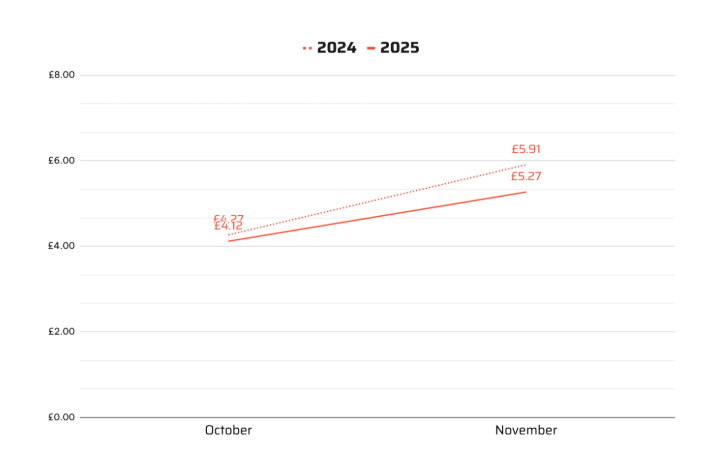
Just as important is what happens after. Once the retail rush ends, costs ease off, and that creates an opportunity many B2B advertisers miss.
How to manage a rising cost per lead through Black Friday and Q4
You can’t opt out of the auction, but you can control how exposed you are to it. Here’s how we approach Q4 for lead gen and B2B clients.
1. Front-load budget before Black Friday, then ease off
Shift budget into early November, before retail spend hits its height, and pull back during BFCM week itself. What we don’t recommend is going fully dark. Restarting campaigns resets the learning phase and leaves a gap in your pipeline that shows up in Q1.
2. Lean on warm audiences to keep cost per lead down
Retargeting website visitors, social engagers and CRM lists holds up far better over Black Friday. These people already know you, and their higher intent offsets the higher cost of reaching them.
3. Rebalance channels away from the Black Friday rush
If Meta is carrying most of your lead gen, consider moving some spend to LinkedIn during the peak retail weeks. It isn’t cheap, but it’s far less exposed to the retail squeeze, and the targeting is built for B2B.
4. Feed the algorithm quality lead signals
Use the Conversions API and offline conversion imports so Meta optimises towards sales-qualified leads rather than cheap form fills. This matters all year round, but it matters most when every lead costs more.
5. Make creative that stands out from Black Friday ads
In a feed full of countdown timers and ‘up to 50% off’ banners, the last thing you want is to look like another sale ad. Clear, relevant creative that speaks to your audience’s actual problems will earn the attention retail ads are fighting over.
6. Plan for a lower cost per lead after Christmas
Late December into January often brings cheaper inventory as retailers pull back. Many B2B advertisers are still in holiday mode, so a well-timed push here can fill your pipeline at a lower cost while the competition is quiet.
How to judge cost per lead performance over Black Friday
A rising cost per lead during Black Friday is predictable, which means planning needs to come early, not the week your CPL doubles. A few principles keep Q4 in perspective:
- Plan ahead, don’t react. Agree budget pacing, audience priorities and creative in the lead up to Black Friday, so nobody is making rushed decisions mid-auction.
- Measure what matters. Judge Q4 on cost per qualified lead and pipeline value, not raw CPL. A slightly more expensive lead that converts into a sales conversation is worth far more than a cheap one that goes nowhere.
- Set expectations early. A higher cost per lead over Black Friday isn’t a failure if lead quality and pipeline hold. Make sure everyone, from the marketing team to the board, knows what to expect before the numbers move.
Get ahead of the Black Friday squeeze
If you’re already seeing a rising cost per lead during Black Friday, or you want a plan in place before BFCM week hits, we can help. Our paid media specialists will audit your accounts, show you where Q4 pressure is hitting hardest, and put together a budget-pacing proposal that protects your pipeline through to January and beyond.
Get in touch below for your free account audit.
Your Black Friday Paid Social Checklist: What To Do & When [Free Download]
If you’re running Paid Social ads this Black Friday, there’s no better time than the present to start thinking about your strategy and making sure you have everything in place to drive revenue, sales and ROI with considered performance strategies.
One of the most important things when it comes to running successful Paid Social ads? Time.
The Social algorithms need time and data to learn, creative needs time to be approved and tested, and audiences need time to be built. If you’re still setting up when peak arrives, it’s too late. In 2025, advertisers who went into peak still validating catalogues, setting measurement baselines or configuring value-based bidding missed the conversion surge entirely, with no time to course-correct.
Key Dates 2026:
- The BFCM period runs from Thursday 26 to Monday 30 November.
- Black Friday is 27 November, and Cyber Monday is 30 November.
- Working backwards, anything that needs a 3-week learning or validation window must be live by early November at the latest.
Download our Paid Social Black Friday Checklist below, and get the tips, tricks and insight you need to set your business up for it’s best Black Friday yet!
Get your Paid Social Black Friday Checklist!
"*" indicates required fields
Results From A Revamped Meta Ads Creative Strategy
Bigger results don’t always mean bigger budgets. Sometimes they just mean better creative – which is exactly what Rat Race saw when we revamped their Meta Ads creative strategy.
Rat Race creates epic adventure challenges – the kind that push people to their limits and make for genuinely compelling content. With a naturally visual, story-rich brand, Meta should be a powerful platform for them. And it is – but when we came on board, there was a clear opportunity to make their Meta Ads creative strategy work a lot harder.
Rat Race’s Result-Driving Meta Ads Creative Strategy
The core issue was creative diversity. Rat Race had strong brand assets, but without a varied mix, the algorithm has less to learn from and less chance of finding the right people at the right moment. So we changed that.
The biggest shift was bringing UGC-style content – videos made by actual challenge participants – into paid campaigns alongside existing brand assets. Real people documenting real adventures connect with audiences in a way that polished brand creative simply can’t replicate. It’s also exactly the kind of signal Meta’s Andromeda algorithm thrives on. Feed it a richer, more varied creative mix and it gets much better at finding the right people – without you needing to narrow the targeting yourself. Creative becomes the targeting.
Alongside that, we refined the campaign structure using Traffic and Sales objectives and brought in Advantage+ Shopping Campaigns to support broader, more efficient reach.
The results?
Spending 20% less than the same period last year, Q1 2026 delivered:
- +73% impressions
- +404% ThruPlay video views
- +98% link clicks
- CPC down 59%
More reach, more engagement, more efficiency. All from a smarter Meta Ads creative strategy, not a bigger budget.
You can read the full breakdown in the case study.
Interested In Seeing Similar Results?
Our team of Paid Social and PPC experts are here to help – drop us a line using the form below and we’ll get back to you to arrange a free audit of your existing account.
How Kiddies Kingdom Boosted Results Without Touching Their Paid Social Budget
Sometimes the biggest wins don’t come from a bigger Paid Social budget – they come from using what you already have more intelligently.
Kiddies Kingdom is a well-established retail destination for parents, stocking a huge range of baby and kids products across some of the biggest names in the category. Their Meta activity was ticking along, but there was a clear gap between what it was doing and what it could be doing – particularly around how their product catalogue and customer data were being used.
How Kiddies Kingdom Achieved More From Meta With The Same Paid Social Budget
No changes to their Paid Social budget were needed. Just a smarter approach.
Their catalogue had been limited to a promotional strategy, which is a pretty narrow use of what a full product feed can do. On top of that, audience targeting was leaning on pixel data alone – missing the richer signals that their own CRM data could provide. We tackled both together.
We opened up the full product feed and introduced targeted product sets to prioritise the right items in the right contexts – sale products, higher-ticket items, and brands with stronger margins. Alongside that, we refreshed their audience lists and rebuilt their lookalike stacks using CRM-based audiences rather than pixel data. The algorithm is only as good as the data you feed it, and this gave Meta a much cleaner picture of who Kiddies Kingdom’s best customers actually are.
The results?
Quarter on quarter, CPA dropped 35%, ROAS increased 78%, and CPC fell 58%. Proof that you don’t always need a bigger PPC budget to see meaningfully better returns – sometimes it’s about making the budget you already have work harder.
You can read the full breakdown in the case study.
Interested In Seeing Similar Results?
Our team of Paid Social and PPC experts are here to help – drop us a line using the form below and we’ll get back to you to arrange a free audit of your existing account.
How Jo Alexander Got Quick Paid Social Results in 30 Days
We don’t always get to share such quick Paid Social results, but when a client joins and things click into place from the off, it’s worth talking about.
Jo Alexander – a premium garden furniture brand with over 20 years under their belt – came to us at the start of March 2026. They had a short seasonal window to work with and Meta activity that wasn’t pulling its weight. Yet within their first month live with us, they were seeing the kind of quick Paid Social results that most brands spend an entire season chasing.
Jo Alexander’s Quick, 30-Day Paid Social Results
The core issue was that their campaigns were doing too much heavy lifting at the bottom of the funnel and not enough higher up. They were capturing people who were already ready to buy, but not doing much to bring new customers into the picture. For a brand with genuinely beautiful, sustainable products, that felt like a missed opportunity.
We restructured things around a proper full-funnel approach – better creative, smarter use of their first-party data, and feed segmentation to make sure their best products were getting seen by the right people. Nothing revolutionary, just solid strategy applied consistently.
The results?
- +523% revenue
- +440% ROAS YOY
Both with only 15% more spend! Proof that with the right strategy in place, quick Paid Social results aren’t just possible – they’re repeatable.
We’ll let the numbers do the talking – you can read the full breakdown in the case study here.
What Jo Alexander Said:
“From the outset, they [Circus] quickly identified and resolved issues that had been holding performance back, and the results have been clear – higher sales alongside reduced costs. The team has taken full ownership of the account with confidence and professionalism, bringing a level of expertise and proactivity that we hadn’t experienced with our previous agency.”
Interested In Seeing Similar Results?
Our team of Paid Social and PPC experts are here to help – drop us a line using the form below and we’ll get back to you to arrange a free audit of your existing account.